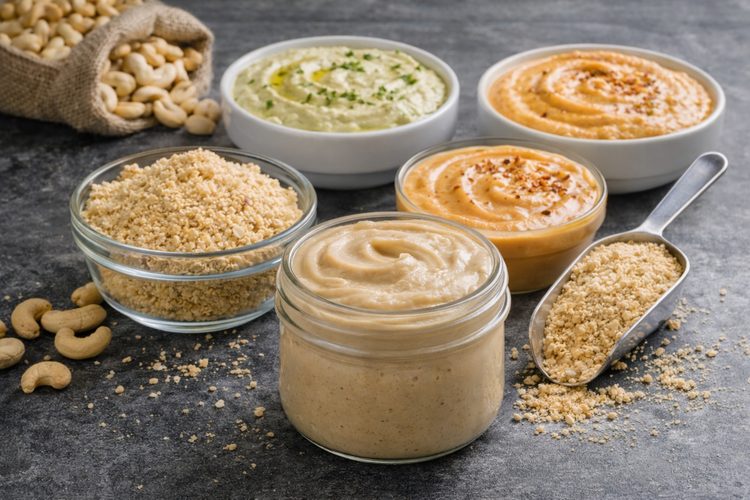
Cashew ingredients are widely used in sauces, dips and smooth spreads because they offer a rare combination of functionality and commercial flexibility. Unlike many other nuts, cashews can deliver a neutral-to-rich flavor, natural emulsification support, and a smooth, creamy texture when processed correctly. This makes them highly adaptable across plant-based dairy alternatives, savory sauces, ready-to-eat dips and premium spreads.
From a buyer sourcing perspective, the key point is that cashews are not a single ingredient. Buyers are choosing between formats such as whole kernels for wet grinding, cashew paste, cashew butter, fine flour or custom-milled slurry bases. Each format behaves differently in terms of viscosity, oil release, emulsion stability, and processing cost. The best commercial outcome comes from aligning ingredient format, processing method, packaging and product positioning before quotation.
How this topic shows up in real buying decisions
In real projects, buyers are typically solving for one of three core outcomes: achieving a stable emulsion, delivering a specific mouthfeel, or building a premium product identity. Cashew ingredients can support all three, but the specification must match the intended use.
For example, a plant-based cheese sauce may require a very fine cashew paste with consistent oil dispersion to achieve a smooth and stable texture. A dip application may tolerate slightly coarser material if the goal is a more natural or rustic appearance. A premium spread may rely on roasted cashew butter to deliver flavor depth without additional flavor systems.
Buyers therefore compare multiple formats: raw kernels for in-house grinding, pasteurized kernels for safety-sensitive applications, pre-ground cashew paste for efficiency, or finished cashew butter for ready-to-use systems. The decision is rarely only technical. It also reflects labor availability, processing capability, throughput requirements and total delivered cost.
What cashews are doing functionally in sauces and spreads
Functionally, cashews act as both a fat source and a structure-building ingredient. When hydrated and processed, they can form stable emulsions that mimic dairy-like creaminess. Their natural composition allows them to contribute body, smoothness and mild sweetness without dominating the flavor profile.
In sauces, cashews often act as a base that carries seasoning and stabilizes the system. In dips, they provide thickness and mouthfeel. In spreads, they define the texture entirely. This flexibility is why cashews are widely used in plant-based dairy, culinary sauces and premium ready-to-eat products.
However, achieving the desired result depends heavily on grind size, hydration ratio, and oil distribution. A poorly specified cashew ingredient can result in graininess, separation or inconsistent viscosity. That is why specification detail matters.
Cashew format selection: kernels vs paste vs butter
One of the first commercial decisions is whether to source raw material or processed formats. Whole kernels offer flexibility but require grinding equipment and process control. Cashew paste provides a consistent base with reduced processing steps. Cashew butter offers the highest convenience but may limit formulation flexibility depending on roast level and oil profile.
For industrial buyers, the decision often comes down to scale and control. High-volume manufacturers may prefer kernels for cost efficiency and in-house customization. Mid-scale or fast-moving operations may choose paste to simplify production. Finished product manufacturers may opt for butter to minimize processing complexity.
Texture and viscosity control
Texture is one of the most critical variables in sauces and spreads. Cashew ingredients can produce a wide range of textures, from light and pourable to dense and spoonable. The key drivers are particle size, water ratio, and processing intensity.
Fine grinding typically produces smoother textures but may require more energy and tighter process control. Coarser grinding can create a more natural or artisanal feel but may introduce variability. In commercial terms, the right choice depends on whether the product is positioned as highly refined or intentionally rustic.
Viscosity also affects packaging and shelf stability. A product designed for squeeze bottles requires different flow properties than one packed in tubs or jars. These decisions should be made early because they influence ingredient specification and processing requirements.
Oil release and emulsion stability
Cashews naturally contain oils that contribute to creaminess, but uncontrolled oil release can lead to separation. This is particularly important in sauces and dips that need to remain stable over shelf life.
Buyers should consider how the cashew ingredient interacts with other components such as water, acids, salts and stabilizers. In some systems, additional emulsifiers or stabilizers may be required. In others, careful control of grind size and processing conditions can achieve stability without additional inputs.
From a sourcing standpoint, consistency in raw material and processing is critical. Variability in oil content or particle distribution can lead to inconsistent product performance, which becomes a commercial issue in large-scale production.
Typical use cases include plant-based dairy alternatives, savory sauces, dips, spreads and ready-to-eat products. The quote request should clearly define the intended application and texture target.
What Atlas would ask before quoting
For sauces, dips and spread applications, Atlas typically asks buyers to define: target format (kernel, paste, butter), application type, desired texture, packaging format, destination market and expected volume. Additional details such as viscosity target, emulsion stability requirements and processing method can further improve quote accuracy.
These inputs allow Atlas to align the request with appropriate California processing partners and suggest realistic sourcing options. Without this detail, comparisons between suppliers can become inconsistent and less meaningful.
Commercial planning points
Commercially, these programs often move through stages: formulation trial, pilot production, scale-up and repeat supply. Each stage may require adjustments to ingredient specification. A format that works in development may need refinement for large-scale production.
Packaging and logistics also play a role. Industrial bulk formats differ from retail-ready or private label packaging. Export programs may require additional documentation and stability considerations due to longer transit times.
The most successful programs are those that prioritize repeatability. Consistent specification, reliable supply and aligned packaging help reduce risk and support long-term product success.
Buyer planning note
Atlas Global Trading Co. uses topics like this to help buyers move from concept to execution. If you are developing a sauce, dip or spread using cashew ingredients, sharing your format, texture target, volume and destination allows the next step to be grounded in a practical sourcing discussion.
Need help sourcing cashew ingredients?
Turn your formulation into a practical quote request with Atlas.
- Define format (kernel, paste, butter)
- Specify volume and timeline
- Include destination market