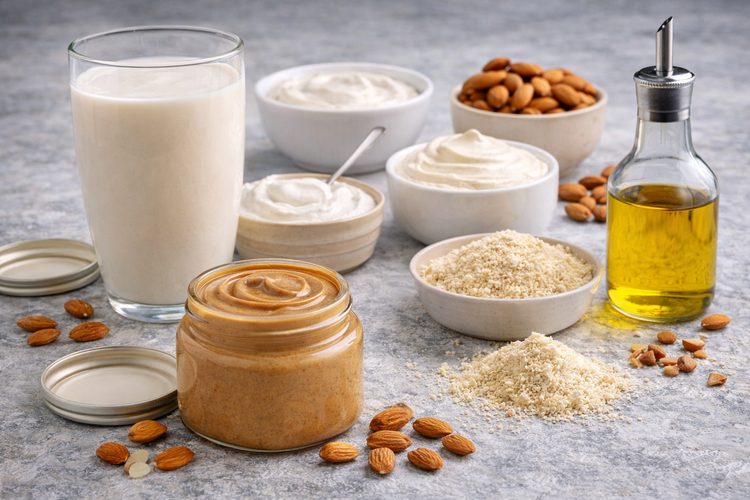
Plant-based dairy development is one of the clearest examples of why almond sourcing should be specification-led rather than price-led. In these systems, almonds are not only an ingredient identity. They influence solids loading, creaminess, emulsion behavior, protein positioning, flavor cleanliness, color and label strategy all at once. The stronger commercial outcome usually comes from deciding what role the almond ingredient must play before comparing supply options.
That matters because a plant-based beverage, spoonable yogurt alternative, cultured-style base, creamer, frozen dessert, spread, soft cheese alternative or dairy-free sauce base does not use almonds in the same way. An almond flour or meal may be selected for solids and body. Almond butter may be used when the developer wants richer creaminess and nut flavor. Almond oil may be added for lubrication, smoothness or fat-system tuning. Almond protein-oriented ingredients may be reviewed when the commercial brief includes nutritional positioning or higher-protein product targets. Each route leads to a different technical and commercial conversation.
Why almonds remain relevant in plant-based dairy
Almonds have longstanding relevance in plant-based dairy because they allow developers to work across several product dimensions at once. They can contribute a familiar plant-based identity, a softer and more premium nut profile, a lighter visual impression than some darker seeds or legumes, and a formulation base that can be tuned toward beverage, spoonable, frozen or spreadable systems. In many cases, almonds are used not because they solve every functional requirement on their own, but because they help the finished product taste and present in a more consumer-friendly way.
For buyer buyers, that means the question is rarely “Do we want almonds?” The more useful question is “Which almond format creates the right balance between body, creaminess, protein story, label direction and delivered cost?” Once that is clear, the quote request becomes more practical and supplier quotes become more comparable.
Commercial takeaway: in plant-based dairy, the almond ingredient should be selected against the finished system. A quote for almond flour, almond butter, almond oil or an almond protein-oriented ingredient is only meaningful when the target product and process are clearly defined.
How this topic shows up in real buying decisions
In practice, buyers working in plant-based dairy often compare raw-derived ingredients and further processed almond forms including flour, meal, butter, oil and protein-oriented components. The right choice depends on what the finished product needs to do on line and on shelf. Some concepts need suspended solids and mild almond character. Others need a smoother emulsion system, richer mouthfeel or stronger nutritional positioning.
For almonds buyers, the usable product menu is broader than whole-kernel thinking. In plant-based dairy, the relevant commercial menu usually includes fine flours and meals for body, butters for fat-and-solids contribution, oils for mouthfeel and emulsion tuning, and more protein-focused almond ingredients where the developer wants to raise protein contribution or refine the nutrition story. Which of those makes sense depends on whether the customer is building a beverage, yogurt-style system, creamer, frozen dessert, culinary dairy alternative or blended hybrid formula.
Where each almond format tends to fit
Almond flour or fine meal is often considered when the target system needs solids, a mild nut background, body and a more ingredient-led structure. It can be useful in beverage bases, spoonable products and dairy-free dessert systems where the formulator wants almond identity without relying solely on separated oil or highly concentrated paste systems.
Almond butter is commonly relevant when the formulation needs richer mouthfeel, visible nut character, smoother nut flavor or a combined fat-and-solids contribution. It can support creamers, yogurt-style systems, frozen dessert bases and premium dairy-free applications where creaminess and indulgence matter.
Almond oil is more specialized but commercially important. It may be reviewed when the developer needs to adjust lubrication, richness, sheen or fat-system behavior without adding additional particulate load. In some programs it helps refine mouthfeel or smooth out the sensory profile of a broader plant-based system.
Almond protein-oriented ingredients may be considered when the buyer wants a stronger protein proposition, lower relative fat than full-fat almond ingredients, or a way to integrate almond identity into higher-protein plant-based products. These ingredients are especially relevant when marketing, label and nutrition panel decisions are part of the sourcing conversation from the beginning.
Product categories where the format decision changes most
The plant-based dairy category is broad enough that one almond input cannot reasonably fit every use case. In beverages, buyers usually care about suspension behavior, smoothness, light color, flavor cleanliness and total solids economics. In creamers, the emphasis often shifts toward fat contribution, whitening effect, smoothness and flavor compatibility with coffee or tea systems. In yogurt-style or spoonable alternatives, body, stability and cultured-product texture become more important. In frozen desserts, the almond system may need to support richness, clean flavor, fat profile and inclusion compatibility.
There are also cheese-alternative and spreadable systems, where almond butter, flour or protein-oriented ingredients may each be relevant depending on whether the product is soft, cultured, whipped or processed into a more structured dairy-free base. The sourcing implication is simple: a supplier should not be guessing which plant-based dairy category is involved.
Flour considerations: body, suspension and process fit
Almond flour and meal are frequently discussed in plant-based dairy because they can help build the solids phase of a product. They may contribute body, mild nut character and a more recognizable ingredient story, but they also create practical formulation questions around dispersion, particle perception, color and downstream processing. This is why particle size is not a small detail. A flour that works well in one beverage or dessert system may not be right for a more refined or smoother application.
From a commercial standpoint, buyers should decide whether the flour is expected to act mainly as a solids contributor, a texture modifier, a flavor carrier or a positioning ingredient. They should also define whether the product can tolerate some particulate character or whether the target is a more uniform, cleaner-finish system. That choice affects what Atlas would try to quote and compare.
Butter considerations: creaminess, flavor and richness
Almond butter typically enters the discussion when the target product needs a fuller nut profile, thicker mouthfeel or a richer sensory impression than a flour-only route may provide. It can be especially relevant in premium plant-based dairy concepts, where the goal is not just functionality but also indulgent eating quality. In many systems, almond butter contributes both solids and fat at the same time, which can simplify some aspects of formulation while complicating others such as viscosity control, oil management and process handling.
That is why almond butter should not be quoted as though it were merely a flavor addition. The buyer should specify whether it is acting as a primary base ingredient, a creaminess support ingredient, a flavor layer or part of a hybrid formula. Those distinctions materially change cost-in-use and process expectations.
Formulation note: in plant-based dairy, almond butter can improve richness and nut character, but it also changes the system’s fat behavior and process profile. It should be sourced against the real application, not only against a target flavor description.
Oil considerations: mouthfeel, lubrication and finish
Almond oil is often overlooked in early conversations because it is not the most obvious consumer-facing ingredient. Commercially, however, it can matter when a developer is fine-tuning mouthfeel, lubrication and fat-phase behavior. In some systems, it helps improve smoothness or reduce the lean feeling of a low-fat base. In others, it may be useful for refining the finish of a product that already has enough almond solids but needs a better sensory curve.
Buyers should still be precise. If almond oil is being considered, the brief should state whether the aim is creaminess enhancement, visual finish, fat system tuning, premium ingredient story or another specific function. Otherwise the quote may not reflect the true role the oil is expected to play.
Protein considerations: nutrition positioning and formulation trade-offs
Protein is one of the most commercially sensitive topics in plant-based dairy because it influences nutrition messaging, texture, consumer expectations and the broader ingredient stack. Almonds are not always selected as the only protein source in these products, but almond protein-oriented ingredients can become relevant when the buyer wants to improve protein contribution while keeping almond identity in the formula. In some cases, the objective is not maximum protein. It is a more balanced positioning between protein, mouthfeel, label readability and premium ingredient perception.
That is why buyers should decide early whether protein is a core product claim, a secondary benefit or simply part of a better-for-you formulation direction. If protein is a headline feature, the quote request should say so explicitly. If it is secondary, the supplier may prioritize flavor and texture fit differently. This one clarification often changes which almond format is commercially sensible.
Flavor management in almond-based dairy systems
Flavor is one of the reasons almonds remain commercially attractive in plant-based dairy, but it still needs active management. A mild almond base may work well in neutral beverages, vanilla systems, premium coffee creamers or lighter dairy-free desserts. A stronger almond presence may suit more indulgent lines or products that want to lean into nut identity. At the same time, too much almond character can narrow flavor flexibility in fruit, cultured or highly aromatic systems.
From a sourcing standpoint, buyers should define whether they want the almond to be background, balanced or hero-level. The same applies to roast character. Most plant-based dairy systems will not use the same almond treatment that a snack product would use, but some applications may still benefit from slightly warmer or more developed flavor inputs. That should be specified rather than assumed.
Color and visual profile
Appearance matters in plant-based dairy, particularly for beverages, creamers and spoonable formats where consumers often expect a clean, light and consistent visual profile. Almond format selection affects color directly. Finer and blanched-leaning systems may support a cleaner appearance, while other inputs may contribute more visible particulates or a warmer tone. Neither is inherently wrong, but the target visual should be defined before sourcing.
This becomes especially important when the product is being sold into retail under a premium, clean or dairy-comparable positioning. A quote should reflect whether the product can tolerate visible nut character or whether the line needs a smoother and lighter presentation.
Emulsion and stability thinking
Plant-based dairy systems are sensitive to stability because the finished products often need to hold texture and visual consistency across filling, transport, storage and use. Almond ingredient choice affects how the formulator approaches that challenge. A flour-led system may need one type of process logic. A butter-led system may need another. An oil-tuned system changes the fat phase again. Protein-oriented ingredients create their own texture and suspension questions.
The commercial lesson is that almond sourcing should account for process realities. Buyers should mention whether the line is HTST, UHT, chilled, frozen, cultured, homogenized, blended at low shear or handled in another defined way. This helps reduce the gap between prototype success and commercial run performance.
Label strategy and premium plant-based positioning
Almond ingredients can help a plant-based dairy product communicate a more premium, recognizable and consumer-friendly identity. That can matter in categories where the brand wants to avoid a formula that reads as overly technical or detached from food-based ingredients. Some buyers therefore use almond flour, butter or almond-derived protein not only for functional reasons but also because the ingredient supports the finished product story.
This is one of the reasons Atlas encourages buyers to share label intent early. A formulation aimed at a mainstream value dairy alternative may prioritize cost structure and process fit. A more premium line may place additional weight on ingredient recognition, visual simplicity and flavor refinement. Those are different commercial briefs and should be quoted differently.
Buyer planning note: the best plant-based dairy quote is usually built from the real application brief: product type, almond format, texture target, fat and protein role, packaging route and shipment timing. That is what turns a broad inquiry into a usable sourcing discussion.
What Atlas would ask before quoting
For plant-based dairy projects, Atlas generally recommends converting the concept into a more practical quote request. The most useful starting points usually include:
- Target product type: beverage, creamer, yogurt-style product, frozen dessert, spread, culinary base or another dairy-free system
- Exact almond format required: flour, meal, butter, oil, protein-oriented ingredient or a combined system
- Desired role of the almond ingredient: body, creaminess, fat contribution, protein positioning, flavor or label support
- Target sensory profile including smoothness, richness, nut character and visual cleanliness
- Processing route and any key stability or handling considerations
- Pack style and whether the program is industrial bulk, foodservice, retail-ready, private label or export-oriented
- Destination market, launch timing and commercial stage
- Expected trial, monthly or container-level volume rhythm
Commercial planning points
Commercially, plant-based dairy projects often develop in stages: bench work, validation run, launch volume and repeat replenishment. Atlas uses that logic to guide pack and shipment planning because a trial quantity for a development kitchen and a repeat industrial program for retail supply are not the same conversation. The format that works technically may still require a different pack strategy or commercial rhythm depending on scale.
When relevant, the brief should also mention whether the program is industrial bulk, foodservice, retail-ready, private label or export-oriented. That one clarification often changes packaging, documentation, shelf-life planning and shipment assumptions. It also helps avoid quotes that look competitive on paper but do not fit the real route to market.
Common buying mistakes to avoid
One common mistake is asking for a generic almond ingredient price before deciding whether the system actually needs solids, butterfat-style richness, oil adjustment or protein support. Another is treating plant-based dairy as one category when beverage, creamer, yogurt-style and frozen dessert applications all behave differently. A third is choosing the almond format around concept language alone without defining the processing route and commercial packaging model.
It is also common to under-specify the role of protein. If the brand intends to market the product on protein, the supplier should know that early. If protein is secondary and texture or label strategy matters more, that should also be stated clearly. These decisions shape the sourcing logic from the start.
Procurement summary
Almonds for plant-based dairy are best sourced as a system decision, not a single-ingredient decision. Flour, butter, oil and protein-oriented ingredients each play different commercial and technical roles. The right choice depends on the target product, desired mouthfeel, nutrition positioning, label strategy, process route and packaging model.
Atlas Global Trading Co. uses topics like this to move conversations from general interest into a more specification-minded inquiry. If you are evaluating California almond ingredients for a plant-based dairy program, the most useful next step is to share the product type, the almond format under review, the fat and protein role, the pack style, the destination market and the expected scale of the program.
Need help sourcing almond ingredients for a plant-based dairy line?
Use the contact form to turn your concept into a practical quote request covering format choice, sensory goals, pack style and commercial timing.
- State whether you need flour, butter, oil or a protein-oriented almond ingredient
- Add the product type, texture target and protein or fat role
- Include destination market, timing and expected volume
Frequently Asked Questions
What is the main buyer takeaway from “Almonds for Plant-Based Dairy: Flour, Butter, Oil and Protein Considerations”?
The main buyer takeaway is that plant-based dairy sourcing works better when the almond format, target texture, fat system, protein approach, processing route and packaging plan are defined together before quotation.
Which almond formats are most relevant for plant-based dairy development?
Common options include almond flour, almond butter, almond oil and almond protein-oriented ingredients. The right choice depends on whether the product needs body, creaminess, emulsified richness, nut flavor, solids contribution, protein positioning or a cleaner ingredient story.
What should buyers specify before requesting a quote?
Buyers should define the product type, desired mouthfeel, target fat and protein role, processing conditions, pack style, destination market, expected volume and launch timing. Those details make quotes more comparable and more commercially useful.
Can this topic be applied to both U.S. and export programs?
Yes. The same selection logic applies to domestic and export plant-based dairy discussions, although documentation, packaging, shelf-life planning and shipment requirements may differ by destination.