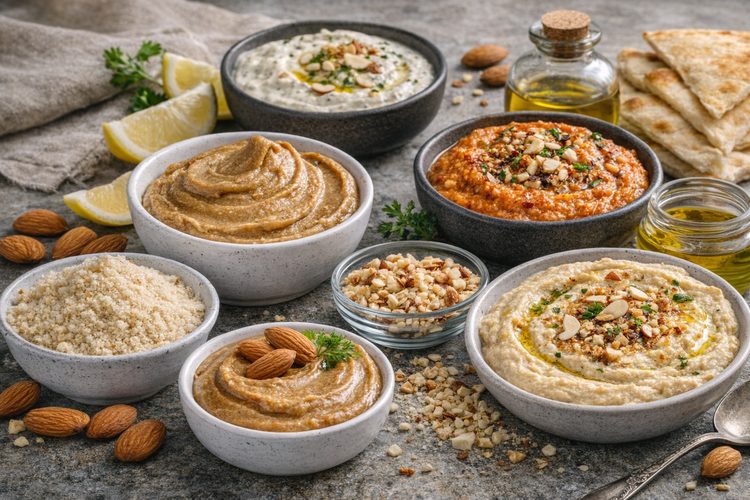
Almonds fit naturally into sauces, dips and spreads because they can do several jobs at once. Depending on the format, almonds can build body, contribute natural fat, create creamy mouthfeel, deliver visible particulate texture, support a richer flavor profile and help position the finished product as more premium or more ingredient-forward. In commercial terms, that versatility is attractive because one raw material family can support multiple product concepts across chilled, ambient, foodservice and export retail programs.
For Atlas, this topic becomes important when a buyer is not simply buying almonds as a commodity ingredient, but as a functional component in a semi-fluid system. The central question is usually not “do you have almond ingredients?” but rather “what exactly does the almond need to do in the finished formulation?” A manufacturer may need the almond fraction to create smoothness in a savory dip, add richness to a spread, stabilize texture in a blended sauce, reduce dependence on dairy components, carry seasoning in a nut-based condiment, or support a premium texture in a spoonable or pumpable product without creating process issues.
That is why almond ingredient selection for sauces, dips and spreads has to be treated as a formulation-and-process decision rather than just a purchase by product name. Almond butter, almond paste, almond flour, fine almond meal, roasted ground almonds, small diced fractions and even almond oil can all make sense, but not for the same reasons. The right choice depends on target viscosity, particle perception, oil release, color, flavor intensity, processing method, fill temperature, pack format, shelf-life strategy and total delivered cost.
Why almonds are commercially relevant in semi-fluid applications
from a buyer's perspective, almonds appeal to formulators because they can bridge the gap between functionality and premiumization. A sauce or spread can use almond ingredients to achieve a creamier, richer or more culinary profile while also improving label story, sensory differentiation and perceived value. This is especially relevant in applications where the buyer wants a product to feel more distinctive than a starch-thickened or low-cost oil-based alternative.
In some formulations the almond fraction works mainly as a texture contributor. In others, it is part of the main flavor identity. For example, a smooth almond butter base can give a dip a fuller, rounder texture and support nut-forward flavor without visible particles. A fine almond meal can add subtle body and a more natural solids contribution. A roasted almond paste can help anchor a Mediterranean-style sauce, a nut-based savory spread, a satay-style preparation, a romesco-inspired system or an upscale plant-based application. In all of these cases, the almond is doing more than decorating the ingredient list. It is changing how the product feels, tastes and is positioned commercially.
In sauces, dips and spreads, the best almond ingredient is usually the one that solves both a sensory problem and a process problem at the same time.
Where almond ingredients are most commonly used
Commercial demand for almond-based semi-fluid systems usually appears in a few recurring categories:
- Savory refrigerated dips that need creamy texture with a more premium nut-based profile.
- Spreadable products for retail, deli and foodservice use, including almond-based savory spreads and blended nut vegetable spreads.
- Sauces where almonds contribute body, richness or suspended fine solids, such as Mediterranean-style, roasted pepper, herb-based or nut-forward condiments.
- Plant-based dairy alternatives and cultured-style spreads where almond format affects smoothness, flavor and stability.
- Foodservice sauces and back-of-house bases where the buyer values concentrated nut flavor and consistent handling performance.
- Export retail programs where almonds support premium positioning in jars, tubs, pouches or portion packs.
These categories may sound similar, but the technical demands can differ sharply. A chilled dip, a hot-fill spread, a sauce for pouch filling and a premium glass-jar condiment do not necessarily require the same almond format. That is why Atlas generally recommends that the buyer define the end use first and only then discuss the ingredient choice.
How this topic shows up in real buying decisions
In actual purchasing discussions, buyers usually compare several directions at once: almond butter versus almond paste, flour versus fine meal, blanched versus natural, raw versus roasted, smooth systems versus visible particulate systems, and sometimes full-almond bases versus blends where almonds sit alongside cashews, seeds, dairy ingredients, oils or vegetable purees. The choice is rarely only about taste. It is usually a balance among mouthfeel, pumpability, particle visibility, oil behavior, ingredient declaration, color target, cost-per-kilogram and cost-in-use.
A buyer making a chilled dip may prefer a smoother almond ingredient that disperses well and does not create excessive grit. A customer building a premium savory spread may want more roasted flavor and a thicker, spoon-coating texture. A foodservice sauce may need to remain pumpable or pourable under defined temperature conditions. A retail condiment in glass jars may prioritize appearance, suspension and shelf presentation. The same almond family can support all of those concepts, but not through a one-specification approach.
Main almond formats used in sauces, dips and spreads
Almond butter
Almond butter is often the starting point when the formulator wants a smooth, rich and naturally fatty almond base. It can contribute body, emulsified fat phase support, nut flavor and a creamy mouthfeel in one ingredient. From a commercial standpoint, it is attractive because it can reduce formulation complexity in products that need a concentrated almond character with relatively low visible particle presence.
However, buyers should still define what kind of almond butter they need. A very smooth system behaves differently from a coarser one. A raw-style butter gives a different flavor and color impression than a roasted butter. Natural oil separation behavior matters, especially in jarred or shelf-stable concepts. Process temperature, shear conditions and pack format all influence whether the selected almond butter will behave as intended through production and shelf life.
Almond paste
Almond paste can be useful where the manufacturer wants a denser, more concentrated solids contribution and a more substantial body than liquid oils or thin nut bases can provide. In savory systems, it can support richer structure in spreads and thick sauces and can serve as a base in formulations where the almond should carry both texture and flavor identity.
Commercially, the value of almond paste often appears in more premium applications rather than high-volume cost-first formulations. Atlas would usually ask whether the customer wants the paste mainly for texture, flavor concentration, visual opacity or a combination of all three. That answer influences whether almond paste is the correct input or whether almond butter or finely milled almond material would provide a better cost-function balance.
Almond flour and fine almond meal
These finer dry formats often make sense when the buyer wants to add body, subtle grain-free solids, a controlled nut note or support for texture build without moving fully into a paste or butter system. Depending on the formulation, almond flour or fine meal may help thicken or enrich a sauce or dip while still allowing the processor to control oil separately.
Particle size matters here. A very fine flour may disappear more completely into the matrix, while a coarser meal may leave more texture and visual character. The buyer should not treat these as identical. In semi-fluid systems, even small differences in fineness can affect mouthfeel, settling behavior, perceived grittiness and line performance.
Roasted ground almonds
When the flavor target is more culinary and pronounced, roasted ground almonds may be preferred. This is especially relevant in sauces or spreads where the almond is meant to be tasted clearly rather than function only as background body. Roast level affects not just aroma and flavor but also color and the overall premium signal of the finished product.
Roasted systems can be highly effective commercially, but buyers should think carefully about consistency from batch to batch, especially if the end product is brand-sensitive. A spread that leans on roasted almond identity will feel variation more clearly than a formulation where almonds are only a supporting ingredient.
Small diced or textured almond inclusions
Not every sauce or spread needs to be completely smooth. Some premium dips and savory spreads benefit from controlled particulate texture. Small diced almond pieces can support a more handcrafted or culinary feel, especially in products intended to look artisanal or visually rich. But this only works if the particle size fits the product viscosity and the package format. An inclusion that looks appealing in a deli tub may be problematic in a squeeze pouch or narrow-fill nozzle.
Almond oil
Almond oil is usually not the main structural input in these categories, but it can be relevant when the buyer wants part of the almond story expressed through flavor roundness or oil-phase contribution. It may be used more as a supporting component than a primary base. The commercial logic depends on whether the customer is buying it for flavor expression, premium positioning or formulation balance.
Functional questions buyers should answer first
Before asking for a quotation, it helps to translate the product idea into a functional brief. Atlas typically starts with questions such as:
- Should the almond make the product smoother, thicker, richer, more textured or more visibly premium?
- Does the product need to be spoonable, spreadable, pumpable, pourable or pipeable?
- Will the finished system be chilled, frozen, ambient, hot-filled or aseptically packed?
- Is oil separation acceptable, controllable or commercially unacceptable?
- Should the almond flavor be subtle, supportive or central to the finished profile?
- Does the pack format tolerate particles, or does it favor a smooth homogeneous matrix?
Once those points are defined, the ingredient discussion becomes more practical. Without them, a buyer may receive a nominally correct almond product that does not fit the actual process or product expectations.
Texture and mouthfeel: what the buyer is really buying
Many almond ingredient purchases in this category are ultimately texture purchases. The customer may ask for almond butter, meal or paste, but the real requirement is often a target mouthfeel. Does the sauce need to coat food with a smooth, luxurious body? Does the dip need a creamy spoon feel without chalkiness? Does the spread need density and cling without becoming pasty? Does the product need visible almond character or should it read as seamless and refined?
Those questions matter because almonds bring both solids and fat. That combination can be highly useful, but it can also magnify textural flaws if the format is wrong. A too-coarse material can introduce unwanted grit. A too-rich paste can make the system heavy or difficult to process. A very smooth butter can create a pleasant creamy profile but may still require support if the finished product must resist separation or maintain a specific cold-temperature spreadability.
In semi-fluid formulations, particle size and oil behavior often influence customer perception more than ingredient name alone.
Emulsification and oil behavior
One of the most important technical issues in almond-based sauces, dips and spreads is oil management. Almonds naturally contain oil, which can be beneficial for richness and mouthfeel, but that same oil fraction has to be managed carefully in the finished system. Buyers need to think about whether the almond format releases oil quickly or remains more integrated, how it responds to shear, and whether the formulation is expected to stay visually stable across filling, storage and end-user handling.
In some products, slight oil expression may be acceptable or even expected. In others, especially retail-ready jars and premium branded spreads, visible separation can be commercially undesirable. This is why it is important to define whether the product is intended to look fully homogeneous on shelf or whether some natural behavior is acceptable within the category norms. The answer affects which almond form and processing route make the most sense.
Atlas would also want to know whether the formulation depends on the almond itself to support emulsified texture or whether the almond is only one part of a broader stabilizing system. This is a major distinction from a sourcing perspective.
Raw versus roasted almond ingredients
Roast choice changes more than flavor. Raw or lightly processed almond formats usually support lighter color, fresher nut notes and a more neutral direction that can be built up with seasoning, herbs, garlic, cultured notes or other strong components. Roasted formats usually deliver deeper flavor, darker tone and a more assertive nut identity. Neither is universally better. The right option depends on whether the finished product should feel fresh and light, savory and rich, or strongly nut-driven.
In commercial product lines, this distinction matters because roast choice can define where the product sits in the portfolio. A lightly colored almond dip may fit a fresh refrigerated segment, while a roasted almond spread may signal a more culinary or premium pantry product. Buyers should specify whether visual color consistency is important, especially if the product is packed in glass or clear containers where the sauce or spread itself becomes part of the shelf presentation.
Blanched versus natural almonds in semi-fluid systems
Blanched almond formats are often chosen when the buyer wants a cleaner appearance, milder visual tone and a smoother finished look. Natural or skin-on formats may create a darker color and more rustic profile. That can be desirable in some premium or artisanal-style products, but it should be intentional. Skin presence affects appearance, flavor nuance and perceived refinement, particularly in smooth spreads and light-colored dips.
For many commercial buyers, the decision comes down to the finished visual promise. If the product is meant to look sleek, creamy and uniform, blanched material is often easier to work with. If the product is meant to look culinary, robust or less processed, skin-on material may help. The important point is that this is a brand decision as well as a formulation decision.
Processing considerations: shear, heat and flow behavior
Sauces, dips and spreads can be gentle or demanding on ingredients depending on the process route. A processor may use cold blending, heated kettles, high-shear mixing, colloid milling, homogenization, hot fill, chilled filling or other combinations. Almond ingredients respond differently depending on their format. A butter or paste may disperse differently under shear than a fine meal. A coarse fraction may work in a deli-style spread but not in a narrow-nozzle filling system.
That is why Atlas would usually ask how the customer plans to process the formulation. The same almond input can behave acceptably in one plant and poorly in another if the line conditions differ. Shear sensitivity, heat exposure, residence time and fill temperature all influence the finished result, especially where the buyer is targeting a consistent premium texture.
Pack style matters more than many buyers expect
The package is not just a downstream choice. It affects what almond formats are practical. A wide-mouth jar can tolerate thicker texture and visible particles more easily than a squeeze bottle. A foodservice pouch may demand more controlled flow. A chilled deli tub may allow more artisanal texture and a less uniform appearance. Single-serve cups may require tighter fill control and a smoother surface finish. These are sourcing questions as much as packaging questions, because the ingredient choice and the pack style should align.
For export retail, pack style can also influence logistics and documentation. A glass-jar premium almond spread may communicate value well, but it changes freight assumptions. A pouch or plastic tub may offer a different landed-cost structure. When Atlas discusses almond ingredient programs, pack style is included because it can materially affect how the best ingredient should be selected and quoted.
What Atlas would ask before quoting
For almond-based sauces, dips and spreads, Atlas usually recommends turning the product concept into a quote request with these points:
- Target almond format: butter, paste, flour, fine meal, roasted ground almonds, diced texture or oil-supported system.
- Application: savory sauce, refrigerated dip, premium spread, plant-based spread, foodservice base or export retail product.
- Texture target: smooth, creamy, spoonable, spreadable, pumpable, textured or inclusion-led.
- Flavor direction: mild almond, roasted almond, neutral base, herb-forward, pepper-based, savory nut blend or culinary sauce profile.
- Process conditions: cold blend, heated mix, high shear, hot fill, chilled fill or other critical process notes.
- Pack style: tub, pouch, squeeze bottle, jar, foodservice pack or industrial bulk.
- Destination market and volume rhythm: trials, pilot runs, launch volume, repeat replenishment and whether the program is domestic or export-oriented.
That framework makes it easier to move from idea-stage discussion to a realistic quote request. It also helps Atlas discuss relevant California partner options instead of reducing the conversation to a generic almond price inquiry.
Typical commercial trade-offs buyers evaluate
Commercially, this category often comes down to trade-offs. A very smooth almond butter may give excellent creaminess but can be more expensive than a dry format used alongside separate fats. A fine almond meal may support label goals and texture, but the formulation may still need additional work for suspension or creaminess. A roasted almond paste can create strong premium character, but it may also narrow the flavor direction and darken the product beyond what some retail buyers want.
Another common trade-off is between premium sensory impact and line simplicity. A textured deli-style spread with visible almond particulate may be commercially attractive and differentiated, but it may not suit every filling system or export route. A smoother, more standardized system may travel and pack more easily while giving up some artisanal character. Atlas usually frames these choices in terms of commercial fit rather than assuming there is one ideal almond format for every customer.
Cost-in-use versus price per kilogram
As with many formulated foods, the cheapest almond ingredient is not always the best commercial choice. What matters is how efficiently the ingredient supports the final product target. A more functional almond butter or paste may justify a higher purchase price if it reduces the need for additional texture modifiers, improves mouthfeel, strengthens the premium story or supports a cleaner route to the desired viscosity. On the other hand, a lower-cost dry almond fraction may make more sense where the formulator already has a robust emulsion or body-building system.
That is why Atlas tends to discuss total formulation logic, not just input cost. Buyers usually make stronger decisions when they think in terms of finished-product performance, pack fit, yield and market positioning instead of headline ingredient price alone.
Product family thinking: one almond base, multiple SKUs
Many commercial buyers can improve efficiency by building a family of products around one or two core almond specifications. For example, one smooth blanched almond butter system might support a classic savory dip, a herb-almond spread and a foodservice sauce base with different seasonings or vegetable additions. Likewise, one roasted almond paste system might support a premium red pepper sauce, a nut-forward spread and a culinary condiment range.
This approach can simplify sourcing, reduce validation complexity and create more leverage in recurring purchasing discussions. Atlas often finds that buyers benefit from thinking about an almond platform rather than a disconnected set of single-SKU ingredient requests.
A good almond quote request for sauces, dips and spreads should describe the intended texture and process just as clearly as the desired ingredient name.
Commercial planning points
Commercially, these projects often move through a predictable sequence: bench concept, validation trial, pilot production, launch volume and repeat replenishment. Atlas uses that progression because it helps separate exploratory R&D needs from true commercial supply needs. A customer in early development may need sample-scale flexibility and broad technical comparison. A launched retail or foodservice line usually needs tighter specification alignment, more disciplined pack assumptions and clearer replenishment planning.
It also helps to define whether the program is:
- Industrial bulk ingredient for further manufacture.
- Foodservice-oriented sauce or spread base.
- Retail-ready branded dip or spread.
- Private label line.
- Export-oriented finished product or ingredient program.
That single classification changes assumptions about packaging, documentation, artwork timing, shelf presentation, pallet planning and shipment rhythm. It also changes what Atlas should ask California processing and packing partners when building a realistic supply discussion.
Buyer planning note
Atlas Global Trading Co. uses topics like this to move a customer from broad interest to a more specification-minded inquiry. For sauces, dips and spreads, that means discussing not only whether the almond is raw or roasted, fine or smooth, but also how the ingredient should perform in the finished system. The best sourcing decision usually comes from aligning almond format, texture target, process conditions, packaging style and commercial timing.
If you are evaluating almond ingredients for a sauce, dip or spread, the most useful first message is not simply “send pricing for almond butter” or “quote almond flour.” A stronger inquiry would describe the target application, desired mouthfeel, whether the product needs to be smooth or textured, the process route, the pack format, the destination market and the expected volume pattern. That gives Atlas a much better basis to discuss realistic California partner options and to translate product interest into a commercially grounded quote request.
Need help sourcing almond ingredients for sauces, dips or spreads?
Use the contact form to define the right almond format, texture target, process conditions and commercial scope for Atlas.
- State the exact almond format or texture goal
- Add process type, pack style and target volume
- Include destination market and launch timing
Frequently Asked Questions
Which almond formats are most commonly used in sauces, dips and spreads?
The most common formats are almond butter, almond paste, almond flour, fine almond meal and in some systems almond oil or small diced inclusions. The right choice depends on whether the target product needs smooth body, visible texture, nut flavor intensity, controlled oil release or clean-label thickening support.
What is the most important technical issue when buying almond ingredients for semi-fluid applications?
The main technical issue is functional fit inside the full formula. Buyers should define particle size, blanching preference, roast level, oil behavior, target viscosity, texture, processing conditions, fill temperature, package format and shelf-life expectations before asking for quotations.
Can the same almond ingredient work for both chilled dips and shelf-stable spreads?
Sometimes, but not always. A chilled dip, a hot-filled sauce and a shelf-stable nut spread can require different texture, microbiological, packaging and oil management assumptions. The ingredient choice should be matched to the process and the finished product format rather than treated as a one-size-fits-all input.
Does Atlas help buyers move from concept to quotation for almond-based spreads and sauces?
Yes. Atlas uses the same questions covered in the academy to help buyers frame more practical quote requests around almond format, target texture, application, pack style, destination market and expected volume.
Can these almond ingredient discussions apply to both U.S. and export programs?
Yes. The same formulation and sourcing logic can support domestic and export programs, although packaging, labeling, documentation and shipping assumptions may vary by destination and by whether the customer is buying industrial ingredients or retail-ready finished product.