Origin framework
Decide whether origin must be tightly defined for brand, QA, importer or internal approval reasons, or whether broader supply flexibility is acceptable.
Practical notes on origin strategy, processing route selection, pack structure and commercial planning decisions for repeatable cashew supply programs.
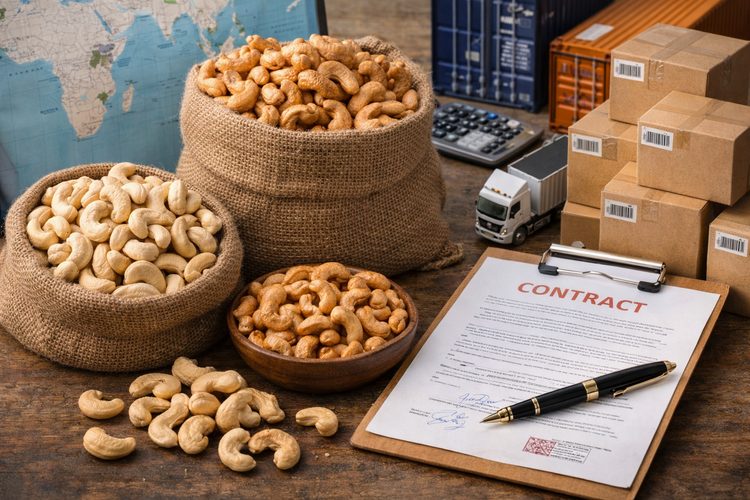
Origin, processing route and contract planning are closely linked in cashew trade because buyers are not really purchasing a nut in the abstract. They are purchasing a product path. That path includes where the raw material or processed material comes from, how it is handled, what further processing or finishing is required, how it will be packed, when it is needed and how the commercial relationship should be structured to support continuity. In other words, the stronger commercial outcome usually comes when specification, process route, packaging and shipment timing are aligned before the order is placed.
In industrial practice, many sourcing problems described as “price issues” are actually planning issues. A buyer may believe two offers are directly comparable when in reality they differ on origin assumptions, processing scope, documentation, pack format, lot structure or contract timing. That is why experienced procurement teams usually build cashew programs around a more complete quote request. They want to understand not only what the product is, but also how that product will move through the commercial system.
Origin matters because it shapes the buyer’s expectations around consistency, flavor profile, appearance, documentation logic, commercial lead time and supply continuity. In some programs, origin is discussed explicitly because the customer or market expects it. In others, it matters indirectly because origin influences how the product is processed, traded or positioned. Even where the end buyer is primarily focused on delivered performance, origin can still affect the commercial route behind the quote.
For buyer buyers, origin should not be reduced to a marketing point alone. It is part of risk assessment. It may affect how the importer thinks about timing, how the customer explains the product internally, how certain documents are prepared and how repeat business is planned. Some customers are comfortable with a wider origin framework as long as the specification is protected. Others prefer a more tightly defined origin story because their internal QA, brand or customer commitments require it. The key is to make that expectation explicit rather than assumed.
For cashews, the quote should reflect the real format and route. Whole kernel material is different from diced, meal, flour, butter or oil, and the commercial logic also changes when the material is raw, pasteurized, dry roasted or oil roasted. A buyer evaluating cashews for industrial manufacturing is not simply choosing a nut; they are choosing the level of processing already performed before the product reaches their line.
That distinction matters because processing route influences both application fit and total delivered economics. A customer buying whole kernels for in-house further processing has a different cost structure and operational goal from a customer buying roasted diced pieces for direct inclusion or finished flavored lines for export retail. Two products may both be “cashews,” but the contractual assumptions behind them are not the same.
In practice, buyers usually evaluate origin and processing together rather than separately. A sourcing conversation becomes stronger when the buyer asks questions such as: do we need raw material for further manufacture, or do we need a more finished product; are we buying on technical performance, on retail presentation or on a combination of both; do we need a product that can support a repeat industrial program, or are we covering a short-term demand window; and does the destination market require particular paperwork, label logic or pack structure?
These questions show why contracting cannot be reduced to price per pound or price per kilogram alone. The usable product menu usually includes raw cashews, pasteurized cashews, dry roasted cashews, oil roasted cashews, diced cuts, meal, flour, butter and oil. Which of those makes sense depends on the end use, whether the customer is manufacturing further, packing for retail or planning export distribution. A correct contract begins by narrowing that route.
Many buyers enter cashew trade through spot purchases, especially when testing a market or covering a short-term requirement. Spot buying can be commercially useful, but it should not be confused with program planning. A spot buy often prioritizes immediate availability and fast execution. A repeat program requires a different conversation around continuity, pack alignment, replenishment rhythm, documentation expectations and how both sides will handle changes in demand or timing.
From a trading standpoint, the best programs are built around repeatability. That means clear documentation, agreed packaging, sensible shipment cadence and a commercial structure that supports continuity rather than one-off emergency buying. Atlas generally encourages customers to identify whether the inquiry is exploratory, trial-stage or part of a wider recurring need. That one clarification often improves the quality of the quotation process immediately.
A workable contract usually starts with a clear statement of what the buyer is really trying to secure: short-term coverage, plant-approved repeat supply, export retail continuity, private label launch support or a broader multi-shipment program.
Contract planning works better when the buyer defines the actual commercial route rather than only the product name. An industrial bulk bakery ingredient program, a plant-based dairy input, a flavored snack line, a foodservice pack and an export retail SKU may all involve cashews, but they do not need the same contract structure. Some require stable monthly replenishment. Some require seasonal coverage. Some require validation lots before scale-up. Some require more packaging detail because the product is consumer-facing. Others need more technical clarity because the product will be reformulated or processed further.
Atlas therefore encourages buyers to define intended use, pack style, destination, timeline and quality expectations early. Those inputs reduce avoidable back-and-forth and improve comparability across California supply options. They also help distinguish whether the contract should be treated as a one-time supply event or the foundation of a longer trading relationship.
Even when the article topic is origin and contracting, application still matters. Typical use cases for cashews on this website include snacks, bakery, confectionery, plant-based dairy and spreads. The product brief should always match one of those concrete end uses because application changes the meaning of the contract. A buyer sourcing cashew butter for dessert fillings is contracting around texture and creaminess. A buyer sourcing diced roasted cashews for snack blends is contracting around bite, appearance and pack consistency. A buyer sourcing flour is contracting around particle behavior and blendability.
That is why a complete quote request usually includes both commercial and technical language. The buyer is not only saying what they want to buy. They are explaining what the ingredient must do.
A useful way to think about cashew contracting is to ask how much value-added work should be completed before the product ships. At one end of the spectrum, the buyer may want a simpler product form and perform more work in-house. At the other end, the buyer may want a more finished product to reduce plant complexity, labor or downstream processing steps. This is not just a technical choice. It is a make-versus-buy decision inside the broader ingredient strategy.
For example, buying raw whole kernels for internal roasting and cutting is different from buying finished roasted diced material. Buying cashew butter for direct formulation is different from buying flour or meal and building the system internally. Each step added before delivery changes how the contract should be evaluated, because it changes risk allocation, plant workload and comparability between offers.
When relevant, the brief should also mention whether the program is industrial bulk, foodservice, retail-ready, private label or export-oriented. That single clarification often changes packaging, documentation and timing assumptions. A bulk ingredient program may focus on efficient handling, stable replenishment and warehouse practicality. A retail-ready or private label program usually brings more attention to pack presentation, label coordination, carton structure and market timing. An export-oriented program may place additional weight on transit conditions, paperwork flow and shipment windows.
For that reason, pack style should be part of contract planning from the start and not treated as an afterthought. In commercial terms, packaging is part of the offer, part of the handling model and part of the landed value calculation.
Contract planning also depends heavily on timing. Some buyers need immediate coverage. Others need a predictable monthly schedule. Others still may need stage-gated supply: first sample, then validation run, then launch volume and then repeat replenishment. Atlas uses that logic because many cashew programs develop in steps rather than in a single jump from inquiry to full-scale recurring volume.
Shipment rhythm matters because it helps both sides decide whether the program should be quoted as a one-off spot transaction, a staged launch or a continuity-oriented supply relationship. Timing also shapes how buyers think about documentation, inventory planning, warehouse intake and internal approvals.
In many trade discussions, buyers and sellers both use broad language such as premium, standard, industrial or export quality. Those terms can be commercially useful as starting points, but they are usually not enough on their own to support a repeatable contract. A better approach is to define the real quality expectations around the application, the product form and the pack route. That could mean appearance expectations, processing state, particle profile, roast preference, texture behavior or another function-specific requirement.
When those details are tied to the contract structure, the buyer is in a stronger position to compare options and manage repeat business. Without that clarity, a price may look attractive while still being weakly aligned to the real need.
Can this topic be applied to both U.S. and export programs? Yes. The article logic is relevant to both domestic and export discussions, although packaging and documentation details may vary by destination. The same questions about origin, processing route, product form and continuity apply in both cases. What changes is often the operating detail: documentation burden, transit timing, retail or private label requirements, market-specific pack needs and how the importer wants the file package structured.
That is why destination should be named early in the inquiry. In export programs especially, the commercial path is not complete until the destination is known.
Origin strategy is strongest when it is matched to a real contract structure: defined product route, clear application, agreed pack style, realistic delivery rhythm and destination-aware paperwork planning.
Atlas uses the same topics covered in the academy to structure more practical and specification-minded quote requests. For origin, processing and contract discussions, Atlas would normally ask buyers to define the following points before quotation:
That level of detail helps reduce avoidable quotation ambiguity and makes comparisons between supply options more commercially honest.
Commercially, the strongest cashew programs are usually built with a progression in mind: trial quantity, validation run, launch volume and repeat replenishment. That structure gives both buyer and supplier a clearer basis for planning, especially where the end use is sensitive to format, roasting, cut size, texture or packaging. Atlas uses that progression because it reflects how many real buyer ingredient programs actually develop.
For contract planning, the key question is not just “what is the price today?” but “what is the right structure for this business if it continues?” Once that question is asked, the conversation usually improves. Origin becomes more relevant, process route becomes more precise and packaging becomes easier to define.
Atlas Global Trading Co. uses topics like origin, processing and contract planning to move conversations from broad interest to a specification-minded inquiry. If you are evaluating cashew supply, share the format, application, process route, pack style, estimated volume and destination using the floating contact form so the next step can be grounded in a real commercial need. A stronger brief usually leads to a stronger quote.
Decide whether origin must be tightly defined for brand, QA, importer or internal approval reasons, or whether broader supply flexibility is acceptable.
Clarify how much value-added work should be completed before delivery, from raw format supply to roasted, cut or more finished product forms.
State whether the business is a spot requirement, trial program, launch-stage supply or repeat replenishment relationship.
Identify pack style, shipment route and destination market early, because these influence timing, documents and landed commercial logic.
Use the contact form to share your product, packaging, destination and timing requirements for a practical quotation.
The main buyer takeaway is that cashew programs perform better when origin assumptions, processing route, pack style, contract timing and end-use requirements are aligned before the order is finalized.
Origin and processing route affect quality expectations, appearance, flavor profile, supply continuity, documentation logic and the commercial structure behind the quote. Buyers should therefore contract around the real product path rather than only around price.
Buyers should define the product format, intended application, preferred processing route, pack style, destination market, delivery cadence, quality expectations and whether the business is a spot buy, trial run or repeat contract program.