Application fit
Define whether the ingredient needs to be visible, structural or fully integrated.
Practical notes on particle size definition, application fit, processing routes.
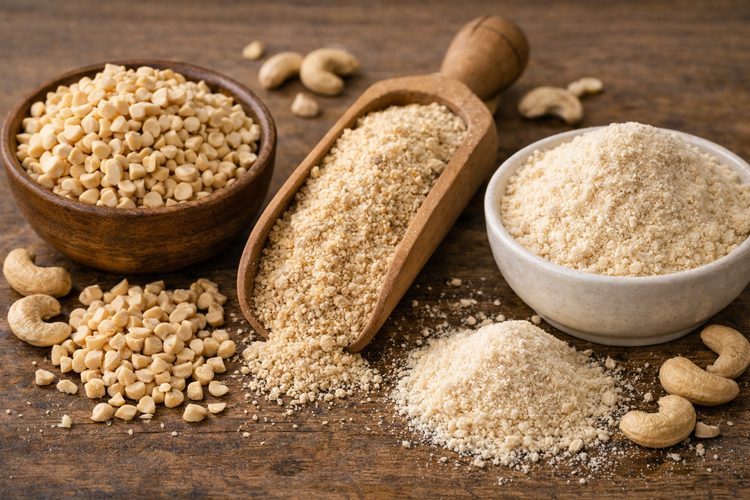
Specifying diced, meal and flour cashew formats is fundamentally about controlling particle size and functional behavior in a finished product. While these formats are often grouped together commercially, they behave very differently in production environments. The stronger commercial outcome usually comes when buyers define how the ingredient should perform in the application before selecting the cut size or grind level.
In cashew ingredients, particle size affects more than appearance. It directly influences texture perception, oil release, blendability, processing efficiency and even final product cost. A coarse diced cashew may deliver visual appeal and crunch but may not integrate well into a smooth system. A fine flour may blend seamlessly but remove visible identity and change perceived richness.
This is why buyers should not treat diced, meal and flour formats as interchangeable. Each format is a distinct ingredient with a specific role in formulation and processing.
Diced formats are typically used where visible particulation and texture are required. These include bakery toppings, snack mixes, granola, confectionery inclusions and premium visual applications.
Meal sits between diced and flour formats. It provides a coarse granular structure that can bind into systems while still offering some texture.
Flour is the most refined format and is typically used where smoothness and full integration are required.
Choosing between diced, meal and flour is not just about size—it is about what role the cashew ingredient plays in the final product.
In real sourcing scenarios, buyers often start with a general idea such as “cashew ingredient” and then refine toward the correct format based on application needs. A snack manufacturer may initially consider diced cashews but switch to meal for better coating adhesion. A bakery may evaluate meal but move to flour for smoother crumb structure. A plant-based producer may choose flour to achieve uniform blending in liquid systems.
The right choice depends on how the ingredient interacts with other components such as sugar, fat, starch, dairy or plant-based bases. It also depends on whether the product requires visual differentiation or seamless integration.
Beyond selecting the general format, buyers should consider consistency within that format. A diced specification may include expectations around size distribution and fines content. A meal specification may define granulation range. A flour specification may define fineness or mesh behavior.
Inconsistent particle size can affect processing performance, especially in automated production lines. For example:
The processing route also influences how these formats behave. Raw cashew cuts may offer a cleaner base for further processing, while roasted formats introduce flavor development and slightly different handling characteristics. Oil-roasted formats may change surface behavior and interaction with other ingredients.
For diced formats, roasting can enhance crunch and flavor. For meal and flour, roasting can deepen flavor but may also influence oil perception and blending characteristics.
As particle size becomes finer, oil availability typically increases. This has implications for formulation:
In bakery or confectionery systems, this can affect moisture balance, texture softness and shelf behavior. In plant-based dairy systems, it can influence creaminess and viscosity.
Different formats require different handling approaches. Diced formats are typically more robust and easier to handle in bulk systems. Meal and flour formats may require more attention to moisture control, flowability and storage conditions.
Buyers should clarify whether the program is industrial bulk, foodservice or retail-ready. Packaging choices such as cartons, bags, liners or bulk formats can influence shelf life, handling and shipment efficiency.
Programs involving cut specifications often evolve through testing stages. Buyers typically move from sample evaluation to plant trials and then to full-scale production. Consistency becomes critical once repeat orders begin.
Clear specification at the beginning reduces the risk of requalification and helps maintain stable supply relationships.
Atlas Global Trading Co. uses this framework to help buyers move from general ingredient requests to specification-driven sourcing decisions. If you are evaluating diced, meal or flour cashew formats, share your application, target texture, pack style and volume so the sourcing discussion can be aligned with your real production needs.
Define whether the ingredient needs to be visible, structural or fully integrated.
Clarify the required size range and tolerance for consistency.
Choose between raw, roasted or further processed formats.
Specify packaging, destination and volume expectations.
Use the contact form to translate your technical requirements into a quote request.
Cashew ingredient performance depends on clearly defining particle size, application and processing route before sourcing decisions are made.
Diced formats provide texture and visibility, meal balances integration and structure, while flour delivers smooth blending and full incorporation.
Yes. The same specification logic applies globally, although packaging and documentation may vary by destination.
Tell us the product, format, volume and destination you need.