Kernel format
Whole kernels suit premium presentation, while splits or selected pieces may support cost targets, higher seasoning expression or blend use.
Practical notes on seasoning adhesion, roast profile, kernel selection, packaging design and key buying considerations for flavored cashew programs.
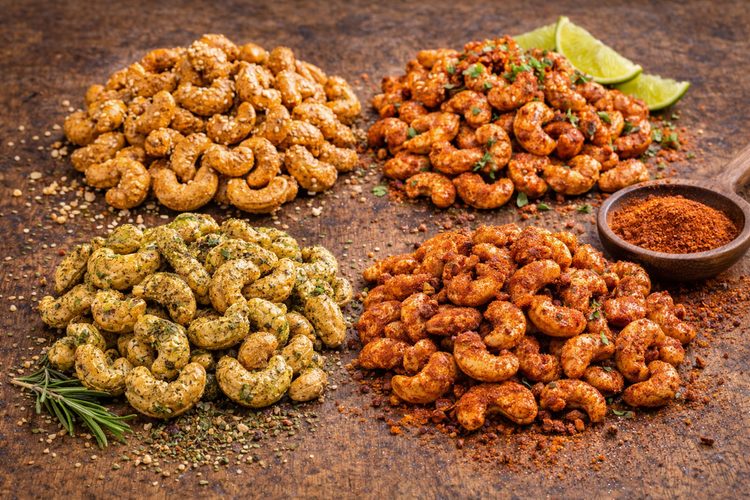
Flavored cashew programs look simple at shelf level, but from a buyer standpoint they are multi-variable projects. A successful line does not depend only on choosing a popular seasoning. It depends on matching the base kernel, roast condition, surface characteristics, oil level, flavor system, pack format and route to market so that the product performs consistently from pilot run through repeat replenishment.
Cashews are especially attractive in value-added snack lines because they already carry a premium visual and a naturally rich, buttery eating quality. That makes them a strong base for savory, sweet, spicy and fusion-style concepts. At the same time, that premium positioning can expose formulation weaknesses more quickly. If seasoning adhesion is poor, if breakage is high, if oil release is inconsistent or if the roast and flavor do not balance properly, the finished product may look expensive but eat unpredictably. Industrial buyers therefore need to build flavored cashew lines around specification discipline rather than trend language alone.
Roasted cashews can be quoted as a relatively straightforward product form. Flavored roasted cashews require more coordination. The buyer is not only selecting a kernel; they are selecting a finished sensory system. That system includes base nut size and grade, roast style, surface oil or binder approach, dry seasoning behavior, visual coverage, target salt or sweetness level, pack format, shelf-life expectations and market position.
In practice, two flavored products that sound similar on paper can behave very differently in real production. A lightly seasoned roasted cashew for foodservice snack bowls is not the same as a heavily dusted retail pouch item. A honey-style glazed cashew requires a different technical approach than a dry savory line. A chili-lime export item may need stronger flavor persistence to survive longer transit and a wider usage window, while a domestic premium retail line may prioritize a cleaner label position and more restrained seasoning intensity. This is why Atlas encourages buyers to define the commercial use case first and the flavor concept second, not the other way around.
The visual and eating quality of a flavored cashew line begins with the underlying kernel choice. Whole kernels usually support the most premium retail presentation and are common when the buyer wants strong shelf appeal, cleaner bowl presentation or a gifting-style product posture. Splits, large pieces or selected cuts may be commercially useful where the product is aimed at mixes, toppings, portion packs or value-oriented flavored concepts.
Kernel size influences more than appearance. It also affects roast uniformity, seasoning coverage, perceived bite and fill weight economics. Larger kernels can look more premium but may require more careful control if the objective is even color and balanced flavor on all surfaces. Smaller kernels or splits may present more total surface area relative to their size, which can support stronger seasoning expression, but they can also change bulk appearance and perceived premium value. Buyers should therefore define whether the line is intended to win on premium whole-kernel presentation, aggressive flavor carry, cost-controlled snack positioning or blend compatibility.
Roast choice is central to flavored cashew development. Dry roasted lines often appeal where buyers want a cleaner finish, firmer bite, controlled oil perception or a seasoning system that depends on a measured application step rather than an overt oil-roasted character. Oil roasted lines can deliver a different visual sheen, richer immediate flavor release and sometimes stronger initial seasoning hold, depending on the process design and target outcome.
Pasteurization status and pre-roast handling also matter. Buyers who are building premium snack lines, private label items or export retail programs should think of roast style as a commercial positioning tool as well as a process variable. A lighter roast may preserve more of the natural cashew character and suit subtle or dairy-style flavors. A more developed roast note can work better with smoke, barbecue, chili, masala, garlic or sweet heat profiles where the nut needs enough toasted backbone to stand up to the seasoning.
Many flavored nut projects succeed or fail on adhesion quality. Good seasoning adhesion means more than getting powder to stick in the plant. It means consistent visual coverage, limited fallout in the pack, balanced flavor in the consumer’s hand and manageable performance through transport and shelf life. When adhesion is weak, the pack accumulates loose powder, the first servings taste different from the last servings and the line can look less premium even if the kernel quality is acceptable.
Cashews create a specific adhesion discussion because they are naturally rich, relatively delicate and smooth-surfaced compared with some other nuts. The seasoning system therefore needs to account for how much direct surface hold is possible, whether a light oil phase or binder step is needed, how much fine powder the pack can tolerate and whether the finished product is meant to look evenly coated or more naturally dusted. Buyers who simply request a flavor by name without discussing adhesion expectations often end up with misaligned samples.
In flavored cashew lines, the right question is not only “which flavor?” but also “how should the flavor sit on the nut?” A fine uniform dust, visible particulates, a glossy glaze or a restrained topical coat each creates a different commercial product.
Flavored cashew lines usually fall into one of two broad commercial styles: dry-seasoned systems or glaze-style systems. Dry-seasoned systems are common in savory snacks. They may rely on measured oiling, warm application windows, powder particle design and tumbling performance to create consistent coverage. These lines often need close attention to dust levels, pack cleanliness and seasoning balance so the product tastes bold enough without creating excessive loose powder.
Glaze-style systems are more relevant where the target product is sweet, sweet-salty or visibly coated. Honey-style, maple, caramelized, sesame-style or dessert-inspired profiles may use a syrup, sugar or binding phase that changes the finished texture, visual identity and pack behavior. These lines can be commercially attractive because they create a more obviously value-added appearance, but they also require clearer planning around stickiness, clumping risk, moisture management and pack integrity. The right choice depends on the target consumer proposition and operational route.
Not every successful flavor profile works equally well across every market channel. Retail pouch programs often support more differentiated flavor development because the product must justify shelf attention and repeat purchase. Foodservice lines may prioritize broader appeal, operational ease and strong performance in open bowls, mini-bars, airline service or hospitality applications. Private label programs may need a flavor framework that fits a retailer’s category architecture and margin expectations. Export programs may require profiles that travel well across multiple consumer preferences or that are adapted for a specific regional palate.
This means flavor selection is partly a commercial channel decision. A bold Korean-style chili concept, a black pepper profile, a sea salt line, a garlic herb variation, a truffle-inspired SKU or a sweet heat concept may each be appropriate, but not for the same customer, pack size or replenishment model. Atlas therefore prefers to discuss flavored cashew projects in the context of who will sell the product, where it will be sold and how often it needs to be reordered.
The usable flavor menu for cashews is broader than many buyers initially assume. Commercial lines are often organized around a few core flavor families:
From a sourcing standpoint, the exact flavor name matters less than the technical description behind it: powder or glaze, strong or moderate intensity, visible particulates or smooth coat, clean-label priority or broader formulation flexibility, and whether the product is meant to read as premium, everyday snack or promotional innovation.
Buyers often begin development by choosing a flavor family, but successful flavored cashew lines usually depend more on calibration than on concept. How salty should the product be? How quickly should heat arrive on the palate? Should sweetness lead or finish in the background? Should the nut remain clearly identifiable or should the seasoning take center stage? These are line-building questions, not finishing touches.
Cashews naturally bring a mild, rich and slightly sweet profile of their own. That makes them a flexible canvas, but it also means overly aggressive seasoning can flatten the premium nut character. Conversely, a flavor that is too restrained may not justify the added value position. In commercial development, the target is usually a balanced line where the nut and the seasoning both remain legible. The exact balance depends on channel, price point and brand posture.
What the product looks like in pack is commercially important. Consumers and category buyers often read flavor strength visually before tasting. A product with obvious, even coverage may signal boldness and indulgence. A cleaner-looking, lighter-dusted product may suggest premium restraint, lower mess and more natural appeal. Some customers want visible herbs, seeds, spice flecks or textured coatings because they support a gourmet story. Others want a neat, uniform finish that reads more polished and consistent.
This is why sample approval should include discussion of visual style, not just taste. A seasoning can be technically correct in flavor but still wrong for the intended market if the appearance does not match the proposition.
Cashews are a premium nut, but they are not indestructible. Additional handling steps such as roasting, tumbling, coating, seasoning and packing can increase the importance of breakage control, especially when the line is based on whole kernels and sold on visual premium value. Buyers should think about breakage not only as a yield or QC issue, but as a brand presentation issue. Broken kernels can change pack aesthetics, alter perceived value and affect how seasoning is distributed through the finished pack.
This consideration is especially relevant in export shipments, e-commerce packs, club-style formats and premium gifting programs where transit and repeated handling can amplify product stress. Packaging choice, case count, fill weight and freight planning therefore influence finished product quality just as much as the flavor formula does.
Flavored cashew programs can be industrial bulk, foodservice, retail-ready, private label or export-oriented, and each path changes the packaging discussion. Bulk formats may prioritize line feeding, repacking efficiency or downstream portioning. Foodservice lines may focus on portion control, ease of service or back-of-house handling. Retail-ready programs usually place more weight on brand presentation, consumer convenience, shelf impact and barrier expectations. Private label adds the layer of retailer requirements and format standardization. Export programs may require more deliberate planning around case structure, pallet efficiency and shelf-life protection during transit.
For that reason, Atlas prefers buyers to mention pack format at the beginning of the discussion. A seasoning concept that works in a fast-turn domestic pouch line may need adjustment for a longer-travel export program or a premium rigid-pack concept. Packaging is not an afterthought; it is part of the product architecture.
In actual procurement conversations, flavored cashew lines are usually evaluated across several linked criteria: the base nut must be commercially appropriate, the roast and flavor must align, the product must look credible in its chosen pack, and the program must be scalable from trial to repeat business. Buyers often compare whether a whole-kernel line or a more cost-conscious mixed-size line makes more sense, whether dry roasted or oil roasted gives the right eating quality, whether the flavor profile should be mass-premium or more adventurous, and whether the pack should be designed for foodservice, retail or export shelf conditions.
These decisions are not independent. A premium whole-kernel rosemary sea salt cashew in a stand-up pouch is a different commercial project from a chili-garlic split cashew intended for snack blends or foodservice portions. The earlier those distinctions are documented, the more useful the price and supply discussion becomes.
For flavored cashew projects, Atlas encourages buyers to turn the product concept into a quote request with practical detail. The most useful inquiry usually answers the following questions:
That level of specificity helps separate a real program from a generic flavor inquiry and supports more meaningful sampling and quotation.
Typical use cases for cashews on this website include snacks, bakery, confectionery, plant-based dairy and spreads. Flavored cashew lines are most directly tied to snack, retail-ready and foodservice uses, but the commercial brief should still identify the exact application and route to market.
Many flavored nut projects fail because trial-stage assumptions are allowed to carry too far into launch. A trial may only need a small quantity and enough consistency to evaluate market fit. A launch program needs a supply structure that can support repeatability, packaging availability, replenishment timing and commercial continuity. Atlas generally recommends describing the project stage clearly so that sampling, pricing and pack assumptions are aligned from the start.
A practical sequence often looks like this: concept review, first sample, application or market validation, revised sample if needed, initial commercial lot, then repeat replenishment. Each stage should answer a different question. Is the flavor right? Is the roast right? Does the product hold up in the intended pack? Does the delivered cost still make sense at scale? This approach reduces the risk of confusing idea-stage enthusiasm with launch-stage readiness.
Flavored roasted cashews are value-added snack products, so shelf-life planning should be considered early. Seasoning system, oil phase, pack barrier, storage conditions and transit duration can all affect how the product presents over time. A product intended for fast domestic rotation may allow more flexibility than a product planned for export distribution or multi-node retail logistics. Buyers should therefore think about the selling window, shipping route and stock-holding pattern when discussing flavored lines.
This does not mean every project needs the same shelf-life strategy. It means the strategy should match the commercial reality. A premium short-run seasonal item, a core retail SKU and an export container program are different businesses even if they share the same nut category.
Private label and export retail discussions often become packaging-led earlier than industrial projects. That is because label panel space, case structure, display expectations and market-specific presentation requirements may influence pack size and merchandising logic long before the final order is placed. In flavored cashew programs, this can also affect the ideal flavor strength and visual coating level. A product built for a premium minimalist private label may need a different finish from a bold export retail line that depends on immediate visual impact.
The earlier the buyer states whether the line is private label, export retail or foodservice, the easier it becomes to design the right commercial path instead of retrofitting the product after samples have already been approved.
Atlas Global Trading Co. uses topics like flavored cashew development to move buyers from broad concept language into a specification-minded sourcing conversation. The most productive next step is to share the base kernel preference, roast style, target flavor direction, packaging format, estimated volume and destination market. That turns the discussion from “we want flavored cashews” into a real commercial brief that can be priced, sampled and compared properly.
Whole kernels suit premium presentation, while splits or selected pieces may support cost targets, higher seasoning expression or blend use.
Dry roasted and oil roasted routes do not behave the same. Roast choice affects bite, sheen, flavor carry and overall line identity.
Decide whether the line should have a light dust, bold savory coat, visible particulates or a sweeter glaze-style finish.
Bulk, foodservice, retail-ready, private label and export packs each change barrier, case, presentation and freight assumptions.
Trial runs, seasonal launches, monthly replenishment and container programs require different sourcing and timing discussions.
Commercially, flavored cashew projects tend to move through recognizable stages: trial quantity, validation run, launch volume and repeat replenishment. The right operating model at each stage may differ. A trial run may prioritize flexibility and learning. A launch program should prioritize comparability, timing, packaging readiness and a realistic path to repeat business. Buyers who define those stages clearly generally get more relevant quotations and fewer surprises later.
When relevant, the brief should also clarify whether the program is industrial bulk, foodservice, retail-ready, private label or export-oriented. That one clarification often changes assumptions around pack style, documentation, labeling posture, shipment rhythm and freight planning. For flavored lines, it can also influence the recommended intensity and visual finish of the seasoning system.
From a trading standpoint, the best flavored cashew programs are built around repeatability rather than only first-sample appeal. A commercially strong line is one that can be sampled, approved, packed, shipped and replenished with a clear specification logic behind it. That is the point where the flavored concept becomes a real supply program.
Use the contact form to turn your flavor concept into a practical quote request for Atlas and its California processing partners.
The main buyer takeaway is that flavored cashew projects work best when roast style, seasoning system, pack format, destination market and volume plan are defined together rather than treated as separate decisions.
Buyers should specify kernel grade or piece format, roast style, target flavor direction, seasoning intensity, pack style, destination market, regulatory or labeling needs and expected trial or monthly volume.
Yes. The same commercial logic can support U.S. and export programs, although packaging, documentation, shelf-life planning and labeling details may vary by destination.