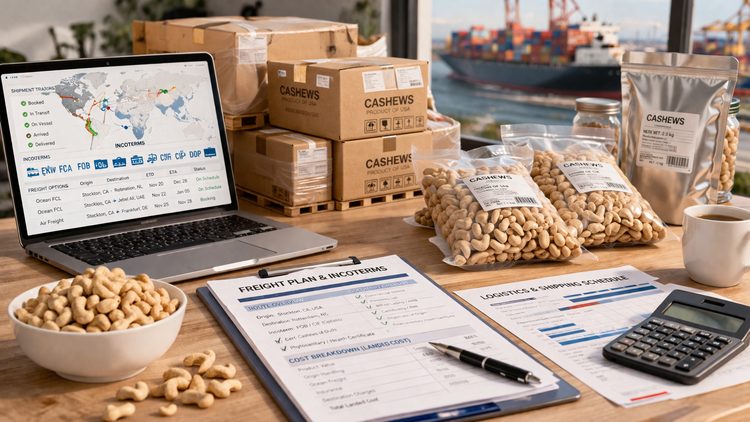
Freight planning and Incoterms matter because industrial nut buying is rarely only about nominal price. The stronger commercial outcome usually comes from aligning specification, process route, packaging and shipment timing before the order is placed. In cashew sourcing, the commercial risk often appears not in the product itself but in the gap between quoted price and real delivered cost. A buyer may approve a product number that looks attractive at first glance and still end up with a more expensive, slower or less reliable program once inland transport, port coordination, export paperwork, destination handling and timing risk are added back in.
That is why experienced buyers do not compare cashew offers only by price per kilogram. They compare the route. Who is responsible for pre-carriage? Who books ocean freight or air freight when needed? Where does risk transfer? Who controls export clearance? What packaging route supports the transit profile? What happens if the program is foodservice, retail-ready, private label or export-oriented rather than simple industrial bulk? These are not secondary questions. They determine whether the program is commercially workable.
Why Incoterms change the real meaning of a cashew quote
Two cashew quotations may describe the same product and still be commercially different if they are issued under different Incoterms. One offer may reflect only product value at origin or pickup point. Another may include carriage to port, export handling, freight or delivery to destination. If the buyer compares these offers without normalizing the terms, they are not comparing like for like.
For that reason, Incoterms are one of the first practical tools for making quotes comparable. They define where cost responsibility sits, where risk transfers and which parts of the journey are managed by the seller or the buyer. In cashew programs, this influences planning for bulk ingredients, foodservice packs, retail-ready lines and export container routes alike. The more structured the supply program, the more important it becomes to choose terms that match the buyer’s logistics capability and internal procurement model.
Buyer shortcut: a low number on the product line is not always the best quote. A better question is what that quote actually includes, where the responsibility changes hands and what the real landed and usable cost will be at the destination you care about.
How this topic shows up in real buying decisions
For cashews, the quote should reflect the real format and route. Whole or kernel material is different from diced, meal, extra fine flour, butter or oil. The commercial logic also changes when the material is raw, pasteurized, dry roasted or oil roasted because packaging, transit sensitivity, shelf-life planning and damage risk can all differ by format.
For cashew buyers, the usable product menu usually includes raw cashews, pasteurized cashews, dry roasted cashews, oil roasted cashews, diced cashews, meal, flour, butter and oil. Which of those makes sense depends on the end use, whether the customer is manufacturing further, packing for retail or planning export distribution. Freight planning becomes particularly important once the buyer needs to coordinate packaging, container efficiency, destination documents, inventory timing and risk transfer in a single commercial brief.
Why landed cost matters more than headline price
Landed cost is often the more useful commercial measure because it reflects what the buyer actually pays to get usable product to the intended place. In real cashew sourcing, that may include not only product cost but also origin handling, inland delivery, export documents, freight, insurance where applicable, destination handling, customs-related coordination, warehouse timing and the indirect cost of delay or mismatch.
This is why Atlas encourages buyers to describe the desired destination and route early. A quotation under one Incoterm can look cheaper than another, yet become more expensive after the buyer adds external freight management, brokerage coordination or destination delivery. The correct comparison is usually not ex-works versus delivered price on face value. It is the total cost of obtaining the right product in the right condition at the right time under a route the buyer can actually manage.
Common freight planning questions cashew buyers should settle early
1) Where is the real delivery point?
Not all buyers need the product delivered to the same type of destination. Some need collection at origin, some need shipment to a nominated port, some need arrival at destination port, and others need final delivery to a warehouse, plant or co-packer. The exact delivery point changes which Incoterm is most useful and what the quote should include.
2) Does the buyer want to control freight or outsource it within the commercial offer?
Some buyers have strong internal logistics capability and prefer to manage freight themselves. Others prefer to purchase a more complete route so that product and freight planning stay coordinated. Neither approach is universally better. The right choice depends on internal resources, route familiarity, shipment frequency and the need for flexibility or simplification.
3) Is this a spot buy or a recurring program?
One-time buying and recurring replenishment are different freight tasks. A single shipment may tolerate more manual coordination. A monthly container program or rolling replenishment route benefits from more disciplined terms, packaging assumptions and booking logic.
4) What packaging route fits the journey?
Freight planning is inseparable from packaging. Bulk industrial bags, lined cartons, pails, foodservice packs, retail units and export-ready master cases all behave differently in transport. The buyer should align the pack route with the shipping profile rather than treating packaging as a separate decision.
5) How much timing sensitivity is built into the program?
If the cashew program supports production scheduling, retail launch dates, seasonal demand or private-label commitments, shipment timing matters as much as product cost. In those cases, freight planning should begin early enough that lead times, sailing assumptions, inland moves and destination handling are all part of the commercial discussion.
How Incoterms affect buyer behavior in practice
EXW-style thinking
When the buyer takes responsibility very early in the route, the apparent product number may be lower, but the buyer assumes more operational burden. This can work well for buyers with their own freight systems, strong consolidation logic or local logistics partners. It is less attractive for buyers who do not want to manage each step separately or who need a more integrated quotation.
FCA and similar structured origin handoff routes
Many buyers prefer a cleaner origin handoff where goods are prepared and transferred in a more organized way than a basic pickup model. In practice, this can improve quote clarity and reduce confusion over what has or has not been handled before main carriage begins. It can be especially useful when the buyer still wants control of principal freight but wants cleaner origin coordination.
FOB-style export port logic
Where maritime export is central, some buyers think in terms of delivery up to the loading port and then manage ocean freight onward. This can be commercially useful when the buyer has ocean freight leverage or wants to keep freight decisions separate from product supply while still receiving a more complete export-side product handoff.
CFR, CIF or broader delivered-port style thinking
When buyers want a more integrated quote up to destination port or a broader shipped cost view, they often compare offers on that basis. This can simplify landed-cost evaluation, though the buyer still needs to understand what remains outside the quoted scope at destination.
DDP or fully delivered approaches
Some customers prefer the greatest simplicity and want the goods to arrive at their receiving point with minimal logistics coordination on their side. This can be commercially attractive for buyers focused on purchasing outcomes rather than freight management, but only when the quoted route, responsibilities and exclusions are clearly understood.
The practical point is not to memorize all Incoterms in theory. It is to choose the one that matches the buyer’s internal capability and the commercial reality of the cashew route being purchased.
Freight planning by program type
Industrial bulk ingredients
Bulk buyers often focus on container efficiency, pallet patterns, warehouse delivery, unloading practicality and predictable replenishment. In this environment, the best freight plan often supports regular volume movement rather than one-off optimization. Incoterms should fit the buyer’s actual receiving model and inventory cadence.
Foodservice programs
Foodservice routes may require more flexible delivery sizes, smoother domestic handling or tighter arrival windows if multiple locations or distribution partners are involved. The freight plan should reflect not just shipment cost but also service reliability and pack usability on arrival.
Retail-ready and private-label programs
Retail and private-label cashew lines often add timing pressure because packaging, labeling, customer approvals and launch windows are already synchronized. A freight delay can therefore have a larger indirect cost than in a simpler industrial buy. The selected Incoterm should match how much route control the buyer wants and how much integrated responsibility the supplier is expected to hold.
Export-oriented programs
Export routes are where Incoterms become especially important because the commercial handoff crosses borders, document sets and risk stages. Buyers should not only ask for product and freight pricing. They should also define port logic, destination expectations, documentation flow and how the chosen term aligns with their own import-side capability.
Packaging and freight should be planned together
Freight performance is influenced by how the cashews are packed. Whole kernels may require more protection against breakage. Roasted products may place more emphasis on pack integrity and shelf-life preservation during transit. Diced or flour routes may need stable containment and clean handling. Butter, paste and oil routes introduce different container and temperature-handling questions. A cost-optimized freight route can still fail commercially if the packaging is not designed for that journey.
For that reason, Atlas encourages buyers to connect format, pack style and Incoterm in the same discussion. A full-container industrial program, a smaller foodservice route and a retail-ready export line can all involve the same ingredient family but very different freight logic.
Practical rule: if the product format changes, the packaging route may change. If the packaging route changes, the freight logic and Incoterm preference may also need to change.
What Atlas would ask before quoting
Atlas encourages buyers to define intended use, pack style, destination, timeline and quality expectations early. For freight-related cashew programs, Atlas would also encourage buyers to clarify the commercial route itself so the quote can be built around the real delivery model.
- What exact cashew format is required: whole, pieces, diced, meal, flour, butter or oil?
- Is the route industrial bulk, foodservice, retail-ready, private label or export-oriented?
- What is the delivery point that actually matters: origin pickup, export port, destination port or final warehouse?
- Which Incoterm structure is preferred, or does the buyer want comparative options?
- What pack style and pallet logic should be assumed for freight planning?
- What is the order size: sample, trial quantity, LCL-style movement, regular pallet load or full container program?
- What destination market and required arrival window should shape the route?
- Is the program a one-time buy, seasonal project or repeat replenishment model?
Commercial planning points
From a trading standpoint, the best programs are built around repeatability. That means clear documentation, agreed packaging, sensible shipment cadence and a commercial structure that supports continuity rather than one-off emergency buying. Freight planning fits directly into that model because transport is not just a cost line. It is part of whether the cashew program is dependable enough to support manufacturing, foodservice service levels or retail commitments.
Commercially, these projects often develop in stages: trial quantity, validation run, launch volume and repeat replenishment. Atlas uses that logic to guide pack and shipment planning. A small trial may justify simpler coordination. A repeat monthly program benefits from clearer Incoterm discipline, more stable pack assumptions and a better-defined logistics rhythm. The earlier the buyer states the stage, the better the quote can reflect real commercial needs instead of a temporary approximation.
When relevant, the brief should also mention whether the program is industrial bulk, foodservice, retail-ready, private label or export-oriented. That single clarification often changes packaging, documentation and timing assumptions. It can also change which Incoterm is commercially strongest, because the right balance of buyer control and seller responsibility is different in each route.
Why timing can cost more than freight
In some cashew programs, the direct freight charge is not the biggest source of loss. Delay can be worse. A late container can hold up production runs, private-label launches, promotional calendars or stock availability. A quote that looks slightly cheaper may therefore be commercially weaker if it places too much of the route coordination burden on a buyer that is not set up to manage it smoothly.
This is why Atlas encourages buyers to compare not only freight cost but also route reliability, document readiness, handoff clarity and timing realism. The best offer is often the one that reaches the buyer in the right condition, under the right responsibility split, on a schedule that supports the business plan.
Buyer planning note
Atlas Global Trading Co. uses topics like this to move conversations from broad interest to a specification-minded inquiry. If you are evaluating cashews supply, share the exact format, pack style, estimated volume, destination and preferred delivery model using the floating contact form so the next step can be grounded in a real commercial need. In many successful cashew programs, the difference between a workable quote and a misleading one is not only the product price. It is the freight plan and the Incoterm structure behind it.
Need help structuring freight and Incoterm planning for a cashew route?
Use the contact form to turn this research topic into a practical quote request with product format, pack style, destination and delivery-model details.
- State the exact cashew format and delivery point
- Add target monthly or trial volume
- Include destination market and target timing
Frequently Asked Questions
Why do Incoterms matter so much in cashew buying?
Incoterms matter because they define where cost, risk and operational responsibility transfer between seller and buyer. In cashew programs, that directly affects landed cost, freight planning, document flow, warehouse timing and how offers should be compared.
What should buyers include in a freight-ready quote request for cashews?
A strong request should include the exact cashew format, packaging route, destination market, preferred Incoterm, target shipment window, expected order size, delivery point and whether the program is a trial, regular replenishment or full container route.
Why is a lower unit price not always the better cashew offer?
A lower unit price may exclude freight, documentation, inland delivery, packaging protection or timing support that the buyer still needs to pay for later. The useful comparison is usually landed and usable cost, not only the ex-works or base product number.