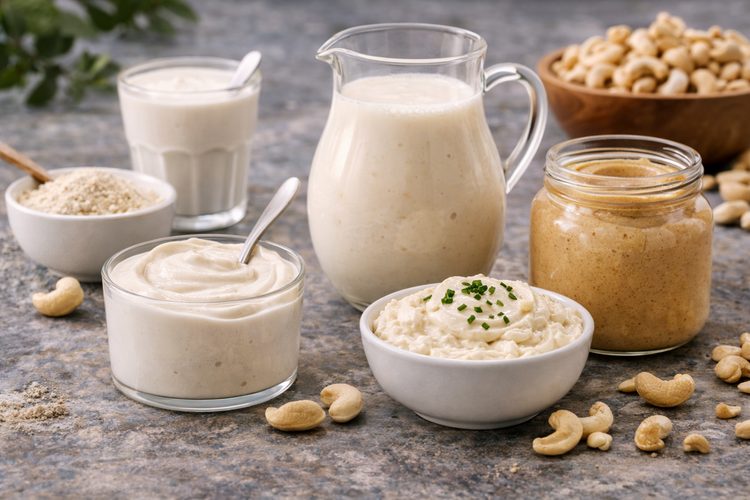
Cashews can move across multiple end uses, but plant-based dairy and creamy formulations require a more specification-driven conversation than many buyers expect. In this category, the ingredient is rarely chosen only for simple nut identity. It is usually selected because it can help deliver creaminess, round mouthfeel, body, texture stability, mild flavor carry and a more premium sensory profile in finished systems that need to feel smooth rather than thin, chalky or harsh. That makes cashew sourcing a technical and commercial exercise at the same time.
Atlas positions cashew programs by asking what the ingredient needs to do on line and in the finished formula. Should it create the base of a dairy alternative? Help soften the texture of a creamy sauce? Improve spoonability in a spread? Support body in a frozen dessert? Deliver a cleaner and more indulgent finish in a plant-based filling? Once the intended function is clear, the product format, roast style, pack size and commercial route can be matched more realistically to the application.
Why cashews matter in plant-based dairy and creamy systems
Among nut ingredients, cashews are often chosen for applications where the finished product needs smoothness without an overly aggressive nut flavor. Their profile is commercially attractive because it can support both indulgent and versatile formulation strategies. A buyer may want a strong signature flavor in some applications, but in many plant-based dairy systems the requirement is different: the ingredient should help create creaminess and a rounded finish while allowing other flavors such as vanilla, chocolate, herbs, cultures, fruit, coffee or savory seasonings to remain clear.
This is why cashews show up across plant-based dairy alternatives, creamy culinary products, spoonable formats, frozen desserts, dessert fillings, nut-based creams, sauces and blended premium spreads. In each case, the ingredient may be working as a texture builder, a fat contributor, a flavor base, a premium positioning aid or a combination of all four. The right buying decision therefore depends less on broad category language and more on the exact performance target.
Buyer shortcut: for plant-based dairy applications, the useful sourcing question is not only “Can you supply cashews?” It is “Which cashew format will give my formulation the right creaminess, process fit and cost structure?”
How this topic shows up in real buying decisions
In practice, buyers compare raw, pasteurized, dry roasted, oil roasted and processed formats such as diced cuts, meal, flour, butter and oil. For plant-based dairy and creamy systems, the most relevant commercial formats are usually cashew butter, paste, meal and flour, but there are cases where kernels or pieces also matter, especially if the customer is processing further in-house. The right choice depends on the balance between creaminess, blendability, oil release, label goals, flavor intensity, line capability and total delivered cost.
For cashew buyers, the usable product menu often includes raw cashews, pasteurized cashews, dry roasted cashews, oil roasted cashews, diced cashews, cashew meal, cashew flour and cashew butter. Which of those makes sense depends on the end use, whether the customer is manufacturing further, filling retail units, running foodservice packs or planning export distribution. The same ingredient family can serve very different needs, but the quote should reflect the real process route rather than a generic category description.
Common plant-based dairy and creamy applications for cashews
Plant-based dairy-style bases
Cashews are commonly used when a formulation needs a soft, rounded and creamy base for products that aim to feel dairy-inspired. In this context, cashews may support body, mouthfeel and flavor neutrality compared with more assertive alternatives. Buyers in this category usually care about how cleanly the ingredient disperses, how it behaves under shear, how it supports viscosity and whether it introduces the desired level of richness without overpowering the rest of the system.
Creamy spreads and spoonable products
Cashews are also relevant in creamy retail or foodservice products where spreadability and smooth finish matter. Here the ingredient may help create a product that feels richer and more premium than a formula built only around starches, oils or lower-cost solids. Buyers should think carefully about texture target, oil behavior, final pack type and the expected consumer or operator experience.
Plant-based sauces and savory creamy formulations
In savory applications, cashews can support a cream-style texture and a more rounded finish in sauces, dips and spoonable savory products. The ingredient may be contributing body, fat phase, emulsification support or culinary smoothness. In such products, the buyer needs to know whether the cashew component is there as a hero ingredient, a functional base or a behind-the-scenes texturizer, because that choice affects both cost logic and format choice.
Frozen desserts and chilled creamy products
Plant-based frozen desserts, chilled desserts and layered creamy products often use cashews when the texture brief calls for indulgence rather than austerity. In these products, the ingredient may help soften perception, reduce iciness, improve richness or support a more premium spoon experience. Buyers should evaluate the ingredient within the actual thermal and storage conditions of the finished system, not only at ambient sample evaluation.
Dessert fillings and cream-style inclusions
Cashews can be useful in fillings, swirls and cream-like dessert systems where the goal is smoothness with a gentle nut identity. In these applications, buyers often look closely at grind profile, body, flow, oil release and pack handling. The correct cashew route here may differ significantly from one meant for a beverage-adjacent or spoonable dairy-style base.
Which cashew formats make sense for creamy formulations
Cashew butter
Cashew butter is one of the most direct routes when the buyer wants concentrated creaminess, nut fat contribution and a rich, smooth texture. It is often used when the formulation benefits from a dense, ready-to-process nut base. Commercially, buyers should not only request “cashew butter.” They should describe target texture, roast style, expected use temperature, natural or stabilized expectations, pack size and the way the butter will be processed into the final system.
Cashew paste
Depending on the process route, buyers may discuss cashew paste as a texture-driven ingredient for cream-style systems, fillings or smoother blended applications. Paste-style materials are relevant when the product needs a consistent, easily integrated nut phase and when the buyer wants to reduce the amount of in-house pre-processing. The exact practical meaning of “paste” can vary, so the brief should clarify texture and use conditions.
Cashew meal and flour
Cashew meal and flour may be preferred when the customer wants to build the creamy system from a dry ingredient route, whether for easier blending into a formula, different pack economics or more flexible in-house hydration and processing. These formats can contribute nut richness and body without the same handling profile as butter. They are often useful in plant-based dairy, bakery-creamy systems, desserts and dry-mix-adjacent formulation routes.
Whole kernels for in-house processing
Some customers prefer raw or pre-treated kernels when they plan to soak, grind, roast or otherwise process cashews themselves. In that case, the commercial logic shifts. The buyer may be optimizing for more control over the finished process route, internal texture design or plant capability. Atlas would typically encourage such buyers to define the exact in-house processing intent before quotation so offers can be aligned with the real application and operating model.
Technical points that matter in formulation
Texture and mouthfeel target
Plant-based dairy projects often succeed or fail on mouthfeel. Cashews are frequently used because they can help create roundness and a smoother finish, but the ingredient still needs to be matched to the finished product. A drinkable format, a spoonable product, a spread and a sauce all require different texture logic. Buyers should therefore specify whether they need pourability, spoonability, body, creaminess, density or smooth indulgence.
Flavor carry and roast expression
The degree of roast and processing route influences how much nut character carries into the final product. A lighter profile may support a more neutral creamy system. A more roasted profile may be useful in indulgent or dessert-led products. The correct decision depends on whether cashew flavor should stay in the background or act as a noticeable part of the product identity.
Blendability and dispersion
In plant-based dairy systems, the ingredient must fit the production route. Buyers often focus on whether the cashew ingredient blends smoothly, how it behaves under shear, whether it supports a stable and uniform system and whether it can be handled efficiently at the intended scale. The same cashew ingredient may work well in one manufacturing setup and less well in another if the process expectations are not aligned early.
Oil release and finished stability
Oil behavior can matter significantly, especially in creamy systems that need a clean appearance and repeatable texture over shelf life. Some applications tolerate more oil movement than others. A premium spread, a chilled creamy product and an industrial sauce base may all have different tolerance levels. Buyers should bring this into the specification brief rather than leaving it as an unspoken assumption.
Label strategy and product positioning
Many plant-based buyers are not only solving for texture; they are also solving for positioning. The ingredient has to perform, but it may also need to fit a certain commercial narrative, whether that is premium, creamy, dairy-style, culinary, plant-based or clean-label leaning. That is why buyers often benefit from treating the cashew discussion as both a formulation topic and a market-fit topic.
What Atlas would ask before quoting
For cashew projects in plant-based dairy and creamy formulations, Atlas would typically recommend translating the product idea into a quote request with clear technical and commercial inputs. That makes it easier to discuss realistic California partner options instead of a generic price-only inquiry.
- What is the end application: plant-based dairy alternative, creamy sauce, dessert base, spread, spoonable product, frozen dessert or another formulation?
- What role should the cashew ingredient play: main base, texture support, flavor layer, premium positioning ingredient or inclusion?
- Which format is preferred: raw kernels, pasteurized kernels, roasted kernels, meal, flour, butter or paste?
- Should the profile be neutral and creamy, or should it carry a more noticeable roasted nut character?
- What texture target matters most: pourable, spoonable, spreadable, blendable, thick, light or indulgently dense?
- Will the customer process further in-house, or does the route require a more finished functional ingredient?
- What pack style is needed: industrial bulk, foodservice, retail-ready, private label or export-oriented?
- What is the commercial stage: trial quantity, validation run, launch volume or repeat replenishment?
- What destination market, timing requirement and documentation expectations should shape the quote?
Typical use cases for cashews on this website include snacks, bakery, confectionery, plant-based dairy and spreads. For creamy formulations, the product brief should always connect the chosen cashew format to the actual process route and finished texture target.
Commercial planning points
Commercially, these projects often develop in stages: trial quantity, validation run, launch volume and repeat replenishment. Atlas uses that logic to guide pack and shipment planning, especially when retail packaging, export retail or private label is part of the conversation. In plant-based dairy, this staged approach is especially useful because a sample that works in bench formulation may still need validation at pilot or production scale before it becomes a sustainable program.
When relevant, the brief should also mention whether the program is industrial bulk, foodservice, retail-ready, private label or export-oriented. That single clarification often changes packaging, documentation and timing assumptions. A bulk plant-based manufacturer may want efficient large-format packs and repeatable in-line behavior. A private-label refrigerated spread program may care more about consumer texture, pack finish and monthly replenishment rhythm. An export route may shift attention toward documentation, shipping conditions and pack protection.
Buyers should also compare total delivered value rather than only simple raw ingredient price. A cashew format that costs more per kilogram may still be commercially stronger if it reduces process time, improves finished creaminess, supports cleaner premium positioning or lowers reformulation risk. In this category, the ingredient is often being asked to solve both sensory and operational problems. That makes it important to quote against the real job the ingredient must do.
How this affects supplier discussions
The strongest sourcing conversations usually happen when the buyer moves from broad product interest to a specific formulation brief. Instead of asking for “cashews for plant-based dairy,” a buyer can say that the product is a spoonable cultured-style alternative, a creamy sauce, a frozen dessert base or a premium spread, and then define the target texture, pack style and monthly rhythm. That reduces back-and-forth and improves comparability across options.
From a trading standpoint, repeatability matters as much as innovation. The best programs are built around a clear specification, realistic pack route, sensible shipment cadence and a commercial structure that supports continuity rather than one-off emergency buying. That is especially true in creamy plant-based products where finished texture consistency directly affects customer acceptance and brand perception.
Buyer planning note
Atlas Global Trading Co. uses topics like this to move conversations from broad interest to a specification-minded inquiry. If you are evaluating cashews for plant-based dairy and creamy formulations, share the target format, intended application, pack style, estimated volume and destination using the floating contact form so the next step can be grounded in a real commercial need. The practical objective is not only to source cashews, but to source the right cashew route for the texture, process and commercial positioning your finished product actually requires.
Need help sourcing cashews for a creamy plant-based application?
Use the contact form to share your product, packaging, destination and timing requirements for a practical quotation.
- State the exact cashew format and application
- Add target monthly or trial volume
- Include destination market and target timing
Frequently Asked Questions
Which cashew formats are most relevant for plant-based dairy and creamy formulations?
The most relevant formats are usually cashew butter, cashew paste, fine meal and flour, although diced or kernel formats may still be used in inclusions or toppings. The best format depends on whether the product needs creamy body, smooth texture, visible inclusion or flavor support.
What should buyers specify before requesting a quote for plant-based dairy use?
Buyers should specify the intended application, target texture, roast style, whether the ingredient is for a base or an inclusion, pack format, volume rhythm, destination market and any labeling or process expectations. These details make the quote more practical and easier to compare.
Why are cashews often chosen for creamy plant-based formulations?
Cashews are often chosen because they can help build smoothness, round mouthfeel, mild nut flavor and premium creaminess across plant-based dairy, sauces, frozen desserts, spreads and spoonable formats. Their commercial value usually comes from combining sensory performance with formulation flexibility.