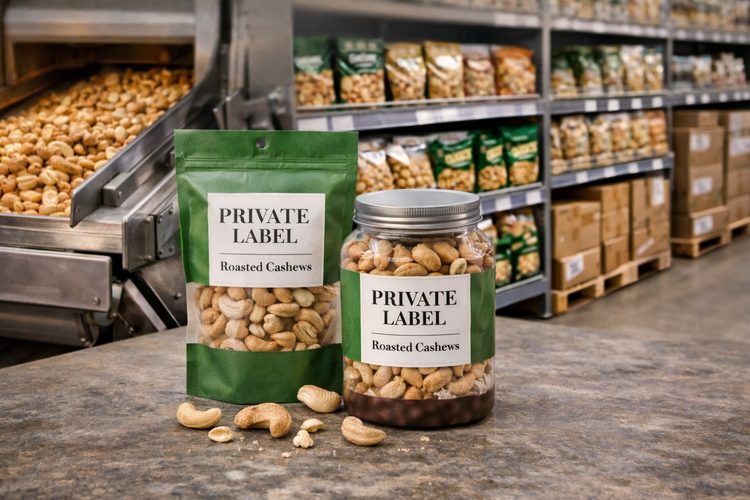
Private label cashew programs are not single transactions—they are structured supply chains. The success of a program depends on aligning product specification, processing route, packaging configuration, labeling requirements, logistics planning and commercial timing before the first shipment is booked. Buyers who treat private label as “finished goods sourcing” rather than “integrated program design” often face delays, inconsistent product execution or margin pressure later in the cycle.
What defines a private label cashew program
A private label cashew program typically involves sourcing raw or processed cashews, applying a defined processing route (such as roasting or seasoning), packing the product into branded retail-ready formats, and distributing it into a defined market. Unlike bulk ingredient sourcing, the program must meet both manufacturing and retail expectations simultaneously.
This means the supplier is not only delivering a nut ingredient, but supporting a finished product concept that must perform on shelf, comply with destination regulations and maintain repeatable quality across production cycles.
Program reality: In private label, the product is judged twice—first by the buyer during sourcing, and then by the end consumer at shelf. Specification discipline must support both.
End-to-end program structure
1. Product definition
The program begins with defining the product: raw, roasted, salted, flavored, coated or blended. The buyer should specify kernel grade, size, roast type (dry or oil roasted), seasoning profile and target sensory characteristics. This stage also includes deciding whether the product is positioned as premium, value, functional or everyday snack.
2. Processing route
The processing stage defines how raw cashews are transformed into finished goods. This includes roasting parameters, seasoning application, oil usage (if any), cooling, sorting and quality control. Each step affects flavor, shelf stability and final product consistency.
3. Packaging design
Packaging is a commercial decision as much as a technical one. Buyers must choose between stand-up pouches, jars, cans, pillow bags, multi-packs or foodservice formats. Packaging influences shelf life, brand perception, logistics efficiency and retail acceptance.
4. Labeling and compliance
Private label programs must meet destination market requirements. This includes ingredient declarations, allergen statements, nutritional panels, barcode systems, language requirements and any regulatory standards relevant to the target region.
5. Logistics and distribution
Shipping method, container planning, pallet configuration and documentation all affect delivery timing and cost. Export programs may require additional documentation and coordination compared to domestic supply.
6. Retail execution
The final stage is how the product performs on shelf. This includes packaging durability, visual appeal, price positioning and consumer acceptance. A strong upstream specification helps ensure consistent downstream execution.
Key product formats in private label cashews
- Raw cashew kernels (for further processing or simple packing)
- Dry roasted cashews (clean-label positioning)
- Oil roasted cashews (enhanced flavor and mouthfeel)
- Salted and seasoned cashews
- Flavored cashew snack lines
- Mixed nut blends including cashews
- Cashew pieces for snack blends
- Cashew butter or spreads
How buyers evaluate suppliers for private label
Private label sourcing is less about finding the lowest price and more about finding a partner who can execute consistently. Buyers typically evaluate suppliers based on processing capability, quality control systems, packaging options, documentation support, export readiness and ability to scale.
Commercial planning points
Private label programs often follow a structured timeline:
- Sample and product development
- Pilot production or validation run
- Initial launch volume
- Repeat production and replenishment
Each stage may require different packaging quantities, lead times and pricing structures.
Packaging strategy and shelf impact
Packaging affects not only product protection but also brand perception and logistics efficiency. Stand-up pouches may suit modern snack brands, while jars or cans may signal premium positioning. Multi-pack formats may support retail promotions. Buyers should align packaging choice with target market expectations.
Export considerations
For export programs, additional factors include labeling regulations, shelf-life requirements, climate considerations, shipping duration and customs documentation. Programs serving Europe, the Middle East or Asia may require tailored packaging and compliance approaches.
Cost structure in private label programs
The total cost includes raw material, processing, packaging, logistics, duties and margin structure. Buyers should evaluate cost-in-use rather than unit price alone. A slightly higher-cost product that delivers better shelf performance and repeatability may be commercially stronger.
What Atlas would ask before quoting
- Product type (raw, roasted, flavored)
- Packaging format and size
- Destination market
- Expected volume (trial, monthly, container program)
- Target launch timeline
Buyer planning note
Atlas Global Trading Co. uses a structured approach to private label programs, connecting California processing capabilities with international market requirements. By aligning specification, packaging and logistics early, Atlas helps buyers move from concept to shelf with fewer disruptions.
Need help launching a private label cashew line?
Share your product idea and Atlas will help translate it into a practical sourcing and production plan.
- Define product and packaging format
- Share expected volume and timeline
- Specify destination market
Frequently Asked Questions
What is the main buyer takeaway from “Private Label Cashew Programs from Processing to Shelf”?
The key takeaway is that successful private label programs require alignment between product specification, packaging, logistics and commercial planning from the start.
What formats are most common in private label cashew programs?
Roasted, salted, flavored and mixed nut products are the most common retail-ready formats, alongside raw kernels for simple packing programs.
How long does a private label program typically take to launch?
Timelines vary, but most programs move from sample stage to launch within a structured process including validation and packaging development.
Can private label programs be export-oriented?
Yes. Many private label cashew programs are designed specifically for export markets, with packaging and compliance adapted to destination requirements.