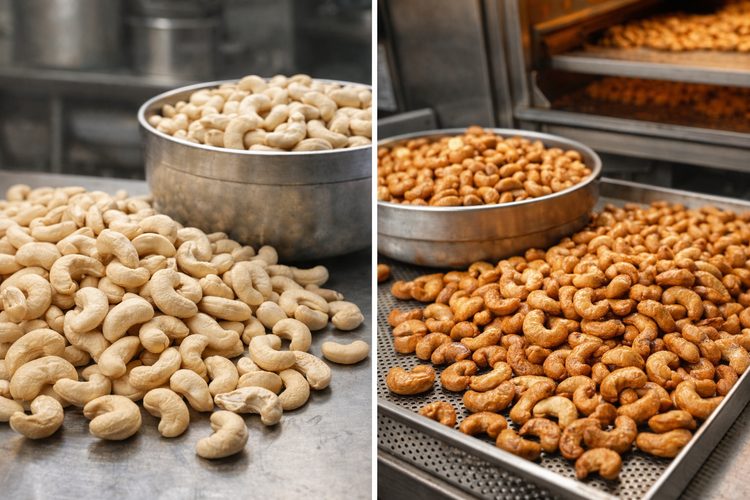
For most commercial buyers, the raw-versus-roasted question is not a simple taste decision. It is a specification decision that affects how the ingredient behaves in production, how much value is added before shipment, how packaging is selected, how shelf-life is discussed, and how landed cost should be compared. A quote for raw cashews cannot be judged on the same basis as a quote for dry roasted or oil roasted cashews because the process route, yield assumptions, labor inputs and finished application risks are different.
That is why experienced purchasing teams usually define the end use first and then work backward toward the correct cashew format. A snack packer, a bakery manufacturer, a nut butter producer, a confectionery processor and a foodservice distributor may all buy cashews, but their ideal commercial format can differ substantially even when the same kernel family is involved.
Core buyer takeaway: The right commercial format is the one that best aligns flavor target, texture target, process responsibility, packaging format, destination market and repeat purchasing cadence. Buyers who decide only from a headline price often create extra roasting cost, breakage, flavor inconsistency or avoidable supply-chain complexity later.
Why raw vs. roasted changes the commercial conversation
Raw cashews and roasted cashews may begin from the same basic kernel stream, but they serve different operational roles. Raw material is often preferred when the customer wants flexibility. It can be roasted later, seasoned later, ground into butter or paste, converted into dairy-alternative applications, coated in confectionery systems, included in bakery mixes, or processed into diced, meal or flour according to the buyer’s own process controls. In other words, raw cashews leave more of the final product development and transformation work with the customer.
Roasted material shifts part of that process burden upstream. The buyer receives a product with developed flavor, altered moisture profile, a more immediate eating quality and a more finished sensory character. That can simplify production in some categories, especially for direct snack packing, topping applications, foodservice use and short-process manufacturing where the customer does not want to install or manage a roasting step.
Commercially, this difference matters because the supplier quote should reflect more than the kernel itself. It should reflect process stage, roasting style, tolerance expectations, seasoning needs if any, packing method, and the degree of readiness the buyer actually requires.
Understanding the common commercial cashew formats
Buyers comparing raw and roasted material should also remember that “cashews” is not one single line item. Commercial supply can be structured around whole kernels, splits, pieces, diced grades, granulated formats, meal, flour, butter, paste and application-specific finished items. Roast style can then be layered onto some of those forms. The practical purchasing decision is often a format matrix rather than a single yes-or-no choice.
Common raw-oriented cashew buying formats
Raw cashews are frequently purchased as whole kernels, splits or pieces for manufacturers that plan to roast, coat, grind or otherwise transform the product in-house. In this route, the buyer typically values processing flexibility, control over roast profile, control over salt or seasoning application and the ability to align flavor development with the final brand standard. Raw kernels can also support multiple product outputs from one procurement stream, such as reserving some volume for roasting, some for paste and some for inclusion preparation.
Common roasted-oriented cashew buying formats
Roasted cashews are often chosen as dry roasted whole kernels, oil roasted snack kernels, roasted salted retail formats, roasted diced inclusion formats, or ready-to-pack foodservice and private label lines. In these cases, the customer is usually buying a more application-ready ingredient. The commercial upside can be reduced in-house processing load, less equipment burden, simpler labor planning and faster deployment into finished packaging or downstream recipes.
Technical differences between raw and roasted cashews
From a product performance standpoint, roasting influences flavor intensity, aroma development, color, crunch, surface dryness and perceived richness. Raw cashews generally present a milder, creamier and less developed flavor. That can be useful in applications where the nut should not overpower other ingredients, or where the manufacturer plans to build flavor in a later stage such as baking, confectionery cooking, spice coating or nut butter roasting.
Roasting develops a more recognizable finished cashew character. Depending on the roast style, the product may become firmer, more aromatic, more brittle or more immediately snackable. This can be highly desirable in retail snacks, bar toppings, salad toppers, trail mixes, granola clusters and premium foodservice garnishes. However, a roasted product may also behave differently during secondary processing. If it is baked again, mixed aggressively, coated under heat or stored in high-fat systems, the buyer should consider whether the roast profile is appropriate for that second exposure.
Flavor development
Raw cashews offer a neutral starting point relative to roasted material. They work well when the buyer wants to control flavor development internally, produce a house roast, add custom seasoning or preserve a softer nut note in blended applications. Roasted cashews deliver a more complete flavor profile at arrival, which can shorten the path to market in finished snack and inclusion programs.
Texture behavior
Texture can be just as important as flavor. Raw cashews can be more suitable when the buyer intends to soak, grind or convert the material into smooth or creamy systems. Roasted cashews are typically favored when immediate crunch, firm bite or visible premium inclusion character is required. The buyer should also consider that roasted kernels may be more fragile in some handling environments depending on roast level and pack-out method.
Appearance and color
Retail-facing categories often care about visual uniformity. Whole roasted kernels used in jars, pouches or foodservice toppings may need more consistent surface color and finished appearance than raw material being sent to an industrial grinder. If a program is consumer-facing, color expectation should be part of the quote request, especially when the product will be sold in transparent packaging or as a garnish on premium menu items.
Oil release and process response
Cashews are naturally oil-bearing, so roast and grinding decisions influence oil release, flow behavior and processing response in products such as nut butters, fillings and bakery systems. A buyer specifying material for a butter or paste line should think beyond whole-kernel cost and ask what format supports the desired spreadability, viscosity, flavor intensity and clean label target.
Dry roasted vs. oil roasted
The roasted category itself should be separated into at least two broad routes: dry roasted and oil roasted. These are not interchangeable from a technical or labeling standpoint. Dry roasted cashews are often preferred by brands that want a simpler ingredient presentation, less added process oil and a roast profile centered on the kernel itself. Oil roasted cashews can offer a different mouthfeel and can support certain flavor systems, salt adhesion or seasoning performance more effectively depending on the finished application.
For snack brands and private label programs, this distinction matters because it affects ingredient deck, sensory profile, nutritional presentation, process consistency and buyer expectations around surface finish. For industrial users, the distinction matters because extra process oil may or may not be desirable in the final formulation.
Where raw cashews usually make the most sense
Raw cashews are often the stronger option when the customer is still adding major value after purchase. Typical examples include:
- Manufacturers producing their own roast profile for branded snack lines
- Processors making cashew butter, paste, cream bases or plant-based dairy components
- Confectionery operations that coat, enrobe or cook nuts into brittle, clusters or fillings
- Bakery manufacturers that want the nut to roast further in cookies, bars, granola or savory dough systems
- Industrial buyers seeking one flexible raw input that can be converted into several finished formats
In these situations, buying roasted product too early in the chain can reduce flexibility. It may also create duplicated thermal exposure, which can shift flavor or texture away from the final target.
Where roasted cashews usually make the most sense
Roasted cashews are often the better commercial choice when the buyer wants a faster route into finished saleable product or immediate sensory performance without additional roasting infrastructure. Typical examples include:
- Retail snack packers filling pouches, jars, canisters or multipack formats
- Foodservice distributors offering ready-to-use toppings or menu components
- Manufacturers using roasted pieces or diced kernels as visible inclusions in premium mixes
- Private label programs where consistent finished eating quality matters more than internal process flexibility
- Import and distribution programs where the buyer wants a more complete ready-to-sell format
In these cases, roasted product can reduce production steps, lower labor demand and simplify equipment planning. That operational value should be part of the cost comparison, not ignored.
Applications by sector
Snacks and retail packing
Snack applications often favor roasted cashews because the finished eating experience is central to the product. Buyers may compare whole roasted kernels, salted or unsalted variations, flavored roasted programs, mixed-nut blend formats and premium gift-pack presentations. For these programs, factors such as roast uniformity, breakage control, flavor carry, pack fill appearance and shelf presentation are commercially significant.
Bakery and cereal
Bakery users may choose either raw or roasted material depending on whether the nut will be baked again and what texture is expected in the finished item. Raw pieces can be attractive where the oven step will further develop flavor. Roasted pieces may be useful when the nut is added late, used as a topping or included in a lower-heat application where finished roast notes should already be present.
Confectionery and inclusions
Confectionery programs often depend on the broader formula. Raw cashews may be appropriate for sugar coating, praline work, caramel systems and secondary cooking. Roasted cashews may be preferred where immediate roasted flavor is a key sensory cue. Buyers should specify whether the application is bar inclusion, cluster manufacturing, panning, enrobing or premium gifting because those routes can influence the right format.
Plant-based dairy and spreads
For cashew creams, sauces, cultured alternatives, plant-based cheese analogues and nut butters, raw cashews are often a logical starting point because they offer processing flexibility and a cleaner base flavor for formulation. That said, some butter or spread concepts may deliberately use roasted material to deepen flavor and reduce the need for separate roast development. The correct choice depends on target taste, label strategy and production design.
Foodservice and hospitality
Foodservice buyers frequently prioritize convenience, immediate appearance and consistent table-ready performance. Roasted whole kernels, roasted halves and roasted pieces can work well in buffet toppings, salad bars, plated dessert finishing, premium rice dishes and grab-and-go snack cups. In contrast, commissary kitchens or large-scale operators with their own finishing capabilities may still choose raw material if it better fits their prep workflow.
What buyers should specify before asking for a quote
One of the most common causes of slow or unclear pricing is an incomplete inquiry. “Quote cashews” is rarely enough for a commercial program. Atlas generally encourages customers to define the commercial need in a more practical way so that offers can be compared on real equivalence.
Minimum useful specification points
- Whether the product should be raw, pasteurized raw, dry roasted or oil roasted
- Preferred form such as whole kernels, splits, pieces, diced, granulated, meal, flour, butter or paste
- Intended end use such as snack packing, bakery inclusion, cereal topping, confectionery, plant-based dairy or industrial grinding
- Target pack style such as bulk cartons, lined cases, foodservice packs, retail-ready pouches or private label configuration
- Destination market and whether the program is domestic or export-oriented
- Estimated trial quantity, monthly volume or container rhythm
- Required timing such as spot requirement, launch date or repeat replenishment cycle
- Any sensory, labeling or process constraints that affect the roast route
How packaging decisions change the correct format
Packaging is often treated as an afterthought, but for commercial nut programs it can materially affect the right sourcing route. Industrial bulk buyers may prioritize pack integrity, pallet efficiency, lot traceability and stable arrival condition. Foodservice buyers may want more manageable units with immediate open-and-use practicality. Retail and private label buyers may need finished roasted product because the packaging program is built around direct sale rather than further processing.
Export programs add another layer. Once the buyer introduces longer transit paths, regional labeling rules, distributor handling variability and container-planning considerations, the raw-versus-roasted question should be tied to total program design. In some cases the importer wants a more finished roasted product to reduce downstream complexity. In others, the importer prefers raw material because final processing will be localized for market adaptation.
Commercial cost logic: price per pound is not the full comparison
Many buyers start with the assumption that raw product is simply cheaper and roasted product is simply more expensive. On a nominal basis that may often be directionally true because roasting adds process value. But the better buyer question is whether the total delivered and usable cost is lower for the actual application.
A raw program may require roasting equipment, labor, yield management, seasoning capability, validation time, process controls and extra production scheduling. A roasted program may cost more on paper but reduce internal handling, accelerate launch timing and improve finished consistency. The commercial answer depends on the buyer’s own operation. Strong procurement teams compare not only invoice price, but also process burden, production efficiency, waste risk, and whether the chosen format supports continuity.
Useful commercial questions to ask internally
- Are we buying an ingredient to transform or a component to use as-is?
- Do we have the equipment and labor to roast consistently at our target volume?
- Will the product face another heat step after arrival?
- Does our label strategy favor dry roasted or another route?
- Is the nut a visible hero ingredient or a background formulation input?
- Do we need a flexible raw stream for multiple outputs, or a finished roasted stream for speed?
Quality and handling considerations
Even when the buyer has chosen raw or roasted, quality alignment still matters. Cashew programs should be discussed in terms of consistency, packing integrity, application fit and suitability for the destination market. For customer-facing products, the buyer may care about appearance, uniformity and flavor repeatability. For industrial transformation, the buyer may care more about how the product performs in grinding, blending, secondary roasting or inclusion processing.
Handling expectations should also be matched to the chosen format. Whole roasted kernels for retail or gift programs may need more careful breakage management than raw material intended for further processing. Likewise, diced or piece formats for bakery and confectionery may be specified differently from whole-kernel snack formats even when both are roasted.
Practical sourcing note: The more consumer-visible the final application, the more important it becomes to define roast style, appearance expectations and pack presentation early. The more industrial the application, the more important it becomes to define process fit, transformation route and cost-in-use logic.
How this topic shows up in real buying decisions
In real procurement workflows, the raw-versus-roasted choice usually appears during one of four moments: initial product development, cost review, supplier transition or packaging redesign. A brand launching a new snack line may start with roasted product because it needs speed and finished flavor. A manufacturer scaling plant-based formulations may migrate toward raw material because it wants more control and internal flexibility. A distributor entering export markets may reconsider pack style and degree of finish based on destination requirements and logistics rhythm. A private label customer may shift from raw sourcing to roasted sourcing simply because repeatability and faster commercialization become more valuable than in-house transformation.
This is why Atlas treats format selection as part of commercial planning rather than a narrow product checkbox. The strongest programs are the ones where the inquiry, quotation and production route all tell the same story.
What Atlas would ask before quoting
Before quoting raw or roasted cashews, Atlas would usually try to understand how the product is expected to function in the customer’s business. A better inquiry is not only “quote roasted cashews,” but “quote dry roasted whole kernels for premium snack packing,” or “quote raw cashew pieces for grinding into plant-based sauces,” or “quote roasted diced cashews for bakery topping applications.” That level of definition improves price comparability and reduces costly misunderstanding.
Typical Atlas questions would include the intended end use, preferred format, whether the product is visible to the consumer, whether secondary processing will occur, what pack style is required, what the destination market is, and whether the program begins with a trial, a validation run or a repeat monthly volume. Those details help turn a general inquiry into a usable commercial brief.
Commercial planning points
Buyers should think in stages. A well-structured cashew program often begins with a sample or trial quantity, then moves to a plant validation run, then to launch volume, and finally into a repeat replenishment cadence. The right format at sample stage may not always be the right format for long-term cost efficiency, so it is useful to plan the full path early.
Commercial planning should also distinguish between industrial bulk, foodservice, retail-ready, private label and export-oriented programs. Those categories drive different assumptions around pack sizes, documentation, label coordination, shipment frequency and the degree of finished processing required before arrival.
For instance, a bulk ingredient user may prioritize manufacturing efficiency and process control, while a private label customer may prioritize finished roast consistency and presentation. Export buyers may also need earlier planning on pack dimensions, labeling workflow, container loading assumptions and channel strategy. The clearer this is at inquiry stage, the more commercially useful the quote becomes.
A simple decision framework for buyers
If the customer is creating the final sensory profile in-house, wants one flexible input for multiple outputs, or expects major secondary processing, raw cashews may be the better starting point. If the customer wants a more finished product, immediate flavor performance, less production burden and faster integration into saleable packs or menu applications, roasted cashews may be the stronger fit. If the customer still needs seasoning or special flavor systems, the roasted route should be specified even more carefully, especially when deciding between dry roasted and oil roasted formats.
Buyer planning note
Atlas Global Trading Co. uses topics like this to move conversations from general interest to practical specification. If you are comparing raw versus roasted cashews for a real program, send the intended application, preferred format, packaging style, destination and estimated volume. That makes it easier to align the inquiry with the most commercially relevant cashew route, whether the need is for industrial manufacturing, foodservice, private label or export distribution.
Need help choosing the right cashew format?
Atlas can help translate your product idea into a quote request that reflects application, roast route, packaging and commercial timing.
- State raw, dry roasted or oil roasted requirement
- Add whole, piece, diced or processed format details
- Include destination, timeline and expected volume rhythm
What a strong RFQ for this cashew topic looks like
A strong request for quotation saves time on both sides. Instead of requesting a generic cashew price, buyers can accelerate the process by using a brief like the following:
Sample RFQ structure: “Please quote dry roasted whole cashews for retail snack packing, unsalted, bulk packed for repacking, initial trial quantity followed by monthly volume, destination Middle East, target launch in Q3.”
That level of detail helps connect the product to its actual commercial use. It also makes it easier to compare supplier offers on equivalent terms rather than comparing incomplete or mismatched quotations.
Frequently Asked Questions
When should a buyer choose raw cashews instead of roasted cashews?
Raw cashews are usually the stronger choice when the buyer will roast, season, grind, coat or otherwise process the material further. They are especially useful when the customer wants more control over final flavor, process timing and application flexibility.
When do roasted cashews make more commercial sense?
Roasted cashews often make more sense when the buyer wants a more ready-to-use product with developed flavor, less internal processing burden and faster movement into snack packing, toppings, foodservice or private label formats.
Is dry roasted the same as oil roasted for commercial buying?
No. Dry roasted and oil roasted cashews are different commercial formats. They can differ in mouthfeel, surface characteristics, seasoning behavior, labeling implications and fit for certain end uses. The roast route should be stated clearly in the inquiry.
What should be included in a quote request for raw or roasted cashews?
A strong quote request should specify product form, whether the material is raw or roasted, intended use, packaging style, destination market, estimated volume, and target shipment timing. The clearer the application, the more useful the quote.
Can the same logic be used for both domestic and export programs?
Yes. The same decision framework applies to U.S. and export programs, although export-oriented business may require additional planning around packaging, labeling, documentation and shipment cadence.