Kernel, paste or butter?
The answer usually depends on plant capability, desired smoothness, labor model and repeatability requirements.
Practical notes on cashew formats, sauce texture, solids contribution, flavor direction and key buying considerations for industrial sauce programs.
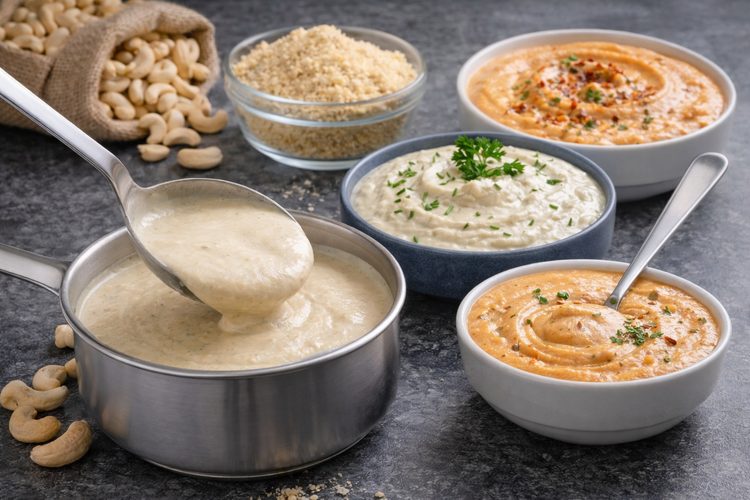
Cashews are increasingly used in sauce systems because they can solve several formulation problems at once. They can contribute body, soft richness, visual opacity, mild nut flavor and a more premium mouthfeel without forcing a product into a strongly nut-forward profile. That makes them commercially useful across plant-based sauces, culinary bases, chilled dips, premium emulsified systems and smooth retail spreads. For buyers, however, “cashews for sauce” is too broad a starting point. Sauce performance depends on the exact ingredient form, how that ingredient is processed, and what the finished sauce is expected to do on line and on shelf.
In buyer terms, cashews in sauce systems are not only an ingredient decision. They are also a process-route decision. A buyer may choose raw kernels for in-house soaking and wet grinding, pasteurized kernels for risk-managed processing, fine meal or flour for solids contribution, or finished butter or paste for simpler batching. Each route changes labor requirement, throughput, texture, oil behavior, packaging type and total delivered cost. The best commercial outcome normally comes from aligning those variables before the quote is requested rather than after development has already started.
This topic matters because sauce systems are especially sensitive to specification mismatch. A cashew format that works in a thick spoonable dip may not deliver the right smoothness in a pumpable sauce. A butter that brings the desired richness in a premium spread may create too much oil expression in a high-acid emulsion if dispersion is not handled properly. A flour that helps with solids loading may not deliver the same finish as a wet-ground paste. In other words, smoothness, solids and flavor should be planned together.
Real buyers typically begin with a product target rather than an ingredient target. They may want a sauce that pours cleanly but still feels rich, a chilled dip with a premium dairy-free texture, a shelf-stable spread with controlled separation, or a foodservice sauce that can be reheated without breaking. Once the commercial target is clear, the cashew specification becomes easier to define.
In practice, buyers usually compare raw kernels, pasteurized kernels, meal, fine flour, cashew paste and cashew butter. The right choice depends on several overlapping questions. How smooth does the finished sauce need to be? How much solids must the cashew contribute relative to starches, oils or other plant ingredients? Is the flavor intended to be neutral, mildly nutty or more developed? Will the sauce be hot-filled, chilled, frozen, retorted or simply blended and packed? Does the plant have wet grinding capability, or would a pre-processed cashew format reduce operational complexity?
For many buyers, the commercial logic changes with the route to market. A pilot-stage brand may prefer paste or butter to avoid capital-intensive preparation. A larger manufacturer may choose kernels because in-house wet grinding offers better cost control at scale. A private label program may focus more heavily on repeatability and pack-ready performance than on theoretical ingredient flexibility. Atlas therefore encourages buyers to define both the product goal and the production reality before discussing price.
Functionally, cashews can contribute several different things in the same formula. First, they provide solids. Those solids help create body, opacity and a more substantial mouthfeel. Second, they contribute fat and a naturally rounded richness that can reduce the need for more assertive fat systems. Third, when properly hydrated and milled, they can support a smooth and cohesive texture that is especially valuable in dairy-free sauce development. Fourth, they provide a mild flavor note that is often easier to build around than stronger nuts.
What matters commercially is that not every sauce needs all of those functions in equal measure. Some systems use cashews mainly for creamy solids. Others use them as a premium flavor-and-body component within a broader emulsion. Others use them to help bridge the gap between label goals and texture requirements in plant-based formulas. The quote request should therefore state what the cashew is expected to do. Is it there to replace part of a dairy system? To create indulgence? To soften sharper acid or spice notes? To improve cling on a finished sauce? To support a smoother finish than a starch-heavy system can offer on its own? The answer affects format choice.
Buyers often say they want a smooth sauce, but smoothness is not a single variable. In sauce systems it can mean absence of grit, low visible particulate, even viscosity, consistent coating behavior and a clean finish on the palate. A formulation may contain enough cashew solids to feel rich but still fail if the dispersion is uneven or the grind is not fine enough for the intended application.
This is why smoothness should be discussed separately from overall solids loading. A medium-body dip may tolerate more textural character than a premium table sauce. A spread may need a satin finish rather than a perfectly fluid pour. A pumpable foodservice sauce may need smoothness for equipment reasons, not only sensory reasons. In technical terms, buyers should try to describe whether they need a spoonable creamy system, a glossy finished sauce, a dense emulsified spread or a lighter pourable base. Those distinctions help determine whether kernels, paste, butter or flour are the more commercially sensible input.
For Atlas, this usually becomes a question of process route. If the customer needs very high smoothness and already has strong wet milling capacity, kernels may work. If the customer wants consistent smoothness with less line complexity, paste or butter may offer a better commercial starting point. If the system only needs solids contribution and minor thickening support, a flour route may sometimes be considered, though it produces a different texture profile than wet-ground formats.
Cashews are useful in sauce systems because they can contribute body in a way that often feels more natural and less sharply thickened than starch-only solutions. In practical terms, the solids coming from cashews can help create cling, opacity, spoonability and a richer perception of the whole formula. This is one reason they appear so often in plant-based cheese-style sauces, creamy cooking sauces, dips and premium dressings or spreads.
However, the buyer should not think of “cashew solids” as a generic metric. Different formats deliver solids differently. Whole kernels ground into a wet slurry behave differently from a finished butter or a fine flour. Hydration, shear and temperature all influence how those solids express themselves in the sauce. A buyer looking only at nominal inclusion percentage may miss the real processing effect. From a commercial standpoint, that matters because the least expensive cashew option on paper is not always the most efficient one in plant operation or finished product performance.
Atlas generally encourages buyers to define whether cashews are acting as the primary body source or one body source among several. If the sauce depends heavily on cashew solids, then format consistency and process compatibility become more important. If cashews are only part of a broader structure system, the buyer may have more flexibility in format selection.
One of the reasons cashews work so well in sauces is that their flavor profile is comparatively adaptable. Raw or lightly processed cashews can support a mild, creamy and relatively neutral base. Roasted or more developed cashew formats can add warmer, richer and more nut-forward notes. Both directions are commercially useful, but the right one depends on the target sauce.
For example, a plant-based alfredo-style sauce or neutral white dip may benefit from a cleaner cashew profile that lets herbs, acids or savory seasonings define the final direction. A more indulgent spread, a premium savory dip or a culinary sauce with richer positioning may intentionally use a more developed cashew note as part of the identity. A buyer should therefore decide whether the cashew flavor should disappear into the system, support it quietly, or become part of the selling point.
This also affects sourcing language. Asking for “cashew ingredient for sauce” without explaining the desired flavor outcome can produce the wrong commercial comparison. Buyers should indicate whether they are looking for minimal flavor intrusion, moderate nut richness or a deliberately premium nut-forward tone. That helps determine whether raw kernels, pasteurized kernels, standard paste or roasted butter-like formats make the most sense.
Typical use cases for cashews on this website include snacks, bakery, confectionery, plant-based dairy and spreads. For sauce systems, the product brief should define whether the project is a pourable sauce, spoonable dip, finished spread, cooking base, plant-based dairy application or another creamy savory system.
from a buyer's perspective, the choice of cashew format is usually where technical and commercial decisions meet. Raw kernels give the buyer maximum control over soaking, hydration and wet grinding, but they also require equipment, labor and process consistency. Pasteurized kernels may be preferable when the customer wants a more controlled microbial risk position or a specified process route. Cashew paste can reduce line complexity and improve repeatability. Cashew butter can move the buyer closer to a ready-to-use format, especially in spread and dip systems. Meal and fine flour may work where solids contribution matters more than extremely high-end smoothness, or where the cashew is only part of a multi-ingredient structure system.
There is no universally best format. The right one depends on plant capability, target texture, finished flavor, pack style and cost model. Atlas would usually encourage buyers to describe what happens in the plant after receipt. Is the ingredient hydrated? Is it dispersed hot or cold? Is there a high-shear step? Is the sauce retorted, chilled, frozen or hot-filled? Does the buyer need an ingredient that can batch quickly with low operator intervention? These questions often matter more than the ingredient name alone.
Some buyers focus heavily on ingredient specification but underweight the effect of the process route. In sauce systems, the same cashew ingredient can perform differently depending on soak time, water ratio, shear intensity, thermal load, order of addition and interaction with acids, salts, hydrocolloids or oils. A commercial program should therefore be built around real processing conditions, not idealized bench assumptions.
For example, a high-shear plant may extract excellent smoothness from kernels and achieve strong cost efficiency at scale. A smaller or faster-moving operation may find that paste or butter reduces batch variability and labor dependence. A foodservice sauce with frequent production changes may benefit from simpler staging and quicker dispersion. In each case, the best sourcing route is the one that helps the plant hit repeatable performance while staying commercially realistic.
This is also where packaging starts to matter. Kernels may arrive in bulk formats suited to industrial handling. Paste or butter may come in pails, drums or other containers that affect staging and batch room flow. The “best” ingredient is sometimes the one that most cleanly fits the production environment rather than the one with the lowest nominal raw cost.
Atlas encourages sauce-system buyers to define intended use, pack style, destination, timeline and quality expectations early. For this topic, though, a stronger brief usually includes a few additional details. Buyers should ideally state the target sauce type, desired smoothness level, solids objective, flavor direction, preferred ingredient form, process route and whether the system is chilled, frozen, hot-filled, retorted or shelf-stable.
It is also helpful to explain the operational context. Is the buyer formulating in-house from kernels? Looking for a semi-processed ingredient to reduce labor? Buying for a contract manufacturer? Building a private label line that needs tighter repeatability? Shipping into export markets with longer shelf-life expectations? These inputs reduce avoidable back-and-forth and help make supplier comparisons more meaningful.
Where possible, the quote request should also mention whether the program is industrial bulk, foodservice, retail-ready, private label or export-oriented. Even in sauce systems, that single clarification often changes packaging, documentation and timing assumptions. A bulk ingredient for further manufacture is not the same project as a finished consumer spread or a branded dip line.
From a trading standpoint, the best sauce programs are built around repeatability rather than emergency problem-solving. That means buyers should think beyond first-sample success and plan for consistent supply, stable ingredient behavior, agreed packaging and realistic shipment cadence. In many projects the commercial stages are fairly predictable: trial quantity, validation run, launch volume and repeat replenishment. Atlas uses that logic because the right ingredient route at trial stage may need refinement before full launch.
Cost should also be viewed in full-route terms. A cheaper kernel input may not be the lower-cost program if it increases soaking time, grinding demands, labor dependency or batch inconsistency. A more processed format may appear more expensive per unit but deliver lower total system cost through labor savings, higher repeatability or simpler plant integration. The correct commercial comparison therefore includes ingredient form, process burden, pack handling, documentation and production rhythm together.
When relevant, buyers should also consider storage and shelf-life implications. Cashew-based sauce inputs can be sensitive to how they are handled after opening or staging. Pack size, exposure time and batch frequency can all influence how well the ingredient performs before it reaches the finished product. This is especially important in premium or export-oriented systems where consistency across runs matters commercially.
In practical development work, the most common trade-offs are usually not dramatic. They are small but important. Does the buyer accept a slightly more rustic texture in exchange for easier processing? Do they want the cashew note to disappear or remain present? Is a higher-solids sauce acceptable if it creates better cling, or does the customer need a lighter pour? Is the buyer trying to reduce label complexity, improve premium texture or simply replace part of another fat system? Each choice pushes the ingredient route in a slightly different direction.
That is why Atlas frames this topic around smoothness, solids and flavor together. A sauce system rarely succeeds on one of those variables alone. A sauce can be rich but grainy. Smooth but thin. Flavorful but operationally difficult. The goal is to define the right balance before sourcing begins.
Atlas Global Trading Co. uses topics like this to move conversations from broad interest to a specification-minded inquiry. If you are evaluating cashews for sauce systems, share the target format, sauce type, pack style, estimated volume and destination using the floating contact form so the next step can be grounded in a real commercial need.
For many buyers, the strongest outcome comes from defining how the ingredient must behave in the plant and in the finished sauce before requesting a quote. Once the needed smoothness, solids contribution, flavor direction and commercial route are clear, the sourcing discussion becomes far more practical and comparable across California supply and processing options.
In sauce systems, buyers normally make better ingredient decisions when they define both the finished product target and the process route that has to deliver it.
The answer usually depends on plant capability, desired smoothness, labor model and repeatability requirements.
Different cashew formats support different flavor directions, from quiet background richness to more noticeable nut character.
Body and pourability often trade off against each other, so the solids target should reflect the real application.
A format that looks fine in pilot work may behave differently when scaled into real batching, heating and filling conditions.
The packaging, documentation and timing expectations change significantly depending on where the sauce is going next.
Commercial structure matters because initial development needs are not always the same as stable launch needs.
Use the contact form to turn your sauce development topic into a practical quote request for Atlas and its California processing partners.
The main buyer takeaway is that sauce performance improves when cashew format, grind profile, solids level, flavor target, packaging style and processing route are defined together before sourcing.
Common formats include raw kernels for wet grinding, pasteurized kernels, cashew paste, cashew butter, cashew meal and fine cashew flour. The right choice depends on smoothness, solids contribution, flavor and plant processing capability.
A sauce can have enough solids but still feel grainy if grind quality, hydration and dispersion are not right. Buyers often need to specify both body and smoothness because they are related but not identical outcomes.
Yes. The same sourcing logic applies to domestic and export sauce programs, although packaging, documentation, shelf-life expectations and shipment planning can vary by destination.