How long will the product really sit?
Transit, receiving delay, internal warehousing and slow consumption can add up. Shelf-life planning should reflect the real route, not only the ideal one.
Buyer guidance on shelf-life protection, warehouse handling, oxygen exposure, packaging selection and commercial planning for cashew ingredient programs.
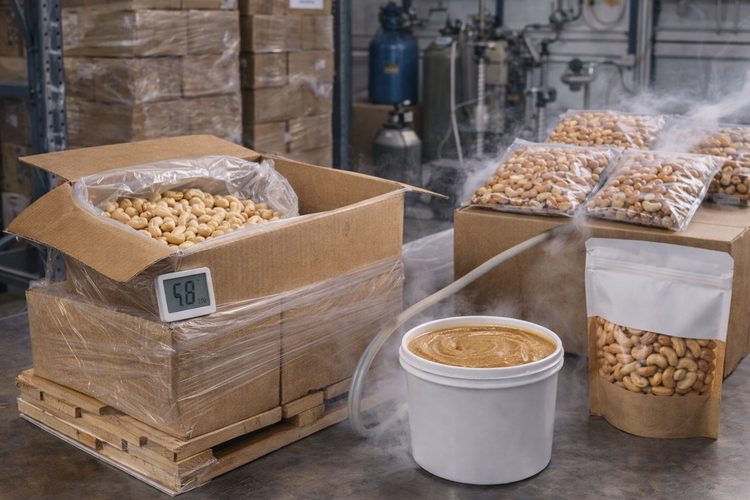
Storage and oxidation control for cashew ingredients matters because shelf-life performance is rarely determined by nominal product specification alone. The commercial outcome depends on how the cashews are processed, packed, stored, shipped, opened, used and replenished. A buyer can source the correct format on paper and still create avoidable quality problems if the storage model does not fit the product form or the route to market.
Cashews are a high-value nut ingredient often selected for premium flavor, creamy character and visual appeal. That value can erode quickly when warehouse temperature, oxygen exposure, barrier packaging, stock rotation and handling discipline are not aligned with the actual application. In buyer buying, the discussion therefore should not stop at “What cashew format do we need?” It should extend to “How will this format hold through our plant, our packaging system, our distribution model and our target shelf window?”
For Atlas, this is an important commercial topic because storage and oxidation risk influence more than product quality. They affect claims exposure, customer satisfaction, inventory economics, rework risk, freight planning and the practical life of the finished product after receipt. A technically sound cashew brief usually includes not only product form and application, but also expected shelf-life horizon, packaging barrier expectations, storage conditions and inventory cadence.
Cashews, like other nut ingredients, contain natural oils that can degrade over time when exposed to oxygen, heat, light and unfavorable storage conditions. From a buyer’s perspective, oxidation is not only a laboratory concept. It becomes visible and commercial through stale flavor, flattened aroma, bitterness, warmed-over notes, texture deterioration, color shift and reduced consumer acceptance. In some applications, oxidation also creates problems before the customer ever tastes the product, because the material may no longer flow, blend or present the way the buyer expected.
The risk profile is not the same across all cashew forms. Whole kernels packed well for short distribution may behave very differently from roasted pieces held in a warm warehouse, or from cashew butter exposed to repeated air entry after opening. Greater surface area generally increases exposure sensitivity. More aggressive processing can also change how quickly flavor drift becomes noticeable. That is why storage planning should be matched to format rather than treated as a generic warehouse instruction.
From a trading standpoint, oxidation control is closely tied to cost discipline. Buying too much product too early, selecting an under-engineered packaging format, or ignoring transit and warehouse conditions can create hidden losses that far outweigh a small price advantage on the front end. Good buyers therefore evaluate shelf-life protection as part of the landed cost discussion, not as an afterthought.
In real purchasing environments, storage and oxidation questions appear in several practical ways. A snack brand may notice flavor fade in roasted cashew pouches at the back end of the shelf-life window. A bakery may see inconsistent inclusion bite because diced cashews have softened after poor barrier storage. A plant-based developer may experience butter separation or flavor drift in a creamy formulation due to extended warm storage of the input paste. A distributor may discover that an export transit route exposes the product to more heat and time than the original domestic pack format was designed to withstand.
These are not isolated quality events. They are often signs that the buying brief did not fully connect product form, pack style and real storage conditions. For example, a buyer may focus on raw versus roasted selection but overlook how often the pack will be opened in production. Another may select a foodservice pack for cost reasons even though the product will move through a longer retail-style distribution chain. Others may ask for a long remaining shelf-life at receipt without discussing whether the order volume and replenishment cadence actually support that expectation.
That is why Atlas encourages buyers to treat storage planning as part of application planning. The correct cashew format is only one part of the answer. The broader question is how that format behaves over time in the intended commercial route.
Not every cashew ingredient carries the same risk profile. Whole kernels generally have lower exposed surface area than diced pieces, granules, meal or flour, although they still require good packaging and appropriate storage. Roasted kernels may be more flavor-sensitive than raw material depending on roast level, handling and end use. Size-reduced formats usually present more exposure because they have more broken surfaces, more fines and more opportunity for oxidative change to become noticeable in aroma and taste.
Cashew butter and paste require a different kind of attention. They may not show “staleness” the same way as a whole snack kernel, but they can still suffer from flavor drift, oil phase issues, headspace exposure and process-related variability if packed or stored poorly. Once a pail, drum or jar is opened repeatedly in production, the product can face a new storage reality very different from the original sealed condition. That should be considered when choosing container size and planned usage rate.
Meal and flour also deserve careful planning because their greater surface area can accelerate sensory change if oxygen and humidity control are weak. In dry blend systems, flavor drift may be partially masked by other ingredients, but in premium bakery, savory coatings or clean-label applications, changes can become more noticeable. The right storage model depends on how exposed the format is and how sensitive the finished application is to even small shifts in flavor or texture.
For most cashew programs, three pressures drive the commercial shelf-life discussion: temperature, oxygen and time. Temperature matters because warm storage conditions accelerate deterioration and can make natural oils behave differently in kernels, pieces and butter systems. Oxygen matters because exposure over time contributes to oxidative flavor change, especially when packaging barriers are weak or opened packs remain in use too long. Time matters because even a well-packed ingredient is still moving along a freshness curve from the moment it is processed and packed.
These pressures do not operate separately. A moderate oxygen exposure may be manageable over a short period in controlled storage, but more problematic over a long hot transit route. A product with excellent initial quality can still disappoint if it sits in a warm receiving area, is transferred into poor secondary containers, or moves slowly through internal inventory. This is why buyers should think in full route terms: supplier pack, transit conditions, warehouse condition, internal handling, open-pack life and finished application shelf expectations.
Commercially, the goal is not to eliminate all risk completely. It is to design a storage and packing system proportionate to the product’s sensitivity and the business model. A fast-moving industrial ingredient program may tolerate a different solution than a premium export retail line or a specialty butter intended for extended finished-goods shelf life.
In many cashew projects, packaging is the main physical control between a stable ingredient and a declining one. Buyers sometimes focus on unit size, pallet efficiency or packaging cost while underestimating barrier performance, seal integrity and headspace management. Yet for many cashew forms, those details strongly influence how flavor, crunch, aroma and visual quality hold over time.
Barrier needs vary by format and route. Whole kernels in industrial packs may need a different protection model than roasted snack pouches or cashew butter in foodservice tubs. Vacuum or nitrogen-managed systems may be relevant in some programs, while others rely more on high-barrier materials and controlled turnover. The right answer depends on how long the product must hold, how often the pack will be opened, whether the route includes export transit, and whether the final customer experiences the ingredient directly or inside a formulated food.
Seal quality also matters. A strong film or liner does not solve the problem if the closure system is inconsistent or the pack is damaged in warehouse handling. For this reason, pack design and logistics discipline should be evaluated together. A packaging format that looks cost-efficient on paper may underperform if it is fragile in storage, poorly resealable after opening or poorly suited to the customer’s actual handling process.
Many oxidation problems are not caused at origin. They happen after receipt because the customer’s storage system is not aligned with the ingredient. Cashews may be held near heat sources, near direct light exposure, in variable ambient conditions or in spaces where opened packs remain unprotected. In industrial settings, an otherwise stable pack can lose protection once operators transfer the ingredient into secondary bins without adequate sealing or leave part-used material in production for too long.
That is why inventory discipline matters commercially. First-in, first-out rotation is basic, but not always enough. Buyers should also think about how much material is opened at once, how quickly an opened pack is consumed, whether partial packs are reclosed effectively, and whether lot identity remains visible after internal transfer. Those details matter for freshness, traceability and complaint investigation alike.
Warehouse planning also affects quote structure. If the buyer expects to hold inventory for a long time, they may need a different pack format, different order cadence or a different processing state than a buyer that consumes product rapidly. In some cases, more frequent replenishment can be commercially better than a large purchase that appears cheaper upfront but increases freshness risk and working capital pressure.
Raw whole cashews may suit buyers who plan downstream roasting or further processing and want more flexibility at receipt. Roasted cashews may be closer to immediate use but can require tighter attention to packaging, storage temperature and open-pack life. Diced, granulated and meal forms are convenient in production, yet they often need more discipline because smaller particle size usually increases exposure and can change texture faster if the package protection is weak.
Cashew flour introduces additional commercial questions around flowability, oil expression, caking risk, aroma retention and blend consistency. A flour that remains acceptable in one dry mix application may become problematic in another if the warehouse is warm or if the material is opened and reused slowly. Cashew butter requires its own handling logic because pack size, usage frequency, headspace, mixing needs and oil separation tolerance can all shape the buyer’s experience after opening.
For that reason, Atlas encourages buyers to avoid copying one storage approach across every cashew format. The most practical storage recommendation is format-specific and application-specific, not generic.
Typical use cases for cashews on this website include snacks, bakery, confectionery, plant-based dairy and spreads. The right storage model depends on whether the cashew is a visible inclusion, a milled ingredient, a creamy base, a foodservice item or a retail-ready finished product.
Before quoting a cashew program where shelf-life and oxidation control matter, Atlas would usually ask about the actual format, the end application, the required remaining shelf life at delivery, the expected storage condition after receipt and the type of packaging needed. A buyer asking for roasted diced cashews for industrial use should not necessarily receive the same commercial recommendation as a buyer asking for roasted wholes in export retail packs or cashew butter for a sauce system.
Atlas would also ask how quickly the product will be used once opened. This is especially relevant for butter, paste, flour and piece formats. Pack size should match operational reality. An oversized container may offer a lower packaging cost per unit but create more repeated exposure during usage. A smaller pack may cost more per kilogram yet perform better operationally and reduce waste, flavor fade or handling inconsistency.
Destination and transit profile are also important. Domestic programs with short transit and fast turn may support one packaging approach, while long export routes with variable climate or extended warehousing may require stronger barrier logic and more conservative commercial planning. These details help reduce avoidable back-and-forth and improve alignment between technical protection and actual supply chain conditions.
From a trade perspective, the best cashew programs are designed for repeatable quality at the moment of use, not only at the moment of shipment. That means buyers should consider the full cost of deterioration risk, not just invoice price. If a cheaper pack format increases breakage, flavor drift, waste, complaints or rework, then it may not be cheaper in real terms. The correct commercial structure often comes from balancing ingredient cost, packaging cost, warehouse reality, turnover speed and shelf-life target together.
Order cadence is one of the most important commercial levers. A large volume buy can appear efficient, but it may expose the customer to longer storage, more open-pack handling and greater flavor risk. Conversely, smaller replenishment cycles may support fresher product use and lower working capital, depending on freight structure and operational rhythm. The correct answer depends on the specific program, but the question should always be asked.
It is also useful to distinguish between industrial bulk, foodservice, retail-ready, private label and export-oriented programs because channel structure changes the packaging and shelf-life logic. An industrial customer may repack or process quickly after receipt. A retail program may need the product to hold through warehousing, distribution, shelf placement and end-customer consumption. An export program may need additional buffer for time in transit and variable destination conditions. These are not small details; they are core commercial inputs.
Buyers sometimes evaluate oxidation only at the raw ingredient level, but its commercial effect often appears in the finished product. In a premium snack mix, stale cashew notes can pull down the perceived quality of the whole blend. In bakery, softened or flavor-faded inclusions can weaken a premium claim. In plant-based dairy or sauce systems, aged butter or paste can shift the flavor profile away from the desired creamy, rounded character. In dry mixes or coatings, quality drift may surface through aroma, color or overall eating quality.
This matters because the cost of failure usually rises the further the ingredient moves through the value chain. A storage mistake discovered before production is one problem. The same issue discovered after finished goods are packed, distributed or sold is much more expensive. That is why storage and oxidation control deserve the same early planning attention as format selection or packaging style.
A useful buyer brief for this topic usually includes the product format, process state, intended application, expected shelf window, packaging type, destination, storage environment and consumption pattern after opening. For example, a buyer may specify roasted cashew pieces for cereal use, industrial bulk packing, monthly replenishment, ambient storage in a controlled warehouse and fast use after opening. Another may specify cashew butter for plant-based sauce production, packed into pails, used over several days after opening, with emphasis on flavor stability and manageable headspace exposure.
The point is not to make the brief overly complicated. It is to give the supplier enough operational context to recommend a format and packaging route that matches how the product will actually live in the supply chain. Better inputs produce better commercial guidance.
Atlas Global Trading Co. uses topics like this to move buyers from broad ingredient interest to a more specification-minded conversation. Storage and oxidation control are especially important in cashew programs because these ingredients are often chosen for premium eating quality, creamy functionality and visible product value. Preserving those advantages requires more than selecting the right SKU name.
If you are evaluating cashew supply, Atlas encourages you to share the exact format, the end application, the pack style, the expected inventory rhythm and the destination market. Those details help determine whether the stronger commercial solution is raw or roasted supply, whole or size-reduced format, industrial bulk or channel-specific packaging, and what kind of storage discipline the program should support from receipt through use.
Storage performance is rarely a warehouse-only issue. It affects product acceptance, replenishment strategy, pack choice and the type of cashew format that should be sourced in the first place.
Transit, receiving delay, internal warehousing and slow consumption can add up. Shelf-life planning should reflect the real route, not only the ideal one.
Repeated air exposure can change the risk profile, especially for butter, flour, meal and piece formats. Pack size should fit actual usage rate.
Ambient fluctuations, warm storage, direct light and inconsistent sealing after opening can shorten usable quality even when the incoming product is sound.
Some buyers are better served by roasting closer to use, while others need ready-to-use roasted material. The answer depends on process capability and time-to-use.
Premium snack and clean-label applications may show sensory changes sooner than highly seasoned or heavily formulated systems.
More frequent replenishment may support better freshness control than oversized inventory positions, even if the unit price looks slightly different.
Atlas can review your product form, application, storage environment and destination route so the quoted solution reflects both quality protection and practical commercial use.
The main takeaway is that cashew shelf-life is strongly affected by product form, roast level, packaging barrier, warehouse conditions and inventory discipline, so storage planning should be treated as part of the original buying decision.
In general, roasted formats, diced pieces, meal, flour and cashew butter are more exposure-sensitive than well-packed whole kernels because greater surface area and process intensity can accelerate flavor change if packaging and storage controls are weak.
Yes. Packaging barrier, seal integrity, oxygen exposure, headspace control and the suitability of the pack format for the distribution channel can materially affect how well cashew ingredients hold flavor, crunch, aroma and visual quality over time.
Yes. The storage and oxidation logic is relevant to both domestic and export programs, but long transit times, climate variation, repacking steps and destination-specific packaging expectations may require tighter commercial planning.