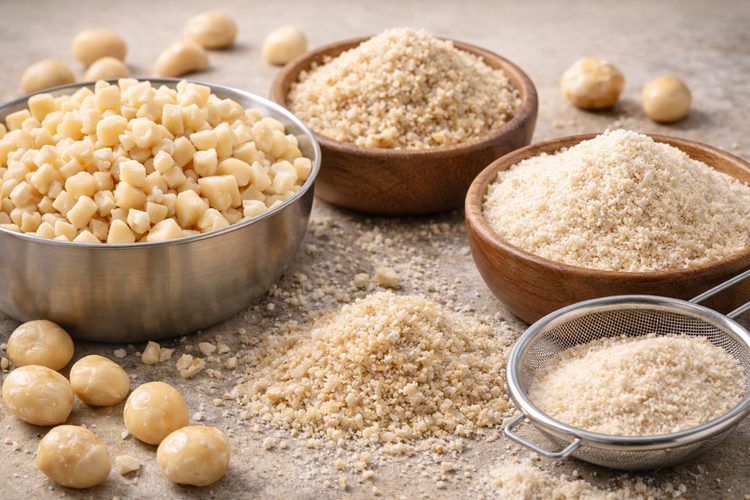
Specifying diced, meal and flour macadamia formats matters because industrial nut buying is rarely only about nominal price. The stronger commercial outcome usually comes from aligning cut specification, process route, packaging and shipment timing before the order is placed. For many buyers, the difference between a successful program and a frustrating one is not whether the ingredient is technically “macadamia,” but whether the particle profile behaves correctly in the actual production system.
That is especially true for secondary macadamia formats such as diced cuts, meal and flour. These products are often treated as interchangeable because they all originate from the same nut. In practice, they perform very differently. A diced format may be chosen for visible texture and controlled inclusion count. A meal may be selected for intermediate body, coating performance or rustic particulate feel. A flour may be needed for smooth incorporation, even dispersion or texture building inside a formula where visible particulates would be undesirable. The sourcing discussion only becomes commercially useful when those functional roles are defined clearly.
Core buyer takeaway: Diced, meal and flour are not simple lower-grade variations of the same product. They are application-driven formats with different technical behavior, cost logic and packaging needs.
Why format specification matters more than category naming
Many buyers begin with a broad request such as “quote macadamia flour” or “send pricing for diced macadamias.” Those terms are often too broad to support a reliable quote. A diced format can range from larger visible cuts suited to bakery inclusions down to smaller technical cuts better suited to confectionery, toppings or blend systems. Meal can range from coarse granular material to finer textured particulate that sits between a diced cut and a flour. Flour can range from slightly rustic fine grind to much smoother, tighter particle systems intended for fillings, coatings or formulated mixes.
From a commercial standpoint, this matters because the supplier may provide a technically correct product that still misses the buyer’s real need. The ingredient name alone does not define the operational outcome. The real commercial conversation begins when the buyer defines what the format is supposed to do in the finished product and on the production line.
How this topic shows up in real buying decisions
For macadamias, the quote should reflect the real format and route. Whole or kernel material is different from diced, meal, extra fine flour, butter or oil. The commercial logic also changes when the material is raw, pasteurized, dry roasted or oil roasted. A roasted diced macadamia for cookie production is not the same commercial product as a raw flour for plant-based formulation or a coarse meal for crumb toppings and coatings.
For macadamia buyers, the usable product menu usually includes raw macadamias, roasted macadamias, diced macadamias, meal, flour, butter and oil. Which of those makes sense depends on the end use, whether the customer is manufacturing further, packing for retail, using the ingredient in foodservice or planning export distribution. Once the format moves away from whole kernels, specification usually becomes even more important because the product is increasingly expected to perform inside a system rather than simply appear as an ingredient.
Understanding the differences between diced, meal and flour
Diced macadamias
Diced macadamias are typically chosen when the buyer wants visible particulate identity, controlled bite and repeatable piece distribution. Inclusions in cookies, premium bakery, snack clusters, dessert toppings, chocolate applications and frozen dessert systems often use diced cuts because they balance visual value and process practicality. Buyers should still define whether the desired outcome is larger premium-looking pieces, tighter uniformity, smoother deposition behavior or better distribution throughout the mix.
Macadamia meal
Meal generally sits between diced formats and flour. It may be selected when the buyer wants more texture than flour but less visible definition than diced pieces. Meal can work well in coatings, crusts, bakery inclusions, toppings, granola-like systems, confectionery interiors, certain savory uses and plant-based applications where a coarser particle profile adds body. The term “meal,” however, is often interpreted loosely, so mesh or particle description should still be specified.
Macadamia flour
Macadamia flour is usually chosen when the ingredient needs to integrate more smoothly into a formulation. It may be used in bakery, gluten-free blends, specialty batters, fillings, dessert systems, sauces, coatings, plant-based dairy alternatives and some confectionery structures. Flour can contribute nut flavor, richness and solids without the more obvious texture of meal or diced formats. But flour is not one universal standard. Mesh range, fat behavior and particle consistency all affect performance.
How application drives the right specification
Bakery applications
Bakery programs often use all three format families depending on the product. Diced formats may suit cookies, bars and visible premium inclusions. Meal may support rustic textures, crusts or toppings. Flour may be used where smoother integration or partial flour replacement is desired. The most useful RFQ identifies not only the format name but whether the nut should remain visually distinct, soften into the matrix or contribute a more integrated nut note.
Confectionery and chocolate systems
Diced cuts can work well for visible inclusions, chocolate bars, bark systems and praline-style accents. Meal may be useful in certain fillings, coated systems or particulate-rich interiors. Flour is more relevant where smoothness, suspension or fine nut distribution is important. In confectionery, cut definition and oil behavior often matter just as much as nominal particle size because the nut is interacting with fat-based systems.
Plant-based dairy and emulsified systems
Finer formats are usually more relevant here because the product is often expected to blend, hydrate or emulsify rather than remain visibly distinct. Flour or very fine meal may be more suitable than diced cuts. Buyers should still define whether the application needs smoother mouthfeel, visible body, controlled grain or a richer rustic profile.
Sauces, dips and dessert systems
For sauces, fillings, dessert layers, coatings or spoonable systems, flour or ultra-fine meal may be preferred. The buyer should state whether the product is direct-use, blended further, heated, pumped, cooled or frozen in the finished system. That helps clarify whether the target should be coarse particulate character or a more homogeneous ingredient system.
Snack and topping applications
Visible diced cuts are often useful when the nut needs to signal premium value on the finished product. Meal may be more suitable for crumb-style toppings or blended crunchy systems. The choice depends on how important visibility is compared with distribution and adhesion.
Raw versus roasted in secondary formats
Roast route changes the product more than many buyers expect. A raw diced format may be intended for further processing, baking or custom roast development on the customer’s line. A roasted diced format is typically closer to ready-to-use and may be selected where immediate flavor, color and texture are important. The same logic applies to meal and flour. Roasted meal or flour can bring stronger developed flavor, while raw formats may be better when the customer wants more formulation flexibility or additional processing later.
That means the RFQ should not stop at “diced” or “flour.” The buyer should also identify whether raw, pasteurized, roasted or another route is preferred. Otherwise, price comparisons can become misleading because the offers may reflect different process states.
Particle size and mesh: what buyers should really specify
Secondary nut formats are often sold under general names, but manufacturing performance depends on more precise language. Buyers generally benefit from defining a target cut range, mesh range or particle profile rather than relying entirely on category labels.
For diced formats
- Define whether the application needs large, medium or small cuts
- Clarify whether visual premium appearance or tight uniformity matters more
- Mention if excessive fines would create problems in the finished product
- Note whether the ingredient is deposited, mixed, topped or enrobed
For meal formats
- Define whether the desired result is coarse, medium or fine meal
- Clarify whether the ingredient is acting as texture, body or coating material
- Mention if the meal must remain free-flowing or if some natural richness is acceptable
- Note whether the meal will be visible in the final product
For flour formats
- Define target mesh or smoothness expectations where possible
- Clarify whether the flour is for bakery, fillings, coatings, plant-based systems or sauces
- State whether the application is sensitive to graininess or sediment
- Mention if the flour is expected to behave more like a fine ingredient or a nut-forward particulate
Oil behavior and handling implications
Macadamias are naturally rich in oil, and that has direct consequences for diced, meal and flour formats. The finer the grind, the more the product may behave differently in terms of flow, clumping, blendability, oil release and packaging sensitivity. Diced cuts may retain more visible structural distinction. Meal and flour may require more careful packaging and handling because the product can become more sensitive to compression, temperature and extended storage conditions.
That does not make finer formats problematic. It simply means the buyer should think about how the product is received, stored, dispensed and processed. An ingredient that works well in a pilot environment may still behave differently at scale if the handling assumptions change.
Why packaging matters for secondary formats
Packaging should match the way the product is used. Industrial bakeries and manufacturers may need bulk formats that support efficient line-side use. Smaller operations or R&D environments may prefer more manageable pack units. Export-oriented programs may require packaging that protects the product through longer transit, more handling events and variable climate exposure. This matters especially for meal and flour because finer formats can be more packaging-sensitive than whole kernels.
When discussing packaging, buyers should think about more than freight. They should also consider warehouse flow, production staging, reseal needs, internal transfer, contamination control and whether the product is used all at once or repeatedly opened across multiple production runs.
Commercial logic: when each format makes sense
When diced formats usually make more sense
Diced macadamias are often the better option when visible texture, premium appearance, controlled bite and inclusion count matter. Cookies, snack bars, premium toppings, dessert inclusions and confectionery accents often fit this logic.
When meal usually makes more sense
Meal tends to work well when the buyer needs intermediate body, textural contribution, coating performance or a less visually distinct nut system. It can provide a useful compromise between premium nut identity and more economical or technically flexible formulation behavior.
When flour usually makes more sense
Flour is generally more appropriate when the ingredient needs to blend smoothly, disappear more fully into the matrix, or contribute flavor and fat without obvious particulate character. It may be the better choice in blends, fillings, sauces, plant-based systems and certain bakery applications where consistent fine distribution is important.
What Atlas would ask before quoting
Atlas encourages buyers to define intended use, pack style, destination, timeline and quality expectations early. Those inputs help reduce avoidable back-and-forth and improve comparability across California supply options. For diced, meal and flour projects, Atlas would also usually ask:
- What is the exact application?
- Should the macadamia remain visible in the finished product?
- Is the product meant to deliver texture, body, flavor or all three?
- Is raw or roasted format preferred?
- What particle range, mesh or cut description best fits the process?
- Does the line require tighter control over fines or flow behavior?
- Is the program trial-stage, validation-stage or repeat commercial volume?
Typical use cases for macadamias on this website include premium bakery, cookies and confectionery, snack mixes, plant-based dairy, sauces and dips. The product brief should always match one of those concrete end uses, because the application is what turns a general cut name into a commercially useful specification.
Commercial planning points
From a trading standpoint, the best programs are built around repeatability. That means clear documentation, agreed packaging, sensible shipment cadence and a commercial structure that supports continuity rather than one-off emergency buying. Secondary formats benefit especially from repeatability because once the correct particle profile is validated, the value comes from receiving that same functional result consistently.
When relevant, the brief should also mention whether the program is industrial bulk, foodservice, retail-ready, private label or export-oriented. That single clarification often changes packaging, documentation and timing assumptions. A flour for internal use in a U.S. bakery is a different commercial program from a fine-ground export ingredient packed for international private-label systems.
Cost-in-use versus nominal price
Buyers should be careful not to treat diced, meal and flour as a simple price ladder where the smallest format should automatically be the cheapest and therefore the most attractive. The right format is the one that performs correctly in the target system. A lower-cost meal may be a poor choice if the application really needs fine flour. A cheaper flour may create worse handling or flavor behavior if the product really needs visible diced texture. Cost-in-use is often the better decision tool than nominal price alone.
Buyer planning note
Atlas Global Trading Co. uses topics like this to move conversations from broad interest to a specification-minded inquiry. If you are evaluating macadamias supply, share the exact format, pack style, estimated volume and destination using the floating contact form so the next step can be grounded in a real commercial need.
For diced, meal and flour formats, the strongest sourcing result usually begins when the buyer defines what the ingredient must do in the final product, how fine or visible it should be, how it will be processed and how often it will be replenished. That is the level of detail that turns a generic nut inquiry into a useful commercial brief.
Need help sourcing around this macadamia format topic?
Use the contact form to turn a broad cut-size question into a more practical quote request with application, particle range and commercial timing clearly defined.
- State the exact diced, meal or flour requirement
- Add target monthly, trial or launch volume
- Include destination market, pack style and timing
Frequently Asked Questions
What is the main buyer takeaway from “Specifying Diced, Meal and Flour Macadamia Formats”?
The main buyer takeaway is that cut specification matters as much as ingredient category. Macadamia diced, meal and flour formats should be sourced against the real application, target particle range, process route, pack style and commercial timing rather than ordered as generic secondary products.
How should a buyer decide between diced, meal and flour macadamia formats?
The choice depends on what the ingredient needs to do in the finished system. Diced formats are usually chosen for visible texture and controlled inclusion size, meal for intermediate particle texture and blendability, and flour for smoother incorporation into batters, fillings, coatings or plant-based systems.
Why is particle size so important in secondary macadamia products?
Particle size affects texture, visibility, distribution, blend behavior, handling and perceived quality in the finished product. A technically correct format may still be commercially wrong if the particle profile does not match the real application.
Should buyers specify raw or roasted for diced, meal and flour formats?
Yes. Roast route changes flavor, appearance and how ready the ingredient is for direct use. A raw format may suit further processing, while a roasted format may be better for applications that require developed flavor without another roasting step.
What should be included in an RFQ for cut or ground macadamia products?
A useful RFQ should define application, target particle size or mesh range, raw or roasted requirement, whether the product must be visible in the finished good, packaging format, destination market, expected volume and target shipment timing.