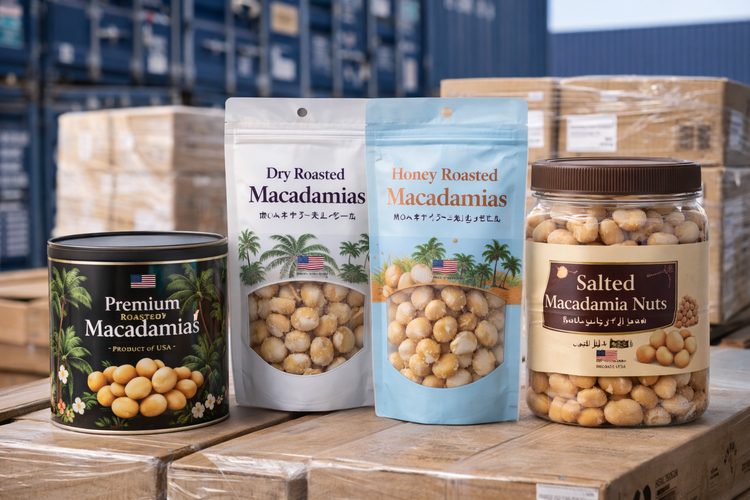
Export retail macadamia programs are less about moving a nut from one place to another and more about translating a premium product into a shelf-ready format that can survive international movement, meet destination requirements and still look commercially correct when it reaches the consumer. Macadamias already sit in a premium ingredient category, so export retail programs usually carry higher expectations around presentation, pack integrity, labeling, product consistency and commercial execution than standard bulk ingredient shipments.
Atlas generally approaches export retail macadamia projects by asking what the finished pack is supposed to accomplish in the target market. Is the product intended to sit in gourmet retail, premium grocery, airport or travel retail, hotel gift shops, department-store food halls, upscale convenience channels, distributor-led specialty grocery or private label export programs? That question matters because the retail channel influences format, pack size, visual design, price architecture, language requirements and restocking logic.
Core commercial point: Export retail works best when product format, pack architecture, channel logic, destination-market requirements and shipment timing are aligned before the first quotation is finalized.
Why export retail macadamia programs need more structure than domestic retail
Domestic retail already requires coordination between product, packaging and shelf presentation. Export retail adds more layers: longer transit paths, more document handling, market-specific label expectations, climate exposure, different pallet and case assumptions, distributor economics and a greater need for forecasting discipline. A pack that works well in one market may need different sizing, labeling or case structure in another. A product that looks commercially viable for local retail can become less efficient once freight, shelf-life window and destination-specific compliance are considered.
This is particularly important with macadamias because the category depends heavily on premium perception. A weak retail pack, an overcomplicated size choice, poor shelf-life planning or a label adaptation issue can quickly reduce the product’s value proposition. In export retail, the pack is both the selling tool and the transport challenge.
How this topic shows up in real buying decisions
In practice, buyers compare raw, roasted, salted, flavored and processed retail-ready formats, as well as different pack sizes, pouch structures, rigid containers, carton systems and private label executions. The right choice depends on the balance between appearance, bite, flavor profile, labeling goals, landed cost, destination fit and channel expectations.
For macadamia buyers, the usable export retail menu often includes plain roasted kernels, salted retail packs, flavored roasted lines, premium mixed nut programs containing macadamias, giftable pack formats, small on-the-go snack units, premium stand-up pouches, rigid jars or tins, and private label export lines. Which route makes sense depends on whether the buyer is supplying specialty retail, modern trade, hotel retail, travel retail, corporate gifting, export e-commerce or premium grocery distribution.
Common export retail product formats for macadamias
Plain roasted retail lines
Plain roasted macadamias are often used where the market values clean premium positioning, straightforward ingredient decks and strong nut identity. These products can work well in upscale grocery, hotel retail, premium natural channels and giftable programs where the nut itself is the hero product.
Salted roasted retail lines
Salted roasted lines can broaden commercial appeal because they sit between pure premium positioning and more familiar snacking behavior. They are often easier to place in mainstream premium grocery and travel retail than completely plain lines, depending on the market.
Flavored roasted retail programs
Flavored lines can create stronger shelf differentiation, especially in specialty retail and export-oriented gourmet programs. In these cases, buyers should define whether the destination market prefers subtle premium flavors, sweeter gifting profiles or stronger savory snack cues.
Mixed nut or assortment formats
Macadamias may also appear in export retail as part of luxury mixed nut programs. Here the product is not only about the macadamia itself, but about how macadamias contribute premium identity to a broader assortment. The case for export may be stronger if the product is positioned as a curated premium blend rather than a single-nut line, depending on the channel.
Gift and seasonal programs
Some export markets support higher-value gifting formats such as tins, cartons, seasonal sleeves, premium jars and branded presentations. In these programs, the retail architecture is often as important as the nut format itself.
How product form affects export retail planning
Whole kernels generally support the strongest premium visual presentation and are often preferred when the product is consumer-facing in transparent or premium presentation formats. However, whole-kernel lines are not automatically the best answer for every export market. In some cases, a smaller size, a different kernel style or a blend format may create better price architecture or broader consumer accessibility.
Roasted versus raw logic also changes in export retail. Most export retail programs involve roasted or ready-to-eat product because the item is intended for direct sale. That makes roast quality, salt level, flavor consistency and pack performance more commercially important than they would be in bulk ingredient trade. Once the product is export retail-ready, the manufacturer is no longer selling a flexible input; they are selling a completed shelf proposition.
Pack architecture and why it matters
Stand-up pouches
Stand-up pouches are common in premium snack retail because they balance shelf presence, shipping efficiency and resealability. They can work well for export when the market favors modern packaging and the brand wants a clean premium appearance without excessive packaging weight.
Rigid jars and canisters
Rigid containers may suit gifting, department-store food retail, hotel retail or travel channels where the product must look more permanent and premium. These formats often create a stronger visual statement, but they also affect freight efficiency and case planning.
Tins and carton-based gift formats
Tins and carton-led premium formats can work in seasonal, gifting or luxury-led export channels. In these programs, the buyer should think carefully about shelf life, transport protection and how the outer presentation influences pack economics.
Single-serve and smaller unit packs
Some export retail programs need smaller units because the macadamia category is premium-priced and consumers may enter the category more easily through lower absolute pack prices. These pack sizes can also support convenience, travel and hospitality-led channels.
Destination-market fit and channel logic
The same product does not fit every market equally well. Some export destinations may favor cleaner premium positioning and simple roasted lines. Others may respond better to flavored lines or gifting presentation. Some channels can sustain higher premium price points if the pack looks luxurious enough. Others require tighter control of price-per-pack and case movement to stay commercially viable.
That is why Atlas encourages buyers to define not only the country, but the target retail lane inside that country. A product meant for specialty grocery in one market may need very different assumptions from a product intended for airport retail, modern premium supermarket, distributor-led traditional trade or premium e-commerce gifting.
Labeling, language and market adaptation
Export retail programs often need more label coordination than buyers first expect. The product may require destination-specific language, allergen presentation, nutritional format adaptation, importer details, barcode alignment, shelf-life statements or channel-specific label adjustments. Even when the product itself is stable, the retail pack may need redesign or relabeling to fit the market properly.
From a commercial standpoint, this affects not only compliance but launch timing. A pack that is technically ready for one market may still need further adaptation before it can move into another. That is why label and documentation planning should start earlier than many first-time export buyers assume.
Documentation and logistics in export retail programs
Retail export is not only about freight booking. It is also about whether the full commercial packet is aligned: packing logic, case configuration, pallet planning, shipment timing, exporter-importer coordination and the underlying document flow. Even a good product can become commercially difficult if the shipment structure does not fit the importer’s warehouse, retail replenishment model or customs timing expectations.
Macadamia retail programs particularly benefit from this planning because the category is premium. Buyers generally want fewer surprises once product is packed and moving. Longer lead chains make forecast visibility more important, not less.
How case packs and pallet structure influence cost
Case count, retail unit dimensions, pallet efficiency and freight cube all affect landed economics. A pack that looks ideal in isolation may not be the strongest option once case density, pallet fill and freight cost are evaluated. This is especially relevant for rigid or giftable formats, which may look stronger on shelf but reduce freight efficiency versus pouches or more compact retail structures.
That does not mean premium packaging is wrong. It means the pack should be chosen with full awareness of its freight and warehouse implications. The best export retail programs are usually those where retail presentation and logistics logic are balanced rather than treated as separate decisions.
Commercial planning points
Export retail projects often move through clear stages: concept review, sample assessment, label and pack development, validation run, launch volume and repeat replenishment. Atlas uses that logic to help frame conversations around pack planning, documentation timing and order rhythm. A launch-stage export order has different needs from a repeat replenishment program that is already flowing into a distributor or retailer network.
When relevant, the buyer should also specify whether the program is retail-ready, private label, premium gifting, foodservice-adjacent retail or export-oriented direct-to-shelf. That single clarification often changes packaging, documentation and timing assumptions. Export retail is not just a shipping destination; it is a commercial model.
What Atlas would ask before quoting
For macadamia export retail projects, Atlas typically recommends translating the product idea into a quote request with five core points: target format, application, pack style, destination market and volume rhythm. For export retail specifically, Atlas would also usually ask the customer to define:
- Plain, salted, flavored or mixed-nut positioning
- Pack size and retail channel
- Target country or region
- Required label language and market-specific pack needs
- Expected case and pallet logic if already known
- Trial, launch or repeat volume stage
- Target ship window and replenishment expectations
Typical use cases for macadamias on this website include premium bakery, cookies and confectionery, snack mixes, plant-based dairy, sauces and dips. For export retail, the product brief should still be tied to a concrete commercial route such as premium snack pouches, private label grocery, travel retail, hospitality gifting or mixed nut assortments for export channels.
Cost-in-use versus nominal quote
Export retail buyers should avoid focusing only on the ex-works or basic quote number. The more useful question is whether the finished retail structure supports the target market once pack cost, freight logic, label adaptation, shelf-life planning and channel price architecture are considered. A seemingly lower-cost program may become less viable if the pack is wrong for the market or the logistics structure is inefficient. A higher initial quote may be commercially stronger if it supports smoother shelf entry and better repeat replenishment.
Because macadamias are already premium-positioned, the retail proposition has to feel complete. The product, pack, documentation and distribution model all need to work together for the program to scale with confidence.
How this topic shows up in real supply planning
Buyers often begin with a broad instruction such as “we need export retail macadamias,” but that phrase still hides the most important commercial variables. Are they building a premium pouch line for Europe, a jar program for the Middle East, a giftable tin for Asia, a private label grocery line for a distributor, or a travel-retail SKU family? Those scenarios create very different assumptions around pack size, label work, freight planning and reorder rhythm.
That is why the quote should reflect the real format and route. Whole kernel material is different from flavored roasted lines, mixed programs, gift packs or compact travel-retail units. The commercial logic also changes when the product is designed for premium modern trade, hospitality retail, airport retail or a distributor-led specialty grocery network.
Buyer planning note
Atlas Global Trading Co. uses topics like this to move conversations from broad interest to a specification-minded inquiry. If you are evaluating macadamia supply for export retail, share the format, pack style, estimated volume and destination using the floating contact form so the next step can be grounded in a real commercial need.
The strongest export retail programs usually start with a simple discipline: define the destination, define the retail job, define the pack, and then build the product around those realities instead of treating export as only a logistics extension of domestic retail.
Need help sourcing around this export macadamia topic?
Use the contact form to turn a broad export idea into a more practical retail quote request with pack format, market fit and shipment timing clearly defined.
- State the exact product and retail pack format
- Add target monthly, launch or container volume
- Include destination market and target shipment timing
Frequently Asked Questions
What is the main buyer takeaway from “Export Retail Macadamia Programs”?
The main buyer takeaway is that export retail macadamia programs work best when product format, pack architecture, destination-market requirements, documentation flow and commercial timing are defined together before quotation.
What details matter most in an export retail macadamia brief?
The most important details usually include raw or roasted format, kernel style or cut, flavor profile if relevant, pack size, retail channel, target country, label language requirements, case configuration, expected order rhythm and launch timing.
Why is export retail different from domestic retail for macadamias?
Export retail programs usually require more discipline around packaging durability, market-specific labeling, document sets, pallet planning, freight timing and shelf-life planning. The same product may need different commercial assumptions depending on destination.
Should export buyers prioritize pouches, jars or giftable formats?
That depends on the channel. Pouches may suit modern premium snacking and better freight efficiency, while jars, tins and giftable packs may better support hospitality, travel retail or premium gifting. The right pack is the one that balances shelf presentation and landed cost logic.
What should a buyer include in a quote request for export retail macadamias?
A useful quote request should define product type, pack format, target channel, destination market, required label adaptation, expected volume, launch stage and shipment timing. Clearer briefs generally lead to more useful export pricing.