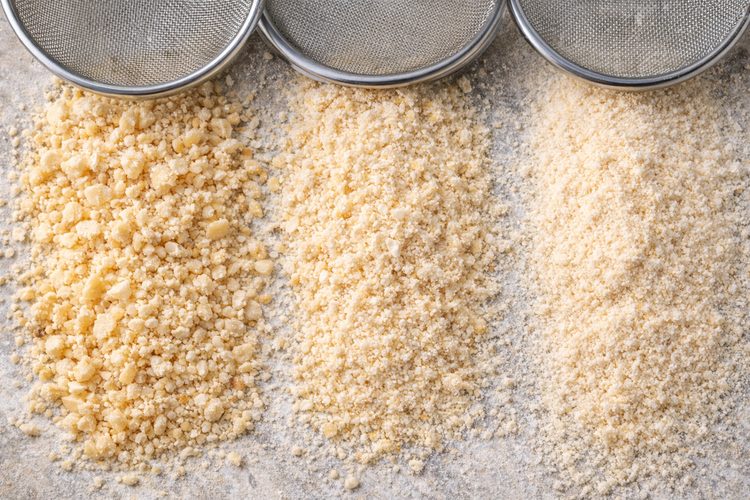
Macadamia flour is not a single product. It is a range of particle sizes, fat levels and process routes that behave differently in manufacturing systems. The commercial outcome depends on specifying mesh, oil content, particle consistency and intended use before sourcing. Without that clarity, buyers often receive material that technically matches “macadamia flour” but does not perform in their process.
Why mesh size matters in manufacturing
Mesh size defines how the flour behaves in mixing, hydration, oil release and final texture. A coarse grind may create visible particulate and texture, while a fine flour behaves more like a functional ingredient in dough systems, batters and emulsions.
Typical mesh ranges
- 10–20 mesh: coarse meal, visible texture, suitable for cookies, coatings, toppings
- 20–40 mesh: medium flour, balanced structure, used in bakery blends and snack systems
- 60–100 mesh: fine flour, smooth mouthfeel, used in batters, fillings and emulsions
Buyers should avoid generic specifications such as “macadamia flour” and instead define acceptable mesh ranges or sieve analysis targets.
Particle size distribution and consistency
Beyond nominal mesh, consistency matters. A flour labeled as 40 mesh but containing wide particle distribution can lead to uneven hydration, inconsistent baking performance and variable product texture.
Manufacturers typically benefit from tighter particle size distribution when:
- Running continuous production lines
- Producing uniform bakery items
- Formulating premium fillings or coatings
Loose distribution may be acceptable in artisanal or texture-driven products but can create variability in scaled operations.
Fat content and processing behavior
Macadamias are naturally high in fat, often exceeding 70%. This directly affects flour handling and functionality:
- Higher fat → richer flavor, softer texture, increased clumping risk
- Lower fat / partially defatted → improved flowability, better blending
Full-fat flour works well in premium bakery and confectionery, while partially defatted variants are often preferred in dry mixes, coatings and extrusion-based systems where flow and consistency are critical.
How this topic shows up in real buying decisions
Manufacturers typically compare:
- Coarse meal vs fine flour
- Full-fat vs reduced-fat flour
- Raw vs roasted grind
- Single-pass vs multi-stage milling
The right choice depends on whether the flour is used for structure, flavor, texture or fat contribution.
Application-specific guidance
Bakery (cookies, cakes, gluten-free systems)
Medium to fine mesh flour is commonly used. Fat content contributes to tenderness and flavor. Buyers should specify moisture and oil migration expectations.
Snack coatings and inclusions
Coarser meal or medium mesh flour provides texture and adhesion. Uniform particle size helps maintain coating consistency.
Plant-based and emulsified systems
Fine mesh flour or paste-like systems are preferred. Smooth texture and controlled oil release are critical.
Confectionery and fillings
Fine flour ensures smooth mouthfeel. Particle uniformity directly affects product quality perception.
What Atlas would ask before quoting
For macadamia flour projects, Atlas typically structures the inquiry around:
- Target mesh size or sieve specification
- Application (bakery, coating, filling, etc.)
- Fat level (full-fat vs reduced-fat)
- Packaging format (bulk, foodservice, retail)
- Destination and compliance requirements
- Volume and replenishment cycle
Key point: mesh size without application context is incomplete. The same 40-mesh flour can behave differently depending on fat level and particle distribution.
Commercial planning points
Macadamia flour programs benefit from structured rollout:
- Trial sampling with defined mesh and fat specs
- Validation in production environment
- Scale-up with consistent supply partner
- Repeat sourcing with locked specifications
Packaging decisions (25 lb bags, bulk totes, retail-ready formats) and logistics planning (domestic vs export) should be aligned early to avoid rework.
Buyer planning note
Atlas Global Trading Co. uses specification-driven discussions to move from general interest to actionable sourcing. For macadamia flour, that means defining mesh, fat level, application and packaging before pricing discussions begin.
Need help sourcing macadamia flour?
Turn your formulation into a specification-ready quote request.
- Define mesh size and fat level
- Share application and processing notes
- Include volume and destination market
Frequently Asked Questions
What mesh size should buyers specify for macadamia flour?
Mesh size depends on application. Coarse meal suits texture-driven products, while fine flour is preferred for smooth systems.
Why does macadamia flour clump?
High fat content causes natural oil release, which can lead to clumping. Lower-fat variants improve flowability.
Is macadamia flour suitable for gluten-free products?
Yes. It is commonly used in gluten-free bakery systems, often blended with other flours for structure and performance.