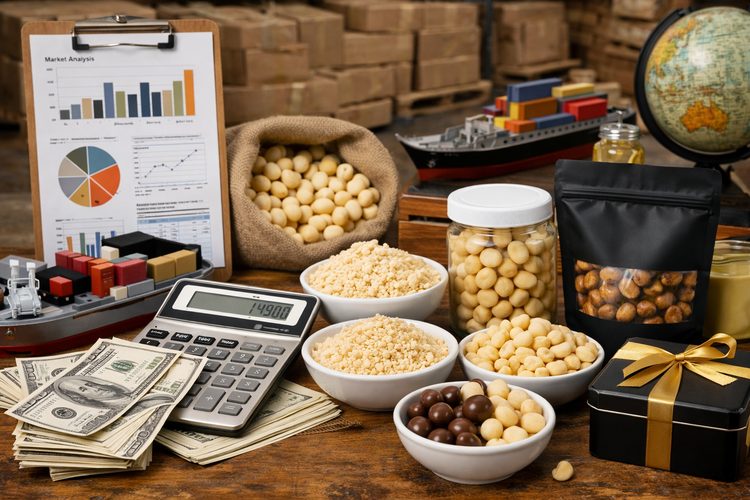
Price drivers in macadamia trading matter because industrial nut buying is rarely only about nominal price. The stronger commercial outcome usually comes from understanding what the price actually represents before the order is placed. In macadamias, a quotation is usually shaped by a combination of product form, kernel style, processing route, packaging, documentation, shipment timing and destination. Buyers who treat macadamias as a single undifferentiated commodity often end up comparing offers that do not actually reflect the same scope.
That is especially relevant in premium nut categories, where the gap between “looks similar on paper” and “is commercially comparable” can be wide. A raw industrial kernel packed in bulk is not commercially equivalent to a dry roasted retail-ready pouch line. A style-selected whole kernel program is not equivalent to diced or granulated material. The quoted price only becomes useful when the underlying assumptions are clear.
Why macadamia prices can vary more than buyers expect
Macadamias sit in a premium nut category, so the price is influenced not only by supply conditions but also by how much value has already been built into the product before it reaches the buyer. One quote may reflect a simpler input for further manufacturing. Another may include sorting, roasting, screening, specialty packing or export-preparation steps. Both may be described broadly as “macadamias,” but they are not the same commercial item.
That is why buyers typically get better results when they ask not only “What is the price?” but “What exactly is included in that price?” The most practical conversations identify whether the customer is buying raw material, semi-processed ingredient, snack-ready format or retail-ready finished pack. Once that is defined, the price starts to make more commercial sense.
A good macadamia quote usually answers three questions at once: what the product is, what processing it has already gone through, and what commercial route it is expected to support. Without those details, price comparisons can be misleading.
Product format is one of the biggest price drivers
For macadamias, the quote should reflect the real format and route. Whole or kernel material is different from diced, meal, extra fine flour, butter or oil. Each format carries a different yield logic, handling profile and processing burden. Whole premium styles often command a different commercial position than broken pieces or ingredient-grade particulate forms. Conversely, more processed forms such as butter, flour or fine ingredient formats may reflect added conversion cost even if the underlying raw material started from styles that are not sold as premium whole kernels.
For macadamia buyers, the usable product menu usually includes raw macadamias, pasteurized macadamias, dry roasted macadamias, oil roasted macadamias, diced macadamias, meal, extra fine flour, butter and oil. Which of those makes sense depends on the end use, whether the customer is manufacturing further, packing for retail or planning export distribution. Price follows that logic.
Kernel style and visual grade affect value
Macadamia pricing is often heavily influenced by the style being purchased. Larger, cleaner, more visually attractive whole kernels are often positioned differently than mixed styles, halves or smaller broken formats. This is especially true when the intended use depends on visual quality, such as retail snack packs, gifting lines, premium toppings or high-end foodservice presentation.
On the other hand, customers buying for grinding, coating, meal or sauce systems may not need the same visual grade. In those cases, style flexibility can improve cost efficiency without hurting the finished application. The buyer should therefore align the style requirement to the real application rather than automatically defaulting to the most premium-looking specification.
Raw versus roasted changes the economics
The commercial logic changes when the material is raw, pasteurized, dry roasted or oil roasted. Raw formats often preserve more downstream flexibility for the buyer, but roasted formats reflect a more finished product state. Roasting adds process steps, changes handling assumptions and can also shift packaging requirements depending on the final route to market.
That means two macadamia quotes can diverge materially simply because one assumes raw bulk supply for further manufacturing while the other assumes ready-to-use roasted product. Roasted can be the better commercial choice if it removes internal processing for the buyer, but it should not be compared directly with raw unless the scope is understood.
Processing route adds value and cost
Macadamias that are roasted, seasoned, cut, screened, ground, blended or packed into consumer formats will naturally carry more process value than base raw material. That does not automatically make them expensive in a negative sense. It means the customer is buying a different stage of the value chain. The real question is whether it is more efficient for the buyer to pay for those services upstream or to take them on internally.
From a commercial standpoint, processing fees and conversion steps should be viewed as part of the total delivered cost, not isolated as a markup. In many cases, a more processed product may actually simplify the buyer’s operations enough to make the quote more attractive overall.
Application fit affects what price level is sensible
Price is not only a supply-side issue. It is also an application-fit issue. A customer using macadamias in premium bakery, cookies and confectionery, snack mixes, plant-based dairy, sauces and dips may not need the same format, visual grade or packaging logic. The product brief should always match one of those concrete end uses. When it does, the price discussion becomes much more rational.
For example, a premium snack pouch program may justify larger whole roasted kernels and more protective packaging. A sauce manufacturer may care more about workable ingredient format than visual perfection. A bar manufacturer may prefer diced inclusions with controlled size and lower cost per functional use. The “right” price is always tied to the finished product strategy.
Packaging can materially change the quote
Packaging is one of the most underestimated price drivers in nut trading. Industrial bulk, foodservice packs, retail-ready units, private-label consumer formats and export-oriented pack structures all create different labor, material and freight assumptions. A quote packed in bulk lined cartons is not directly comparable to one packed into branded pouches, jars or gifting tins.
That is why Atlas encourages buyers to define pack style early. Packaging affects not only conversion cost but also pallet efficiency, storage behavior, freight density, damage risk and the final commercial role of the product. It is a real price driver, not an afterthought.
Destination market matters
The same macadamia item can have a different commercial structure depending on whether it is staying in the domestic market or moving through export channels. Export can add packaging adjustments, labeling complexity, documentation, case-marking needs, longer transit windows and different master-case assumptions. Those factors influence pricing even when the nut itself remains technically the same.
For that reason, destination should be part of the initial inquiry. A useful quote for the U.S. market may not be the right quote for Europe, the Middle East or Asia if the documentation and packaging requirements are materially different.
Volume structure influences price more than many buyers expect
Volume is not only about size. It is also about rhythm. A one-off spot purchase, a small validation run, a regular monthly program and a container-based replenishment structure do not create the same commercial planning conditions. Repeatability often improves the ability to structure packaging, scheduling and logistics more efficiently, while fragmented or emergency buying can create added operational cost.
This is why Atlas often recommends that buyers describe whether the requirement is a trial quantity, validation run, launch volume or repeat replenishment. That simple clarification can materially change how practical the pricing discussion becomes.
Timing and market window affect quoting logic
Needed-by timing can influence how a quote is framed. A well-planned program usually allows more rational coordination of product, packaging and shipment. Urgent requirements or narrow launch windows may reduce flexibility and make certain routes less efficient. In premium categories, timing risk can also matter if the buyer needs specialty styles, private-label packs or export-ready documentation under a tight schedule.
That is why the product brief should include timeline, not only volume. Timing is part of the commercial structure.
Private label and retail-ready scope create different price architecture
Retail-ready and private-label programs often look more expensive than industrial bulk on a simple unit comparison, but they also include additional value layers. Branding support, fill-weight discipline, consumer packaging, labeling, case configuration and route-to-shelf readiness all shape the quotation. A private-label program is not only a raw material sale. It is a finished commercial system.
Buyers should therefore avoid comparing private-label ready pricing with base bulk pricing unless the objective is to evaluate make-versus-buy decisions honestly across the whole program.
Freight and logistics are part of the trading price
Macadamia trading is not only about ex-warehouse product value. Logistics matter. Freight route, shipment size, pallet efficiency, handling conditions, documentation flow and destination all influence the real delivered cost. In some programs, the nut price appears stable while the logistics profile changes enough to alter the landed economics materially.
That is why a specification-minded quote request should identify pack style, destination market and approximate shipment structure. These are not secondary details. They are part of the price equation.
Specification precision usually improves price comparability
Atlas encourages buyers to define intended use, pack style, destination, timeline and quality expectations early. Those inputs help reduce avoidable back-and-forth and improve comparability across California supply options. A vague request for “macadamias price” often produces a generic number that is less useful than buyers hope. A better brief produces a better quote.
In practical terms, buyers usually get more meaningful offers when they state the target format, application, pack style, destination market and volume rhythm. That combination helps distinguish between similar-looking numbers that actually represent very different scopes.
Typical price drivers buyers should watch closely
In day-to-day trading, the most common price drivers usually include:
- format: whole kernel, pieces, meal, flour, butter or oil
- style and visual standard: premium whole styles versus less visually critical ingredient formats
- process level: raw, pasteurized, roasted, seasoned, ground or retail-packed
- packaging scope: bulk, foodservice, retail-ready, private label or gifting
- destination: domestic versus export and the related documentation requirements
- volume rhythm: trial, launch, repeat replenishment or container program
- timing: standard planning versus compressed or urgent shipment needs
None of these should be treated in isolation. The commercial outcome usually depends on how they combine.
What Atlas would ask before quoting
Atlas uses topics like this to move conversations from broad interest to a specification-minded inquiry. A more practical quotation request would usually identify the exact macadamia format, the intended application, the pack style, the destination market and the expected volume rhythm. Atlas may also ask whether the product is industrial bulk, foodservice, retail-ready, private label or export-oriented, because that single clarification often changes packaging, documentation and timing assumptions.
The point of these questions is not to slow down the process. It is to make sure the quote reflects the real commercial need rather than a generic category label.
Commercial planning points
From a trading standpoint, the best programs are built around repeatability. That means clear documentation, agreed packaging, sensible shipment cadence and a commercial structure that supports continuity rather than one-off emergency buying. The more repeatable the program, the easier it becomes to align price with realistic operating assumptions instead of temporary exceptions.
Buyers who plan in stages, such as trial quantity, validation run, launch volume and repeat replenishment, often make better pricing decisions because they can see how the cost structure evolves as the program becomes more defined and operationally stable.
Buyer planning note
Atlas Global Trading Co. uses topics like this to help buyers move from headline price questions to more useful sourcing decisions. In macadamia trading, the number on the quote only becomes meaningful when the product form, process route, packaging, destination and timing are aligned. That is why strong commercial results usually come from a clear brief rather than a price-only comparison.
If you are evaluating macadamia supply, share the format, pack style, estimated volume and destination using the floating contact form so the next step can be grounded in a real commercial need.
Ready to request a quote with the right details?
Use the contact form to share the product, packaging, timing and destination details needed for a more accurate quote.
- State the exact macadamia format and application
- Add target monthly or trial volume and pack style
- Include destination market and target timing
Frequently Asked Questions
What usually moves the quoted price of macadamias the most?
The biggest price drivers are usually product format, kernel style, roast or processing route, packaging type, destination market, shipment timing and volume structure. Quotes become more accurate when buyers define those variables early.
Why can two macadamia quotes look different even when both say “macadamias”?
Because macadamias are not a single commercial item. Whole kernels, broken styles, roasted formats, diced cuts, meal, flour, butter and retail-ready packs all carry different processing, yield, handling and packaging assumptions. The scope behind the quote matters as much as the headline price.
How can buyers get a more useful macadamia quotation?
Buyers usually get more useful quotations by specifying the exact format, intended application, pack style, destination, estimated volume and timing. That reduces ambiguity and improves comparability across supply options.