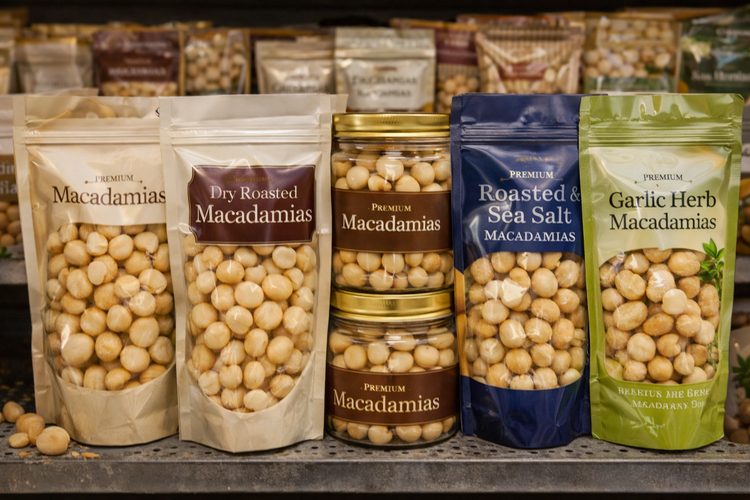
Retail macadamia packs are rarely only a packaging exercise. In practice, they are a shelf-positioning decision. The stronger commercial outcome usually comes from aligning product form, pack architecture, price position, freshness strategy and shipment timing before the program is launched. For macadamias, this matters even more because the category usually sits above standard nut lines in both perceived quality and delivered cost.
A retail pack that works for almonds or mixed nuts is not automatically the right answer for macadamias. The consumer expectation is different. The shelf story is different. The visual standard is higher. The product often needs to justify a more premium price point, whether the program is aimed at mainstream grocery, specialty retail, private label, travel retail, gifting or export.
Why retail macadamias need a premium shelf strategy
Macadamias are commonly positioned as a luxury or upper-tier nut. That means the pack is expected to do more than protect product. It must communicate quality, justify the price, support shelf appeal and reinforce confidence before purchase. In many cases, consumers will judge the category not only by flavor expectations but by visible kernel quality, fill presentation, finish of the packaging and the clarity of the value proposition.
From a buyer standpoint, this makes shelf strategy inseparable from sourcing strategy. A strong retail program is built by deciding early whether the product is meant to read as indulgent, health-forward, gourmet, giftable, travel-friendly, natural-premium or export-ready. Once that position is clear, the choices around form, roast condition, seasoning, pack size and material become more commercially coherent.
In premium retail nut programs, the product, the pack and the price tier must support the same story. Macadamias can command attention, but only when visual quality, fill logic and shelf communication are aligned.
How this topic shows up in real buying decisions
In actual sourcing discussions, buyers usually compare several macadamia routes before a retail program is finalized. Whole kernels may give the strongest luxury impression but also come with a more demanding cost structure. Halves or selected styles may improve economics while keeping a premium appearance. Raw formats can suit customers planning downstream roasting or seasoning. Dry roasted formats often support a clean premium snack line. Oil roasted or seasoned formats may fit richer indulgent or more strongly flavored concepts.
For macadamia buyers, the usable product menu can therefore include raw macadamias, pasteurized macadamias, dry roasted macadamias, oil roasted macadamias, flavored macadamias and selected styles for retail presentation. Which of those makes sense depends on the shelf concept, target channel, pack size, price architecture and whether the buyer is building a domestic program, private-label line or export retail offer.
Shelf strategy starts with product role
The first commercial question is what the macadamia pack is supposed to be on shelf. It may be a hero single-origin style premium nut, a clean-label upscale snack, a flavored indulgence line, a gifting-oriented pack, a hotel or minibar format, a premium travel retail pack or a private-label item aimed at a specific retailer tier. Each of these directions leads to a different product and packaging brief.
For example, a premium everyday snack pack may prioritize clean appearance, practical fill weight and repeat purchase price accessibility. A gifting or specialty-store line may justify more elaborate materials, stronger visual theater and a smaller number of highly curated SKUs. A value-conscious premium private-label line may rely more heavily on disciplined pack sizing and tight format control to hold the price position together.
Format selection: whole kernels, styles and value perception
In retail macadamia programs, the physical form of the nut has a direct effect on shelf value perception. Large whole kernels often communicate the strongest premium message and are commonly used when the goal is luxury presentation. Halves or carefully selected styles may still read as premium while providing more flexibility on pack economics. Smaller styles can work in flavored or mixed concepts, but usually require more support from branding, seasoning or price positioning to feel equally elevated.
The buyer should therefore decide whether the pack depends on a strong visual of large intact kernels or whether the concept is more about flavor, convenience or accessibility. That decision affects not only sourcing cost but also the likely success of the shelf strategy.
Roast style and retail positioning
Roast condition changes the commercial message of the product. Raw or minimally processed packs may appeal to natural-premium or ingredient-aware consumers. Dry roasted packs often support a cleaner, more refined premium snack message. Oil roasted packs may fit indulgent lines with stronger richness and a more familiar snack profile. Flavored or seasoned packs can broaden the consumer base, but they also move the program from pure premium simplicity toward a more developed flavor-led retail strategy.
That means the roast route should be chosen with the market position in mind. A minimalist high-end line may benefit from clean dry roasted kernels in elegant packaging. A travel-retail or specialty grocery line may perform better with more distinct flavors. A private-label retailer may want both: one core premium classic line and one more commercially accessible flavored line.
Pack size is part of the pricing strategy
For macadamias, pack size is one of the most powerful commercial levers. Because the nut category often sits in a higher price band, the same price-per-kilo logic used in bulk buying does not always translate directly to shelf success. Smaller packs can make premium products feel more accessible in absolute price terms. Larger packs may improve value perception for repeat buyers but can also push the shelf price into a narrower consumer segment.
Buyers should think carefully about whether the program is intended for impulse purchase, repeat pantry stocking, gifting, travel, specialty checkout placement or premium wellness snacking. Those channel roles often determine whether a smaller premium pouch, a mid-size stand-up format, a rigid canister or a gift-style box is the smarter choice.
Packaging architecture and premium shelf presence
In retail macadamia packs, packaging is not only containment. It is part of the merchandising system. Flexible pouches, stand-up pouches, rigid jars, tins, canisters, cartons and multi-pack formats each support a different shelf message. Premium shelf strategy often depends on how well the packaging balances convenience, product visibility, barrier protection and aesthetics.
A minimalist natural-premium line may benefit from a clean stand-up pouch with strong graphics and a disciplined window strategy. A higher-end gifting or specialty line may justify more rigid structure, metallic details, elevated carton treatment or box-style presentation. An export retail program may require a different balance of durability, case-pack efficiency and label space. The correct solution is rarely universal. It depends on the retailer, the price point and the target consumer behavior.
Visual presentation and fill logic
Macadamias are a visually sensitive premium product. Breakage level, kernel size consistency and overall fill presentation directly affect perceived quality. A pack that looks underfilled or visually uneven can undermine premium positioning even if the product quality is technically acceptable. That is why fill logic, pack proportions and visible product presentation deserve attention in the quotation stage rather than after packaging is chosen.
For windowed packs or transparent formats, the visual standard becomes even more important. The product must look worth the price before the customer tastes it. In opaque packs, the brand design carries more of the burden, but the product still needs to deliver on opening to protect repeat purchase confidence.
Single-SKU versus assortment logic
Retail macadamia strategies can follow different assortment models. Some brands build one hero SKU that becomes the signature premium offer. Others create a small range built around one or two core roasted lines and several flavored or channel-specific variants. In gifting or export retail, assortment logic may extend into mixed formats, curated collections or seasonal pack structures.
The commercial question is whether the retailer needs a focused, easy-to-understand premium line or a broader platform. Too many SKUs can complicate packaging, forecasting and inventory. Too few may limit shelf presence or retailer interest. The right balance depends on channel ambitions and expected sell-through rhythm.
Private label considerations
Private-label macadamia programs can be commercially attractive because the product category already carries a premium perception. However, private label works best when the buyer defines the retailer tier and the intended shelf comparison. A premium grocer’s private label will typically require a different format, finish and price structure than a broader-market retailer attempting to introduce an accessible premium nut line.
Atlas would typically want to know whether the buyer is pursuing a national private-label program, a regional premium grocery line, a specialty retail concept or an export retailer format. That helps frame pack style, specification level, likely documentation needs and replenishment cadence.
Freshness, shelf-life and packaging protection
Retail macadamia packs succeed commercially only if the product still feels premium at opening. That means packaging barrier, storage conditions, inventory rotation and freight route should be considered part of the shelf strategy. Macadamias are often chosen for their rich, creamy eating quality, so anything that weakens freshness perception can reduce the value story quickly.
Buyers should therefore think through how long the product will spend in packed inventory, transit, destination warehousing and on shelf before final purchase. The right pack for a fast-moving domestic line may not be the right pack for an export retail program with longer transit and shelf windows.
Domestic versus export retail logic
A domestic retail program and an export retail program may share the same core product idea but still require different commercial planning. Export often changes master-case configuration, label requirements, documentation, shipment timing and packaging durability assumptions. A product positioned as premium in one market may also need different pack sizes or flavor options to fit another market’s buying behavior.
That is why destination market should be part of the first sourcing discussion, not a later logistics detail. The more premium the category, the more those downstream variables shape the success of the program.
How premium shelf strategy affects pricing logic
Because macadamias are already a higher-value nut, pricing should be approached strategically. Some programs succeed by defending a clearly premium shelf price with superior packaging and product presentation. Others succeed by using smaller pack sizes to keep the ticket accessible while preserving a premium image. Others use a mix of hero SKUs and entry-point flavored lines to widen the retail audience.
The right answer depends on retailer expectations, channel margin structure, consumer segment and repeat-purchase potential. A price-only sourcing conversation is therefore usually incomplete. The buyer should instead frame the program around total retail architecture: product form, pack size, visual standard, channel and likely shelf role.
What Atlas would ask before quoting
For retail macadamia projects, Atlas would usually recommend translating the concept into a quote request with five practical points: target format, application or channel, pack style, destination market and volume rhythm. In retail terms, this often means clarifying whether the product is whole or style-selected, raw or roasted, classic or flavored, pouch or rigid pack, domestic or export, and whether the volume pattern is trial, launch or repeat replenishment.
Atlas would also want to know whether the program is industrial bulk converted elsewhere, fully retail-ready, private label, gifting-oriented or export retail. Those details make quotations more realistic and reduce the risk of comparing offers that do not actually reflect the same shelf strategy.
Commercial planning points
Commercially, retail macadamia programs often move in stages: initial concept and sample review, validation run, launch volume and repeat replenishment. This staged approach helps buyers assess whether the chosen format, pack size and price point genuinely work in-market before scaling. It also helps align packaging inventory, case-pack planning and freight timing with actual sell-through rather than optimistic assumptions.
From a trading standpoint, the strongest programs are built around repeatability. That means documentation, agreed packaging, sensible shipment cadence and a commercial structure that supports continuity instead of one-off emergency buying. For premium shelf categories, consistency is not optional. It is part of the brand promise.
Buyer planning note
Atlas Global Trading Co. uses topics like this to move conversations from broad product interest to a more specification-minded inquiry. Retail macadamia packs work best when the buyer defines what the product should do on shelf: signal premium quality, deliver indulgent snacking, support gifting, justify a higher price point, broaden a private-label range or serve an export retail channel with clear commercial discipline.
If you are evaluating macadamias for retail pouches, jars, snack packs, private-label lines, gifting programs or export shelf placement, share the exact format, pack style, estimated volume and destination using the floating contact form so the next step can be grounded in a real commercial requirement.
Need help sourcing macadamias for a premium retail shelf program?
Use the contact form to turn this retail concept into a practical quote request with format, pack size, channel and shipment timing defined together.
- State the exact macadamia format and target retail channel
- Add pack style, trial or monthly volume and price-position goals
- Include destination market and target launch timing
Frequently Asked Questions
What should buyers define first when building a retail macadamia program?
Buyers should define the exact macadamia format, target retail channel, pack size, flavor direction, price position, destination market and volume rhythm. Premium retail programs work best when shelf strategy and sourcing strategy are developed together.
Why do macadamias require a different shelf strategy than more standard nut categories?
Macadamias usually sit in a more premium price and perception tier. That means piece size, visual quality, packaging presentation, fill weight, freshness protection and shelf message all play a stronger role in conversion and repeat purchase.
Can the same retail macadamia concept work for both domestic and export markets?
Yes. The same core product idea can work across domestic and export channels, but packaging format, labeling, case configuration, documentation and freight assumptions may need to change depending on destination and retailer requirements.