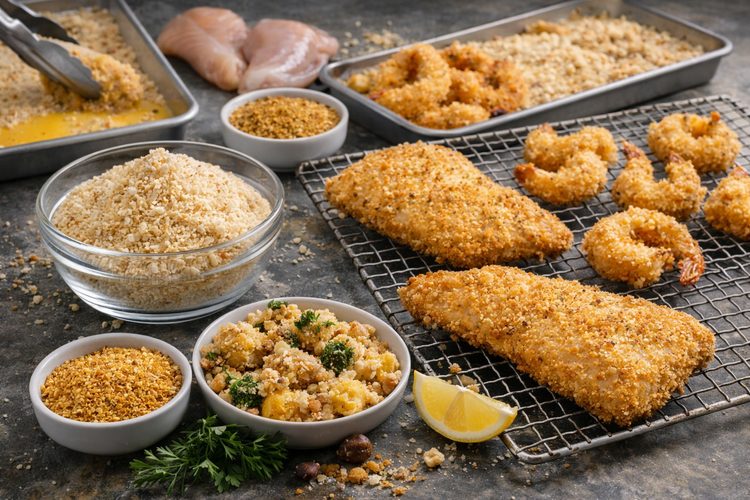
Savory coatings and crumbs with macadamia meal are not simply an ingredient substitution exercise. In most commercial programs, the buyer is not replacing a standard flour or crumb on a one-for-one basis. They are using macadamia meal to change the eating experience, the visual position of the finished product, and the premium value story around the application. That can be highly effective, but it only works when the meal format is matched to the coating system, the process route and the commercial goal.
Macadamia meal is especially relevant when a buyer wants a richer savory crust, a more distinctive nut note, a premium golden appearance, or a more upscale menu or retail message. It may be used in coatings for proteins, seafood, vegetable applications, premium appetizers, prepared foods, frozen items, oven-ready lines, foodservice menu items and specialty retail products. In those cases, the commercial result depends on much more than nominal ingredient cost. The better outcome usually comes from aligning particle size, roast profile, blend ratio, application method, packaging and timing before the quote is finalized.
Why macadamia meal is different from standard crumb systems
Macadamia meal behaves differently from conventional cereal-based bread crumbs, cracker meal or standard flour systems because it brings its own oil content, density, flavor character and browning behavior. That can be an advantage when the goal is a more indulgent savory crust or a premium nut-forward finish. It can also create handling questions if the buyer expects it to behave exactly like a dry, neutral crumb.
In practical terms, macadamia meal can influence coating pick-up, adhesion, visual irregularity, oil release during cooking and the overall mouthfeel of the finished crust. It often adds a richer, rounder nut flavor than leaner nut meals, which can support a more upscale positioning in seafood, poultry, prepared meals and chef-oriented foodservice applications. However, because it is a nut-based ingredient, it usually benefits from more careful particle-size definition and more realistic handling expectations than a generic breading system.
For coating applications, the key commercial question is not simply “Can macadamia meal be used?” but “What role should it play in the system?” It may act as the primary crumb, a premium inclusion within a blended coating, or a visual and flavor layer in a top-coat application.
How this topic shows up in real buying decisions
Buyers evaluating macadamia meal for savory coatings usually compare several routes. Some want a relatively fine raw meal to blend with seasoning and dry carriers. Others want a roasted meal or crumb-style cut that gives a more developed flavor and stronger visual identity. Others want a hybrid approach in which macadamia meal is combined with panko, cracker crumb, starches, spices or functional dry blends to manage both premium eating quality and commercial cost.
The usable product menu can include raw macadamia meal, pasteurized macadamia meal, lightly roasted meal, more developed roasted crumb, coarser granulated macadamia pieces and customized blends where nut content is balanced with other coating materials. Which route makes sense depends on whether the customer is coating proteins, topping casseroles, building ovenable entrée systems, developing chef-led menu items, or packing a retail-ready finished product where label language and cost architecture both matter.
Common applications for savory macadamia coatings
Savory macadamia coating systems are especially relevant where the coating is expected to communicate premium quality rather than simply provide coverage. Typical applications include crusted fish fillets, premium shrimp concepts, poultry coatings, stuffed appetizers, vegetable bites, upscale hors d’oeuvres, prepared meal toppings, gratin-style finishes, casserole toppings and specialty frozen items aimed at better retail or foodservice channels.
Macadamia meal can also be used in dry seasoning crumb systems where the objective is to create a more artisanal, less uniform look. In those cases, the visual irregularity can work in favor of the concept, especially when the buyer wants a chef-inspired or handcrafted appearance. The right finish depends on whether the product is meant to look refined and even, or intentionally rustic and premium.
Particle size is one of the most important specification points
For coating systems, particle size is usually more important than buyers initially expect. A finer meal may adhere more uniformly, blend more easily with other dry ingredients and create a tighter crust. A coarser crumb or granulated meal may deliver a more visible nut effect, stronger crunch and better premium appearance, but may require different binder support or more careful application.
From a sourcing standpoint, buyers should not request only “macadamia meal” without clarifying how fine or coarse the material should be. In actual use, the technical and commercial outcome can change significantly depending on whether the product behaves like flour, like coarse meal, or like crumb. The intended line method, whether hand-applied or mechanically applied, should influence the specification.
Roast profile and flavor development
The roast condition of the macadamia material materially changes the coating system. Raw or minimally processed meal may provide a lighter flavor base and more flexibility for downstream flavoring. Roasted meal can contribute a more developed nut note, deeper color and stronger premium identity. In some systems that is exactly the point. In others, especially where delicate seasonings or light-colored finished products are desired, too much roast development may become visually or sensorially dominant.
That is why Atlas would usually ask whether the macadamia component should function as a subtle background carrier, a visible premium crumb, or a leading flavor note in the finished product. The right roast profile depends on the application. A seafood crust may benefit from a lighter roast that supports clean flavor. A prepared entrée or savory snack coating may benefit from a more defined toasted character.
Adhesion and coating system design
Macadamia meal is often used within a broader coating system rather than on its own. Whether it is applied directly, blended into a crumb mix, or layered as a top coat, the buyer should think through how the meal will adhere and remain stable through handling, freezing, baking or finishing. Adhesion can depend on the substrate, the binder system, moisture level, piece size, surface oil level and total coating build.
Commercially, this matters because premium coatings that look good in bench samples can behave differently on line. A specification-minded inquiry should therefore mention whether the product is intended for hand application, industrial breading, wet batter systems, dry tumble systems, frozen processing or ready-to-cook assembly. That context helps define what grade and format of macadamia meal is commercially workable.
Texture management and eating quality
Macadamia meal is often selected because it changes the bite. Compared with standard crumb systems, it can give a richer, less dry eating quality and a more indulgent sensory impression. The final texture, however, depends heavily on the particle size, the proportion of macadamia in the total crumb, the cook method and the rest of the system.
A higher macadamia ratio may improve richness and premium appeal but also increase cost and alter line performance. A lower inclusion within a blended crumb may still provide a noticeable nut effect while helping manage cost and stability. This is why the buyer should define whether the goal is flavor, crunch, visual distinction, better browning, cleaner ingredient messaging or a combination of those factors.
Oil release and process behavior
Because macadamias are naturally rich, oil behavior should be part of the commercial conversation. In some applications, that richness enhances browning and eating quality. In others, particularly if the system is already fat-rich or if the coating is held for a long time before cooking, the buyer may need a more controlled format or blend ratio. The point is not that macadamia meal is difficult. The point is that it is an active ingredient in the system, not a passive filler.
Buyers should therefore consider whether the coating will be baked, fried, air-fried, toasted, finished in a combi oven, or used in frozen-to-oven programs. The process route influences how the meal should be specified and how the commercial quote should be framed.
Blending macadamia meal with other coating ingredients
In many savory applications, macadamia meal performs best as part of a broader blend. It may be combined with bread crumb, panko, rice crumb, cracker meal, starches, herbs, spices, cheese powders or seasoning systems. That allows the buyer to keep the premium character of macadamia while tuning cost, adhesion, appearance and texture.
This is one of the most common commercial routes because it lets manufacturers position the finished product as premium without forcing the entire coating system to be nut-only. In practical terms, the quote discussion should address whether the macadamia ingredient is intended to be the majority component, a minority functional addition or a visible premium note within a multi-component crust.
Appearance, color and premium visual positioning
Macadamia meal can support a strong premium visual when used correctly. The coating can read as more handcrafted, more golden and more differentiated than standard industrial crumb systems. This is especially valuable in retail prepared foods and foodservice menu items where the consumer needs to perceive value before tasting the product.
However, appearance control depends on consistency. If the particle-size spread is too wide, or if the material is too fine for the desired look, the finished product may not present the intended crust character. This is one reason a better-defined specification usually leads to a better commercial result.
Packaging and handling for macadamia meal programs
For industrial buyers, packaging should match the real use pattern. A manufacturer using the ingredient in production may prefer industrial bulk with handling efficiency and controlled storage in mind. A foodservice-oriented program may need smaller packs to fit kitchen usage and reduce repeated exposure. A retail or export-oriented project may require a different packaging logic entirely if the coating system is being sold as a branded finished blend or packed as part of a prepared product program.
Since macadamia meal is more surface-exposed than whole kernel, handling and storage discipline matter. The buyer should note whether the program is domestic or export, whether the ingredient will be opened and used quickly, and whether the product must support staged production runs over time.
Commercial cost logic in premium crumb systems
Macadamia meal is typically used where the finished product can support a premium story. It is not usually the cheapest path to a coating system, but it can be one of the strongest tools for moving a finished item into a more distinctive commercial position. In many programs, the right question is not only ingredient cost per kilo. It is whether the upgraded coating helps the finished product command a better menu price, shelf price or private-label position.
That is why some buyers use macadamia meal at a controlled inclusion rate rather than building the full system around it. Others lean into the premium message and use it more visibly. The most practical choice depends on volume, channel, target consumer and final product value.
What Atlas would ask before quoting
For savory macadamia coating projects, Atlas would usually ask the buyer to translate the concept into a working quote request. That brief should ideally identify the target format, the application, the coating role, the pack style, the destination market and the volume rhythm. More specifically, Atlas would want to know whether the buyer needs a fine meal, coarse crumb or blended coating ingredient; whether the application is seafood, poultry, prepared foods, foodservice or retail; whether the system is baked, fried or frozen; and whether the buyer is at trial stage or commercial replenishment stage.
Those inputs help reduce false comparisons and make it easier to discuss realistic California processing and supply options. They also create more comparability between quotes that might otherwise look similar on paper but reflect very different particle sizes, roast conditions or packaging assumptions.
Commercial planning points
Commercially, these projects often develop through a familiar sequence: bench trial, pilot or validation run, launch volume and then repeat replenishment. That sequence matters because the right specification for a bench concept is not always the final production specification. Some buyers begin with a more premium-heavy prototype and later refine the blend ratio to meet line performance and target cost. Others do the reverse and increase macadamia visibility once they confirm the finished product can support a higher-value market position.
It is also useful to clarify whether the program is industrial bulk, foodservice, retail-ready, private label or export-oriented. That one distinction often changes packaging, shipment planning and the commercial structure of the inquiry.
Buyer planning note
Atlas Global Trading Co. uses topics like this to move conversations from broad ingredient interest to a more specification-minded inquiry. Savory coatings and crumbs with macadamia meal usually work best when the buyer defines what the coating should deliver: crunch, nut flavor, golden color, premium visual character, menu differentiation or a better commercial position for the finished item.
If you are evaluating macadamia meal for seafood coatings, poultry crusts, prepared meals, appetizer systems, foodservice finishes or export-oriented premium products, share the target particle size, application, pack style, estimated volume and destination using the floating contact form so the next discussion can be grounded in a real commercial need.
Need help sourcing macadamia meal for savory coating systems?
Use the contact form to turn this application idea into a practical quote request with defined particle size, application, pack style and timing.
- State the exact macadamia meal or crumb format
- Add application, process method and target monthly or trial volume
- Include destination market, packaging style and target timing
Frequently Asked Questions
What should buyers specify first when sourcing macadamia meal for savory coatings?
Buyers should define particle size, roast condition, intended application, desired coating texture, packaging format and processing method. Those points determine whether the macadamia meal will behave correctly in crumb systems, batters, top coats or seasoning blends.
Why does macadamia meal behave differently from standard bread crumb or flour systems?
Macadamia meal brings more nut oil, richer flavor and a different texture profile than conventional cereal-based coating ingredients. That affects adhesion, browning, oil release, line handling and the final eating quality.
Can savory macadamia coating concepts be used in both foodservice and industrial manufacturing programs?
Yes. The same technical logic can apply to foodservice, further processing, retail-ready and export-oriented programs, but packaging, pack sizes, line handling expectations and commercial planning usually differ by channel.