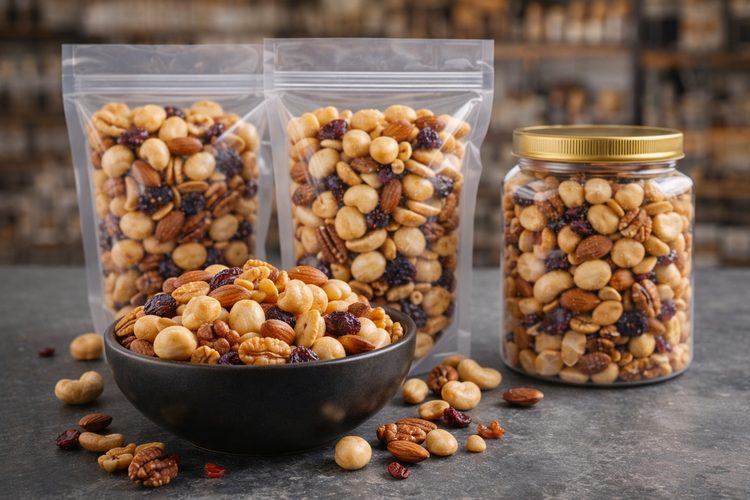
Macadamia snack mix programs are not built the same way as value-led mixed nut programs. In most cases, macadamias are introduced to change the commercial identity of the blend, not just to increase nut content. They help move a mix upward in perceived quality, gifting appeal, premium retail positioning and flavor richness. Because macadamias are a higher-value ingredient, their role in the blend needs to be defined with more discipline than a commodity-style component.
That is why the strongest commercial outcome usually comes from deciding what the macadamia portion is supposed to do before discussing price. In some snack mixes, macadamias act as the premium visual anchor. In others, they contribute buttery richness and cleaner nut flavor. In others, they justify a more premium claim on front-of-pack or help distinguish the line from more common almond-cashew-peanut blends. The product brief should therefore start with function, not only with an ingredient name.
Why macadamias change the position of a snack mix
Macadamias tend to signal indulgence, premium quality and a more curated nut assortment. That makes them especially useful in snack mixes aimed at upscale retail, hospitality, corporate gifting, travel retail, premium foodservice, hotel minibars, specialty grocers and export programs where a “luxury nut mix” concept supports price elevation. In those programs, the presence of macadamias can influence not only flavor perception but also price architecture, packaging choices and merchandising strategy.
From a commercial perspective, macadamias are rarely treated as a neutral filler ingredient. They are usually featured deliberately and are often combined with other premium components such as whole roasted almonds, large cashews, pecans, dried fruit, coconut chips, dark chocolate inclusions or savory flavor systems. The buyer should decide whether the macadamia is meant to be the hero component, a secondary premium note or a small but high-impact accent in a broader mix.
In snack mix programs, macadamias are most effective when the buyer defines the role clearly: premium visual, rich flavor note, buttery texture contrast, luxury positioning, gifting value or mix differentiation. That decision affects format, usage rate, roast style, packaging and final cost structure.
How this topic shows up in real buying decisions
In practice, buyers compare multiple macadamia options before settling on the final mix structure. Whole kernels may deliver a strong premium impression but come with a higher ingredient cost per visible piece. Halves or style-separated broken kernels may improve piece count economics while preserving much of the premium identity. Dry roasted formats may suit clean, crisp and straightforward nut mixes, while oil roasted or seasoned formats may work better in indulgent or savory concepts. Diced formats can support controlled distribution across the blend but may reduce the luxury visual effect if the mix depends heavily on large, recognizable nut pieces.
For macadamia snack mix programs, the usable product menu often includes raw macadamias for further flavor application, pasteurized macadamias for more controlled conversion, dry roasted macadamias for clean premium mixes, oil roasted macadamias for richer surface character, seasoned macadamias for bold snack lines, and diced macadamias where controlled inclusion cost matters more than large-piece identity. The right route depends on whether the customer is manufacturing further, co-packing for retail, packing for foodservice or planning export distribution.
The key question: what does the macadamia need to do in the mix?
Atlas positions macadamia snack mix programs by asking what the customer needs the ingredient to do on line and on shelf. That usually means one or more of the following: add visible premium pieces, deliver clean buttery nut flavor, contribute a softer rich bite against harder nut components, support savory seasoning adhesion, strengthen a tropical or indulgent flavor concept, or elevate the entire mix into a more premium price bracket.
This question matters because the right answer changes the quote request. A premium gift tin mix may prioritize large attractive pieces and elegant visual balance. A protein-forward snack pouch may need better cost control and tighter piece distribution. A travel-retail mix may emphasize shelf appearance and portion packing. An export retail program may require a different package barrier and labeling logic. The role of the macadamia therefore shapes both the sensory design and the commercial design of the program.
Common macadamia formats used in snack mixes
There is no single “best” format for all snack mixes. Buyers should align macadamia format with the product concept, target price and packaging format.
- Whole kernels: strongest premium visual, best for hero-positioned mixes, gifting assortments and top-tier retail concepts where recognizable piece size matters.
- Halves or large styles: useful when the buyer wants a premium look but needs somewhat better piece-count economics and more controlled blend distribution.
- Dry roasted kernels: common in straightforward premium nut mixes where crunch, clean flavor and simpler labeling logic are important.
- Oil roasted kernels: relevant when a richer mouthfeel, glossier appearance or more indulgent snack experience is desired.
- Seasoned or flavored macadamias: suitable for savory, spicy, sweet-savory or specialty concepts where the macadamia carries part of the flavor system.
- Diced macadamias: used when cost control, broader dispersion or secondary premium note is more important than a large-piece luxury visual.
Each of these choices changes the delivered cost, the mix visual, the expected bite profile and the likely shelf-life strategy.
Roast style and flavor development in premium snack mixes
Roast style is one of the most important technical-commercial decisions in a macadamia snack mix program. A lighter roast may preserve the naturally creamy and delicate flavor that makes macadamias distinctive. A more developed roast may help the product stand out against bolder blend partners or stronger seasoning systems. The buyer should decide whether the mix should feel elegant and clean, rich and indulgent, savory and bold, or sweet-savory with broader flavor coverage.
When the macadamia is one element within a multi-component mix, roast style should also be considered in relation to the other inclusions. A very pale macadamia may look refined but may taste subtle beside highly seasoned cashews or glazed pecans. A darker roast may improve flavor presence but reduce some of the visual delicacy associated with premium macadamias. This is why sample evaluation should be done in the full blend, not only on the isolated nut.
Blend architecture: inclusion ratios, piece count and visual balance
Snack mix performance is heavily influenced by blend architecture. Because macadamias are premium, they are often used at intentional inclusion ratios rather than equal-weight blending with lower-cost components. The correct level depends on what the buyer wants consumers to notice. A low inclusion rate can still be effective if macadamias are large and visually prominent. A higher inclusion rate may be justified if the mix is marketed specifically around macadamias or if the brand wants a richer, more indulgent overall eating experience.
Commercially, buyers should think in terms of both weight contribution and visible piece count. A blend may technically contain macadamias, but if consumers rarely see or encounter them, the premium message can weaken. On the other hand, too high an inclusion can distort cost targets and compress margins. Successful programs usually balance three things: visual frequency, sensory impact and delivered cost.
Pairing macadamias with other snack mix components
Macadamias work especially well when the surrounding blend supports rather than competes with their premium character. Typical pairings include almonds for structure and familiarity, cashews for creamy continuity, pecans for indulgent warmth, walnuts for a more distinct flavor profile, dried fruit for sweetness and color contrast, coconut for tropical identity, chocolate or cocoa elements for indulgence, seeds for texture contrast and savory inclusions for bolder snack positioning.
However, not every pairing makes commercial sense. The buyer should consider whether the other components elevate the macadamia story or dilute it. In a premium mix, too many conflicting shapes, colors and flavor notes can reduce the sense of curation. In a value-led mix, too much macadamia may create a cost structure that is difficult to support. The blend should therefore reflect the intended retail or channel position.
Seasoning strategy and surface behavior
Some macadamia snack mix programs are sold as simple roasted nut assortments, while others rely on seasoning to define the line. If seasoning is part of the concept, the buyer should clarify whether the macadamias themselves will be seasoned, whether only the full mix will be tumbled, or whether different components enter the final blend already seasoned. This affects flavor consistency, visual cleanliness and likely handling behavior.
Surface condition matters commercially. Dry roasted macadamias may give a cleaner appearance and simpler profile. Oil roasted or seasoned formats may create stronger flavor impact, but the mix may require more attention to packaging, breakage, oil release and shelf-life presentation. The right answer depends on the channel, price point and desired eating experience.
Texture management in snack mix programs
Macadamias bring a different bite than many common snack mix nuts. They are typically valued for a richer and more delicate crunch rather than an aggressively hard bite. In a premium mix, that contrast can be useful. It allows the macadamia to feel distinct next to almonds, seeds, pretzel elements or crisp legumes. But this also means the buyer should think about breakage control and post-pack handling. A mix designed around premium visible kernels should not be packed or distributed in a way that destroys that visual advantage.
Texture strategy also affects format choice. Whole or large-style kernels may create a more luxurious eating sequence, while smaller pieces can make the mix more uniform but less memorable. The brief should reflect whether the brand wants curation and distinction or easier, more even distribution.
How pricing logic works when a premium nut is in the blend
Macadamia snack mix programs usually require a different pricing conversation than standard mixed nut products. Since macadamias are often one of the highest-value ingredients in the blend, they exert strong influence on cost per kilo, cost per pack and final shelf positioning. That does not mean the program is commercially weak. It means the brand should be intentional about how the nut supports margin.
There are several workable strategies. One is to use macadamias at a controlled but visible inclusion level and let them signal quality without dominating the formula. Another is to create a fully premium mix where the price architecture is designed around the luxury positioning from the beginning. Another is to use macadamias in smaller portion packs where absolute pack price remains approachable even if ingredient cost per kilo is higher. The right model depends on retailer expectations, target consumer and channel strategy.
Retail, foodservice and export programs are not the same brief
A retail-ready snack mix, a hotel snack program and an export gift assortment may all use macadamias, but they do not ask for the same quote request. Retail programs may focus on front-of-pack story, consumer price point, shelf impact and barcode-ready packaging. Foodservice and hospitality programs may prioritize portion control, consistency and practical case configuration. Export programs often bring additional considerations around package barrier, palletization, transit duration, labeling language and documentation.
That is why Atlas encourages buyers to define the channel early. The same macadamia concept may need different pack sizes, labeling formats and shipment assumptions depending on whether the product is headed to U.S. retail, airline catering, hotel minibars, duty-free or export grocery distribution.
Packaging choices for premium snack mix positioning
Packaging is especially important when the mix includes macadamias because the pack becomes part of the premium signal. It also affects freshness retention, oxygen exposure, breakage protection and merchandising outcome. Stand-up pouches, gift boxes, jars, canisters, pillow packs, sachets and foodservice bulk packs each create a different commercial result.
The buyer should define whether the pack needs to emphasize luxury shelf presence, resealability, travel convenience, portion control, gifting presentation, bulk back-of-house use or export durability. These are not purely marketing details. They affect fill weights, packing speed, freight density, shelf-life assumptions and the economics of the overall program.
Shelf-life and storage planning for snack mixes with macadamias
Because macadamias are rich and premium, the storage plan should match the finished product concept. Whole roasted macadamias in a sealed premium pouch may perform differently from seasoned diced macadamias in a multi-component mix with fruit, chocolate or savory inclusions. The more processed and exposed the nut becomes, and the more complex the mix becomes, the more carefully storage planning should be aligned with packaging and inventory rotation.
For snack mix programs, buyers should think about the full chain: pack-off timing, barrier packaging, transit time, warehouse dwell time, rate of sale and end-consumer freshness expectations. A mix can be commercially successful only if its premium promise survives through the real distribution route.
What Atlas would ask before quoting a macadamia snack mix project
For macadamia snack mix projects, Atlas would usually recommend translating the idea into a quote request with at least five points: target macadamia format, mix application or channel, pack style, destination market and volume rhythm. In more developed programs, we would also want to know the intended premium position, approximate inclusion rate, seasoning direction, whether the mix will be manufactured in-house or by a co-packer, and whether the program is a trial, launch or repeat replenishment line.
Those inputs make it easier to discuss realistic California partner options instead of a generic price-only inquiry. They also make quotations more comparable across whole kernels, larger broken styles, roasted formats, seasoned options and retail packing routes.
How snack mix programs typically develop commercially
Commercially, these projects often develop in stages: trial quantity, validation run, launch volume and repeat replenishment. Atlas uses that logic to guide pack and shipment planning, especially when retail packaging, export retail or private label is part of the conversation. Early trials may focus on the macadamia format and the consumer response to premium positioning. Validation runs often address piece-count consistency, blend balance, packaging performance and line economics. Launch volume then shifts focus toward continuity and replenishment timing.
Planning in stages helps control risk in a premium program. It allows the buyer to confirm whether the macadamias are delivering enough value in the blend before committing to larger volume structures.
Commercial planning points buyers often overlook
Several issues are commonly underestimated in premium snack mix development. One is how quickly macadamia inclusion affects the target shelf price. Another is how visual scarcity can weaken a premium claim if piece count is too low. Another is that a beautiful blend concept on paper may not survive real production if components separate, break or distribute unevenly. Buyers also sometimes overlook how packaging changes freight cost and how export lead time compresses the effective shelf-life window remaining at destination.
In practical terms, the buyer should think beyond the formula and ask whether the full system works: ingredient format, blend ratio, pack size, channel price point, freight route and replenishment speed. That full-system view usually leads to better sourcing decisions.
Buyer planning note
Atlas Global Trading Co. uses topics like this to move conversations from broad interest to a specification-minded inquiry. In macadamia snack mix programs, the strongest outcome comes from defining how the macadamia should perform in the blend and how the finished program is meant to sit in the market. The right commercial answer is rarely just “add macadamias.” It is choosing the right format, roast style, usage rate, packaging and replenishment structure for the intended premium position.
If you are evaluating macadamias for mixed nut lines, premium retail pouches, gift assortments, hospitality programs, private label or export retail, share the target format, pack style, estimated volume, destination and price positioning using the floating contact form. That allows Atlas to frame the next step around a real commercial need rather than a generic category discussion.
Need help designing a premium macadamia snack mix brief?
Use the contact form to turn the concept into a practical sourcing outline with format, pack style, destination and volume assumptions that can actually be quoted.
- State the exact macadamia format and intended mix position
- Add target pack size, channel and monthly or trial volume
- Include destination market, timing and price positioning goals
Frequently Asked Questions
What should buyers define first when building a macadamia snack mix program?
Buyers should define the exact macadamia format, target mix position, roast style, seasoning direction, target inclusion percentage, pack format, destination market and expected price architecture. Premium snack mix programs work best when sensory goals and commercial goals are set together.
Why are macadamias used selectively in snack mixes rather than like a lower-cost nut component?
Macadamias are usually positioned as a premium visual and flavor driver rather than only as a base-fill ingredient. Their richer cost profile means they are often used to elevate mix identity, support a luxury claim, justify higher price positioning or create contrast with more economical components.
Can the same macadamia snack mix concept be adapted for retail, foodservice and export channels?
Yes. The core mix concept may remain similar, but the required macadamia format, package size, labeling approach, shelf-life planning and freight assumptions often change by channel. That is why channel and destination should be part of the initial quote request.